Author Archives: Natalie Bennett

Liberal Democrats back more CO2

Turning party political for a moment, news from my inbox has raised my blood pressure: The Liberal Democrat councillors in Lancaster have fully supported a new bypass (the Heysham M6 Link Road) – as did the Tories and Labour. The official word is that it will create an additional 24,000 tonnes of CO2 per annum.

How the Libdems manage to claim to be “green” without the word sticking in their throat is often beyond me – this is entirely typical of the behaviour of their councillors up and down the country.

Good news from Africa

The prevalence of female genital mutilation in Kenya has fallen from 50 per cent in 1999 to 34 per cent now. (What this figure actually refers to isn’t entirely clear – presumably girls emerging from the danger period.)

And showing that it is possible to almost stop the mutilation entirely, in Cameroon, the rate has fallen from 20 per cent to 1 per cent.

And in Nigeria, Kano state which adopted shariah and threatened to stone women for adultery (there were a couple of highly publicised cases) has toned down the approach, the New York Times reports, with the once Iranian-style religious police being reduced to directing traffic and guiding at football stadiums. Amina Lawal, one of the women threatened with stoning, is now a local political activist.

Paris scenes

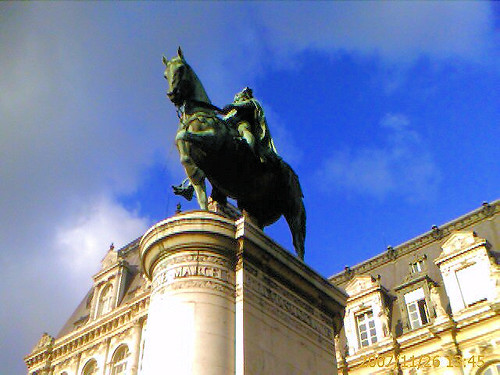
aparisgeneral

Which capital has more generals – Paris or London? I suspect Paris would win that contest easily, but perhaps I just tend to notice them more there.

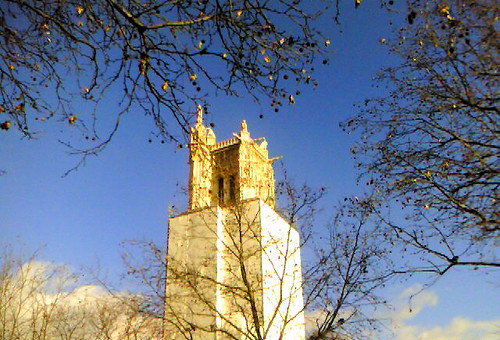
aparistower

This tower in central Paris has been under scaffolding for as long as I can remember. But to judge from the part now peaking out of the top, it is going to be mighty spectacular when finally unveiled.
read more »

Medieval Africa – the great kingdoms

The joys of holiday reading – things that you are interested in for no ulterior process…

The Royal Kingdoms of Ghana, Mali, and Songhay: Life in Medieval Africa is one of those books that does just what it says in the title: this introductory text by Patricia and Frederick McKissack sets out a brief history, a short outline of the life and economies of the kingdoms, and describes the sources on which this information is based – and their contradictions.

That’s great, and is probably all most readers are going to want, since I suspect most will, like I did, come to the subject from the starting point of almost total ignorance. What sparked my interest was a discussion on the Medieval-L listserv, which started with the incidence of the plague in Africa and branched out. I was vaguely aware that there were big and important kingdoms in West Africa at that time, but that knowledge was about as far as it goes.

Royal Kingdoms begins usefully with a map, which places the extent of the medieval kingdoms on a modern map. The first, Ghana (c. 300AD- c.1050AD), was (confusingly) largely in modern-day Mali. The second, Mali (c.1200AD-1500AD), extended beyond that, into the south of what is now Mauritania, most of Senegal and Guinea, and into the western corner of Niger, incorporating the one place name here that almost everyone will know – Timbuktu. Songhay (c.800AD-1580AD) was at its height the largest, extending to cover much of Niger, plus the north of Benin and Nigeria.

The basis of the economy of all of these empires was simple: salt and gold. The latter was so plentiful that it was said in the kingdom of Ghana the value of the two comodities was equivalent, pound for pound. The source of the salt was well-known – the city of Taghaza in the Sahara desert, where the mines were worked by slaves (either captives of war or criminals) whose lives were miserable and short. The city was so miserable that their free overseers worked only on two-month contracts.
read more »
Somers Town People’s Forum protest on November 24

Pictures from a complete set to be found on Flickr. (Just click on one of these pics to find more.)

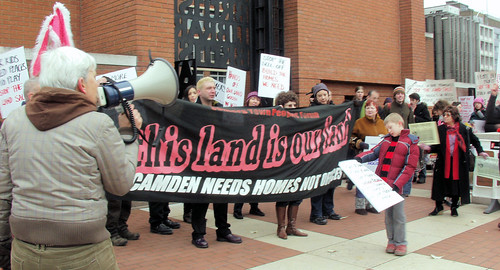
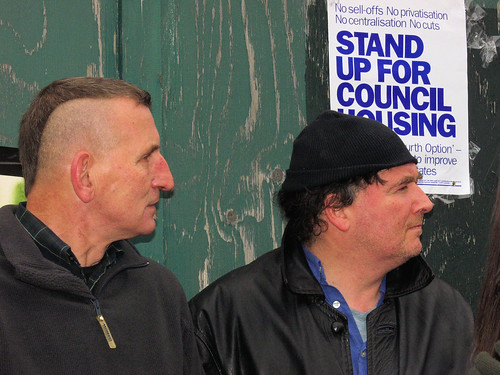
This protest was held on Saturday, with more than 100 people attending despite bitterly cold weather. The group is campaigning for the 3 acres of land behind the British Library to be kept by the government and used for council housing and community facilities, rather than be sold off. I’ve written before, and will again soon on another forum….

Media or any other use of these pictures is welcome with appropriate credit.


novmarch5
Candy Udwin, chair of the forum, addressing the protest as it takes its message into the British Library. (If you saw the London Tonight coverage, this got a little “interesting”.)

novmarch8
(A young participant showing what he’d like the land used for.)

novmarch7
read more »

What would you do if the world was about to end in three hours?

Well, I suppose it isn’t a good holiday question, but it is an interesting one. I was thinking over dinner about how to work out what really matters to you, and trying to answer this question is an interesting way of approaching the less momentous one.

My conclusion? I’d spend it in the British Museum (or given where I am at present in the Louvre) or so other equivalent place of cultural interest.

Yes, OK, you can now all tell me I’m “sad”….