Author Archives: Natalie Bennett

Regent’s Park to Greenwich, to Rainham Marshes, to Regent’s Park

Today the forecast was for cloud and mist and a maximum temp of 6 degrees, so of course I thought I’d take myself out for a nice little tootle on the bicycle, and advertised on the London Cycling Campaign email list was what was biled as a leisurely 12 mile run to Rainham Marches, starting from Greenwich, which is about 8 miles from home …. which I could do at him own pace.

I really should have known better. (On several counts – one of them being that Southwark cyclists’ idea of “leisurely” is my idea of “just keeping contact with the back of the bunch by gritting my teeth and giving it all I’ve got”.)

No, it was fun really – in a slightly beating your head against the brick wall sort of way. I just looked up the distance home from the marshes and it is about 22 miles – and that was after getting to Greenwich, and then doing, to one person’s odometer, 22 miles there (the scenic route via the Woolwich ferry.) So I must have done near 50 miles today… (if you say 80km it sounds even more impressive.)

If the text here is a little tilted my apologies – sitting rather oddly since my seat bones weren’t in the condition for this. (Not to mention my legs….) In fact (another use of the blog) I just looked up my last serious ride and it was August 12, which covered some of the same route – as far as Woolwich.)

Still there were some interesting sights, including these World War II concrete barges (possibly used for D-day? so made due to the wartime shortage of steel) rotting quietly by the river:
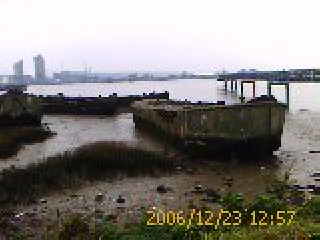
concretebarge

And we went through (scenic route might be an honorary title) London’s great rubbish dump. On the north bank of the Thames opposite Erith are these slightly out-of-place looking hills – and what indeed they are out of place – these were once marshes, like the survivor we were heading for, but they became London’s landfull site. The smell is awful – sour, fetid, almost indescribable really), and there are chimneys where the methane brewing up under these grass-covered monstrosities is burnt off.

Hate to think how much the Christmas season will be adding, if not here then elsewhere. And you have to wonder why it was put right beside the Thames. No doubt theoretically these is some lining supposed to stop it polluting the river, but…

(As this walker notes, this is also the end of the London Loop walking route – a bit of a rubbish finish…)

But Rainham Marshes have survived and should continue to do so, having recently been bought by the RSPB.

There’s a new and fascinatingly enviro-friendly visitors’ centre that even boasts defensive drawbridges, and 2.5 miles of boardwalks that would no doubt be great on a day with a little better weather. (Winter is supposed to be the best time for bird species.)

Unfortunately they haven’t got to the info panels yet – and since this area apparently preserves the medieval field system I’d like to have known more. Guess I’ll have to go back.

But next time I might catch the train…

Pat on the back for a Labour man

Well it is in Scotland, and he does have a history of rebellion, but nonetheless, well done to the Labour minister who has resigned over the plan to replace the Trident nuclear subs.

Communities Minister Malcolm Chisholm has resigned from the Scottish government after voting with the SNP over the replacement of Trident.
He was one of four Labour members who supported the SNP’s motion opposing the replacement of the nuclear submarines with up-to-date models.
Mr Chisholm said his decision had been a “matter of principle”.
The Scottish Parliament failed to agree a position on the future of the Clyde-based fleet.

Gaia strkes back?

I find the Gaia hypothesis a useful way sometimes to think about ecology, although I usually resist the temptation to anthropomorphise the planet. But it is hard not to think that with days of heavy fog around Heathrow in the run-up to Christmas, the planet is doing its best to defend itself: Stranded passengers turn to rail – maybe next year they’ll just go that way straight off, as they should for short trips within Europe.

A sane secular country

There are times when I really love Britain, land of sense and sanity:

The poll also reveals that non-believers outnumber believers in Britain by almost two to one. It paints a picture of a sceptical nation with massive doubts about the effect religion has on society: 82% of those questioned say they see religion as a cause of division and tension between people. Only 16% disagree. The findings are at odds with attempts by some religious leaders to define the country as one made up of many faith communities.

Some of the percentages don’t entirely add up in the answers to different questions, but when you think how fast this secularisation has been, that’s not terribly surprising.

Sporting equality? Of course not

Nicole Cooke, a Briton, is a winner of the Tour de France – but of course that’s the women’s Tour de France, so you can be excused for not having heard of her. And you’re much less likely to see her in the Olympics, since the male cyclists have 11 events, the women seven…

The political school meal long before Jamie Oliver

The latest issue of The Historian, the magazine of The Historical Association, has a fascinating article on “child health and school meals: Nottingham 1906-1945”. It is not that the meals themselves are fascinating – “meat, potatoes and pudding” for “dinner” (what I’d call lunch – but then that’s a whole other social history) features with extraordinary prominence (presumably no vegetables).

But the origins of the meal, in the 1906 Education (Provision of Meals) Act are fascinating – despite lots of reports of children being too ill-fed to learn, the state was extremely reluctant to intervene because “this would be interpreted as extending provisions to the poor and would intimate that the state would provide for all their material needs”. So when meals were provided there was much effort to stress that this was purely to aid the children’s education.

The school medical service (founded 1908) found in Nottingham in 1913 (when the town was suffering a particularly bad trade period, conditions that sounds like what we might expect in Africa today “septic condition of the mouth, chronic gastric disturbance, bilious attacks, constipation, everted costal margins [?] and protrubent abdomen”.

And when you look at the typical home diet — breakfast: tea/coffee, bread and lard; dinner bread and lard, sometimes jam pudding; supper bread and lard or jam. On Sunday bacon and tomatoes added at breakfast and meat and potatoes to the midday meal — it isn’t hard to see why.

Issue No 92, Winter 2006, pp. 12-19.