Author Archives: Natalie Bennett

The good, the bad and the rather satisfying…

Well, sort of good – an interesting campaign by the Nobel peace laureate Wangari Maathai to plant a billion trees in the next year. But she admits this is only symbolic – for the scarey figures are down the article:

Over the past decade 130m hectares (3,235m acres) of trees have been destroyed, according to the UN. Reforesting such an area would require 140bn trees to be planted.

Proving that Australia still occasionally manages to display the right instincts, in spite of so many years of John Howard, there’s been an outcry over plans to relocate a salt-water crocodile who bit a man. Well if someone came right into your house, and went thumping around with a big stick, you might be inclined to bite him too. The tourist has been christened “stupid Stefaan”. Apparently he was also bitten by a monkey in India. Wonder why?

Finally: I’m not gloating – well only a little – but Tim Hames has been eating his column – in line with a vow – after, and it now seems pretty certain, the US Republicans lost the Senate as well as the Reps.

But as a recent discussion I heard on this subject went: a brief yippee was quickly drowned by a flood of explanation as to why US military aggression was structural and wouldn’t really change with the politicians.

Still, I think a small “yippee” should be allowed – always nice when the human race on masse displays a bit of sense.
What is the point?

I happen at work about an hour ago to have been waiting on the phone, and flicking around idly as one does, I cleaned out my Askimet Spam folder on this site – the usual thousand-odd.

Getting home, I went to the management panel to clean up a couple of spam comments that had snuck through, and there I found, deposited in the past hour, a further 34 spam comments.

Surely everyone must have some form of spam blocks by now? Why do these things keep coming?

Meanwhile, in a lovely triumph of hope over expectation, seen outside Euston station: a “dispenser” of one of London’s proliferation of free newspapers, chasing after a jog – actually running, in the hope of the jogger taking a copy.

Surely the three afternoon papers aren’t going to survive the winter: most of the poor folk distributing them will surely be down with double pneumonia.

My climate change rally

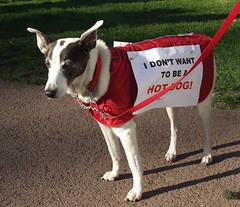
It just struck me that I’ve written about Saturday’s climate change rally in London everywhere but here, so for the record, the collection: I’ve got a straight news piece on OhMyNews, a comment piece on Guardian blogs, reflecting on how a tiny fraction of the human beings who have ever lived have consumed an enormous percentage of the earth’s resources, and here’s my favourite protester, who I haven’t managed to place elsewhere…

ccdog

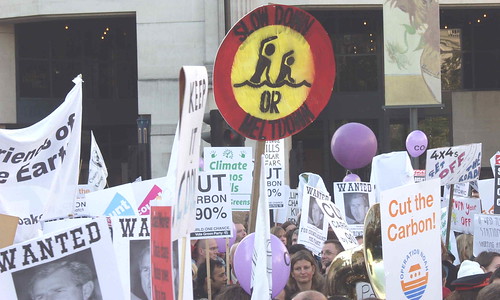
And here’s a more typical scene – which explains why, with 25,000 people there, I spent most of my time flitting around the edges taking photos. (I don’t deal well with being in the middle of large crowds – partly due to my Australian idea of personal space.)

ccslow

Some handy clicks

You’ve got to have some sort of British institutional access, but it surely couldn’t be too hard to talk your way into your local further education library: The House of Commons Parliamentary Papers 1800 – 1901, comprising nearly 6,000 volumes and over 4 million pages are being made available to further and higher education institutions.

Lots of new goodies have been added to the RHS Bibliography, including several thousand new items on the London-specific search.

And that reminds me I forgot to point to the most recent History Carnival, on Holocaust Controversies.

How to be a Nobel Peace Prize-winner

What does it take to be a Nobel Peace Prize winner? The individual winners are a diverse lot, but having read some of the words of Nelson Mandela and the most recent winner Muhammad Yunus, and just completed the autobiography of Shirin Ebadi, Iran Awakening, it seems there is one unifying factor, a clarity of vision that enables these exceptional individuals to understand their own actions, and the workings of their society. That’s combined with a certain pig-headed determination to effect change, and the courage to maintain that even in the face of death.

That makes them sound almost inhumanly perfect, but Ebadi’s book is a very human text, if unusually honest for an autobiography, for, you feel she insists on always being honest with herself. She’d be a loyal, but uncomfortable, friend – always able to see through her compatriots’ self-deceptions, and her own.

Ebadi’s tale is also that of Iran – and particularly of its women. She writes of her mother – a bright woman prevented in the 1940s from attending courage by marriage, obediently in love with her husband, yet also consumed by inner demons that emerged as paranoic fear. So it was her father who was the chief shaper of her life – and he was, she says “as unpatriarchal as could be imagined, for his time”. Crucially, he treated her and her brother as equals, to the astonishment of their servants.

It was not until I was much older that I realized how gender equality was impressed on me first and foremost at home, by example. It was only when I surveyed my own sense of place in the world from an adult perspective that I saw how my upbringing spared me from the low self-esteem and learned dependence that I observed in women reared in more traditional homes. My father’s chapioning of my independence, from the play yard to my later decision to become a judge, instilled a confidence in me that I never felt consciously, but later came to regard as my most valued inheritance.”

read more »

‘I snore..as a horse dothe’

Well not me personally – I sleep (oddly and somewhat uncomfortably) on my stomach, so I don’t think that I do, but the quote just appeals to me in its blunt honesty.

It is from Jehan’s Palsgrave 1530 Lesclarcissement de la langue françoyse. My source is the delightful Oxford English Dictionary email word of the day, which you can also get as an RSS feed.

And being the OED you’re bound to learn at least new usages, if not new words. (They seem generally not to be going for the wholly obscure.)

But I didn’t know that a boat could snore …

c. Of a ship, etc.: To move or cut through the water with a roaring sound; to sail or travel quickly. Chiefly Sc

e.g.From Cupples, George, The green hand; or, the naval lieutenant 1856, p36 “The pilot-boat snoring off close-hauled to windward.”