Author Archives: Natalie Bennett

Can we choose to descend to a less intensive, simpler level of technology and organisation? Have we done it before?

I’ve been reading recently about the people of Southeast Asia who seem to have chosen a “lower” level of development – and a freer, less laborious life – with an attempt to look at a view of history from outside the nation state, and that took me on to Joseph A Tainter’s The Collapse of Complex Societies.

Published in 1988 it is a book that sometimes shows its age (and I think its account of the Ik in northern Uganda – based on others’ research – is frankly bizarre and nonsensical; the controversy is discussed on Wikipedia).

But I found myself revisiting the thoughts of how many peoples through history might have chosen to move back to a lower level of complexity and technology, in the interests of a better life (a thought with obvious importance today).

Tainter is, as you’d expect, much interested in the fall of Rome, which he puts down to, as with other cases, to a decline on the rate of return on expansion, to the point where it starts to be negative: “the Empire had to maintain a far-flung, inflexible administrative and military structure on the basis of variable agricultural output, and in the face of an increasingly hostile political environment.” (p. 149) “During the fourth and fifth centuries .. The Empire… was suistaining itself by the consumption of its capital resources: producing lands and peasant population…. the Dominate paid for the present by undermining the future’s ability to pay taxes… reduced finances weakened military defense, while military disasters in turn meant further loss of producing lands and population.” (p. 150)

His view of the so-called Dark Ages is rather different to the classic one: “The collapse yielded at the same time both a reduction in the costs of complexity and an increase in the marginal return on its investment. The smaller, Germanic kingdoms that succeeded Roman rile in the West were more successful at resisting foreign incursions (e.g. Huns and Arabs) than had been the later Empire. They did so, morever, at lower administrative and military costs. The economic prosperity of North Africa actually rose under the Vandals, but declined again under Justinian’s reconquest when Imperial taxes were reimposed. Thus the paradoz of collapse: a drop in compexity brings ith it a corresponding rise in the marginal return on social investment.” (p. 151)

So there as, Tainter suggests, often a welcome for the “barbarians”. “Contemporary records indicate that, more than once, both rich and poor wished that the barbarians would deliver them from the burdens of Empire. While some of the civilian population resisted the barbarians (with varying degrees of earnestness), and many more were simply inert in the presence of the invaders, some actively fought for the barbarians. In 378, for example, Balkan miners went over en masse to the Visigoths. In Gaul the invaders were sometimes welcomed as liberators from the Imperial burden, and were even invited to occupy territory. … Zosimus, a writer of the second half of the fifth century AD, wrote of Thessaly and Macedonia that “as a result of this exaction of taxes city and ountryside ere full of laments and complaints and all invoked the barbarians and sought the help of the barbarians”.” (p. 147)
read more »

An early history of the London Assembly and mayoralty

With the fourth election of the London Mayor and Assembly, in which I’ll be taking a part, fast approaching (all those doors to knock on!), now seemed an opportune time to take a look back over the origins and structure of this rather curious institution of the Greater London Authority (that term applies _only_ to the combination of the two, for those who like to get the technicalities right – hi Darren!)

I’ve got a lot of respect for Tony Travers, not only because I know that he’s one of a handful of experts on local government in Britain, but because he very sharply chaired one of the ten hustings in 2010 for Holborn and St Pancras, and helped make it one of the most interesting. So his The Politics of London: Governing an Ungovernable City seemed a must-read.

In it, he covers the lead-up to the creation of the GLA in 2000, and the first three years of its existence. I must admit some of the latter is really only of interest to the specialist, but he’s very interesting on the historical long-view of London – broadly what he sees as the “ungovernableness”, and the strains, stresses and nature of the unusual (in British terms) and rather anomalous constitution structure that we have today.

He explains: “The status of the GLA is unclear. The mayor’s hugh electorate and the GLA’s strategic role suggest devolved regional government, like the Scottish Parliament and the Welsh Assembly, but the financial rules and close continuing central government control make it look more like local government. … it is not the top tier in a vertically integrated hierarchical system of metropolitan government. As set out in the legislation, and confirmed in practice, the powers of the mayor are largely those of patronage, persuasion and publicity. Patronage, through his or her ability to appoint to functional bodies; persuasion, using limited control over resources and position at the centre of hat is a continuing system of network and multi-level governance; and publicity through exploiting the mayor’s legitimacy, accountability and democratic claim to ‘speak for London’.” (p. 68)
read more »

Sense of deja vu all over again? Housing, house building, poverty, the City and private and government interests

From A Journey Through the Ruins: The Last Days of London, by Patrick Wright, a slightly curious mixture of architectural/heritage comment and development politics of the 1980s in the capital (first published in 1991). A few snippets of interest…

“Hackney’s experiment with high-rise flats was accompanied by the usual allegations of corruption and graft, but whatever may have been going on locally, there can be no doubt at all that large dividends were being reaped elsewhere. Patrick Dunleavy investigated the links between national politicians, civil servants and the large construction companies that thrived on the public housing programmes during the years of Conservative government, and his findings certainly add up to an interesting picture of corporate and personal involvement. A significant number of of MPs had connections with the construction industry but so too did two ministers in the Cabinet responsible for the high flat subsidy*: Keith Joseph was heir to the Bovis fortune and Geoffrey Rippon was a director of Cubbitts. Among the construction companies both McAlpine and Taylor Woodrow were major contributors to the Conservative Party and also such right-wing pressure groups such as the Freedom Association. Dame Evelyn Sharp as Permanent Secretary at the Ministry of Housing and Local Government during the crucial years, 1954-64; she was also a friend of the construction boss, Neil Wates, and, after her retirement from the civil service, the holder of a directorship at Bovis. Kenneth Wood, Chariman of Concrete Ltd, as among the ‘advisers’ employed by the Ministry of Housing and Local Government from the construction industry; even as late as 1974, a Bovis executive was appointed to ‘mastermind a more vigorous public housing drive’.
Architects are still inclined to blame the worst excesses of the Sixties on every aspect of this planning framework, except their own professional culture. But there can be no doubt that a self-referring professional world built up; one in which consultation with the ‘client’ meant nothing more than discussion with borough architects, planners and other such experts who shared a professional outlook based on what Martin Pawley described as a ‘curious amalgam of ‘modern’ thought and scientific mumbo jumbo’.” (p. 92)

* High-rise flats were always an expensive form of housing… High-rise flats grew out of central-government subsidies. There were ‘expensive site’ subsidies in the Thirties, and in 1946 Attlee’s Labour government had added a ne increment per flat for blocks of at least four storeys high with lifts. But … it was the Macmillan government that triggered the high-rise boom in 1956, when it introduced a progressive storey-height subsidy that gave large increments for four-, five- and six-storey flats and a fixed increment for every additional storey over that.” (p. 91)
read more »

The new Egyptian galleries at the Ashmolean

The mummies and the grave goods are unsurprisingly getting lots of attention in the new Egyptian galleries opened last month at the Ashmolean in Oxford, but on a visit today it was the Nubian aspects of the collection that really got my attention.

Particularly the Meroitic pots – a style I don’t recall seeing before, of a much under-rated and under-covered civilisation (certainly Egyptian influenced, but very distinctive).

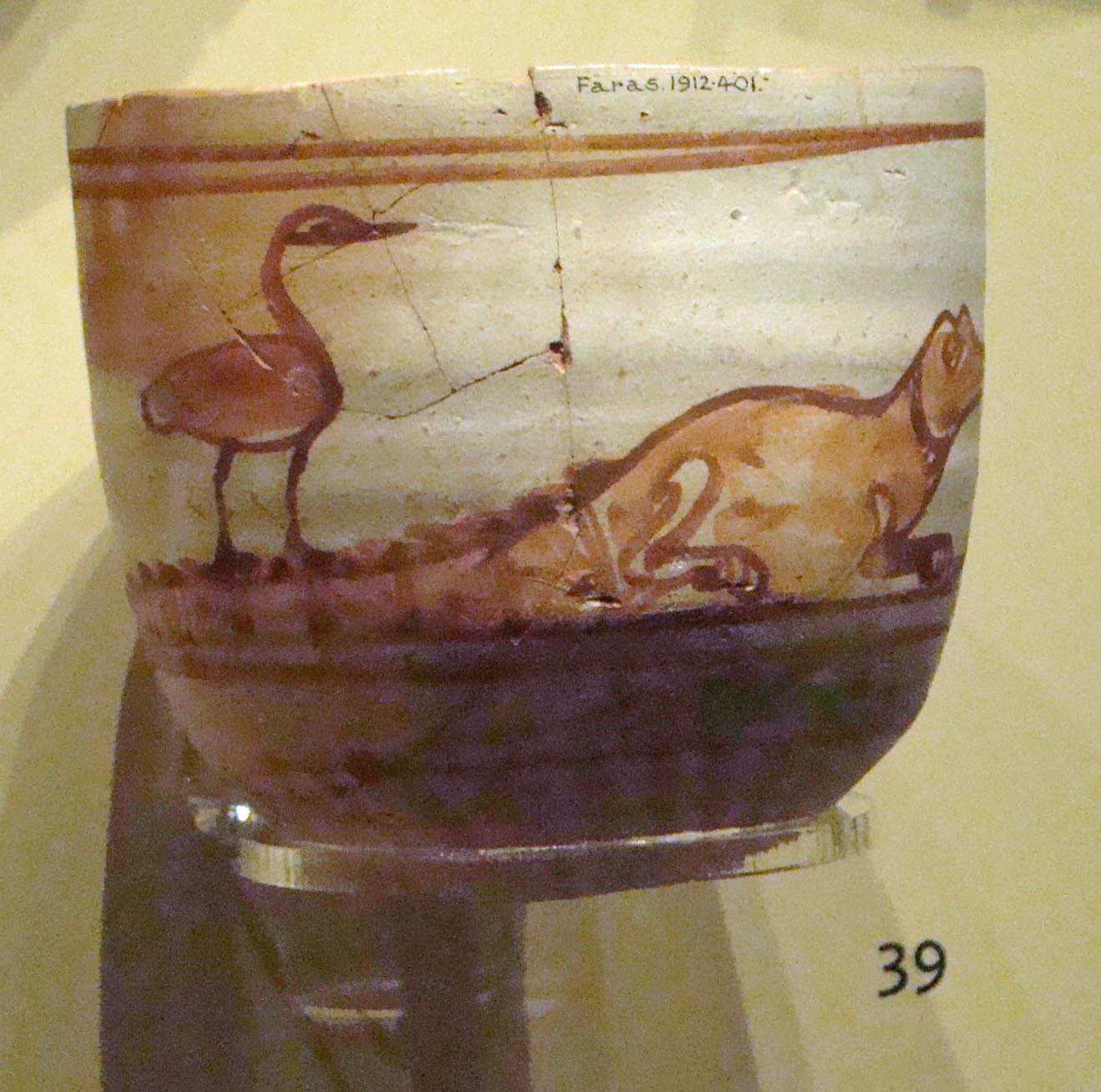
I was particularly taken with this Hathor pot…

But the liveliest were depictions of animals, such as this ibis sitting on the back of a crocodile…

These glorious frogs…

read more »

Online historical bounty

The latest issue of the Institute for Historical Research points to a couple of rich online sources.

The History of Parliament online – pretty much what it says on the tin.

And the Connected Histories, covering 1500-1900. (Not all of the databases linked to are free, but all give at least a snippet, giving a sense of what’s there.)

Feeling very old when I think I can actually remember when the first CD journals arrived in the university library and I discovered the joys of full-text search!

What’s wrong with UK-Swiss tax treaty?

Private Eye of October 14 (p. 29) sets it out very well, after the Treasury published the details of the deal:

The idea is that in return for 20-25% of undeclared British accounts that can be identified, the Swiss will keep their secrecy.

But …

This doesn’t apply to “assets of associations of persons, asset structures, trusts or foundations, if it is not possible to ascertain the beneficial ownership of such assets”. As Private Eye puts it, “this is precisely what the Swiss specialise in”.

Also, there’s an 18-month window before this comes in – May 2013, so even the dim accountholder who used their own name has plenty of time to move the money. The Swiss do have to specify the number of accounts shifted and the top ten tax haven destinations – but not how much money has been moved, or by whom!

Also, the UK has agreed not to make public the data collected… so we won’t know, and it is FOI-proof!