Author Archives: Natalie Bennett

Millicent Fawcett’s campaigning – not much has changed in far too many ways!

Reading The Women’s Victory – and After: Personal Reminiscences, 1911-1918 by Millicent Garrett Fawcett (1920), it’s hard not to think that little has changed in the campaigning world. Fawcett was president of the National Union of Women’s Suffrage Societies, and this little memoir is a pretty well blow-by-blow account of the final push from the non-militant wing of the suffragist movement. (They were, you might say, today’s Friends of the Earth and the suffragettes, with their militant tactics, the Sea Shepherd of the time.)

The parliamentary tactics, the lobbying, the enlisting of parliamentary supporters to convert waverers, the plotting to find ways to disarm the enemies of your cause, and the betrayals coming from those who’d promised support but found excuses to back down might come straight from an account of any similar efforts today.

As today, that often involved meetings with people with whom you had little sympathy – and they the same for you. Fawcett is delightful on the subject of her first meeting with the Chancellor Asquith. “We had with us Miss Emily Davies, the founder of Girton college; Lady Strachey, wife of the well-known Indian administrator; Miss Frances Sterling; Miss I.O. Ford, and other well-known suffrage leaders from our various societies. While we were still in the waiting-room, I was sent for by myself for a preliminary interview with Mr Asquith’s private secretary. If found him a rather agitated-looking young man, who said: ‘I want you, Mrs Fawcett, to give me your personal word of honour that no member of your deputation will employ physical violence.’ ‘Indeed,’ I replied, ‘you astonish me. I had no idea you were so frightened.’ He instantly repudiated being frightened… As we entered the room, where Mr Asquith was sitting with his back to the light on our right, I observed in the opposite corner on our extreme left a lady I did not know. So I said to the secretary in a clear voice, ‘I give no guarantee for that lady’ I do now know her.’ ‘Oh that,’ he rejoined, and again showed some agitation – that lady is Miss Asquith.’” (p. 17)

There’s also some of the same dilemmas as for today about how far a “non-party” campaigning group should do in backing parties that support it and working against those with which it disagrees. There’s some clear defensiveness in Fawcett’s tone as she describes the decision from 1912, after the Liberals had gone back on plans to include women’s votes in the Government Reform Bill in 1911. “It is interesting now to look back at the NUWSS report in the year 1912, and see the care with which we defined our position. No Government candidate was to be supported, because the Government, under Mr Asquith, had shown the most determined opposition to our enfranchisement. When a Conservative candidate was supported, it was because we deemed this the best way of securing the defeat of a Government candidate; when the Labour candidate was supported, it was made clear that this was done because the Labour Party was the only party which had made women’s suffrage part of its programme, and had, moreover, rendered us the signal service of calling upon its parliamentary representatives to oppose any Franchise Bill which did not include women.” (p. 34)
read more »

An American view of the disappearance of the bees – more telling than it knows

A shorter version was first published on Blogcritics

I was sitting on a terrace in Burgundy, watching a dozen honeybees bustling amid the lavender bushes, when I decided that The Beekeeper’s Lament had to be the next book to come out of the “to read” pile. While the hills of the Morvan National Park, with a mixture of forests and pasture lands, often still divided by hedges, bear little resemblance to the extensive, pesticide-soaked monocultures that characterise American agriculture. But now bees are in trouble everywhere around the globe, and it is a problem for all of us. Indeed, that’s partly why I planted those lavender bushes.

The problem is known as Colony Collapse Disorder (CCD) – at least that is the latest, it becomes clear, of a long line of problems that have been haunting beekeepers. The most commonly suggested cause, and certainly still very much in the frame, are neonicotinoid insecticides – used on more than 150 different crops, and in pet flea collars. Genetically modified corn, mobile phone masts, and many other causes have also been suggested. Often, also, traditional pests and diseases of bees – the most destructive of which is the varoa mite – have also been blamed. As Nordhaus amusingly notes, it’s also been claimed as an early sign of Judgement Day – those industrious bees being the first to rise to heaven.

But the explanation that seems to be gaining increasing traction is more complex. Nordhaus notes that CCD seems to share with HIV/AIDS the fact that the condition sees otherwise healthy hives fall prey to conditions laid usually resist -something is weakening the bees. This is not thought to be one single infective agent or other single cause, but fact that these are simply being worked too hard, moved around too much, exposed to too many pesticides, even in tiny doses, facing too difficult weather conditions. But above all, Nordhaus suggests, the of being fed too limited diet – “suffering from the same kind of bad nutrition afflicting humans who eat processed junk food. … Sprawl, mono crops, flawless lawns, weedless gardens, and a general decline in pasture land of make hard for bees to find a suitable diversity of nectar and pollen sources. Bees, it turns out, need natural places.” (p. 249) (And bats, which have ecological similarities to be bees, also suffering hugely –particularly from mysterious “white nose syndrome”.)

One of the things this book makes clear is just how complex and sophisticated bees are. Here’s Nordhaus’s accounts of the production of a pound of honey – which will take a hive a day. “The 50,000 or 80,000 bees who live together in a hive at the height of summer will travel a collective 55,000 miles and visit more than 2 million flowers. … One worker will visit 50 to 100 flowers on each trip from the hive, in the process collecting and dispersing pollen from flower to flower, allowing the plants it touches to reproduce.” (p. 235)

Yet American beekeepers are frequently paid less than the cost production for their honey, and what is sold as honey can be up to 80% corn syrup. Regulation has been judged to be a low priority. (p. 241) And here’s a warning, imports of Chinese honey were banned in 2002, as result of antibiotic contamination, yet curiously after that the top 12 honey-exporting countries now export more than total home production. Few checks are made. (p. 243)
read more »

London life in all its glorious variety and energy

Had a lovely time at the Netley Public School International Evening earlier today, as did a great many excited pupils. A great turnout of parents too.

The DJ did a great mix – up-to-the-minute songs (at least I’m guessing that’s what they were, given some of the older girls knew all of the words and the accompanying actions), and music from around the world.

There was also an eclectic mix of food – including Australian traditional favourites of lamingtons and fairy bread, and a fabulous snack of puffed rice, gram noodles, onions and parsley whose name I have forgotten but was definitely more-ish, particularly the spicy version with mustard oil.

There were lots of simple games and pleasures. I haven’t heard how I went on guessing the number of Smarties in a jar; it was a large jar so I went for 720, based on some quick maths of numbers in three dimensions (yes, I can still do mental arithmetic when I have to!) And the queue of the throw the beanbags in the hoops was a bit long for me, though I would have liked a go.

A huge amount of work from staff and parents making for an unforgettable day for the children – well done all!

Control the car and the supermarkets: a recipe for healthier individuals and a happier society

(A shorter version of this article was published on Blogcritics)

It’s all too obvious now that in many ways developed societies have lost their way. Climate change, economic crisis, huge inequality of which part is misery for some and fearful uncertainty for many more, many hundreds of millions going hungry while obesity is cutting lifespans in a growing number of cases – economies clearly did not, as Keynes and others thought after the Second World War they would, reach a state of sensible material sufficiency, then look to improve quality of life rather than quantity of stuff.

So where did it all go so horribly wrong? Ian Roberts (writing with Phil Edwards) in The Energy Glut: The Politics of Fatness in an Overheating World has at least part of the answer. He ties together the building of societies and economies around the needs of fossil-fuel powered transport to the rise in obesity and removal of almost all physical activity from many Western individuals’ lives, combined with a huge toll or death and injury on developing, and developed, countries’ roads, and the rise of the supermarkets and foods rich in calories and low in nutrients. He’s very firm that obesity is not an individual problem – simply a reflection of the fact that all of us have got steadily fatter, which has of course pushed the upper end of the distribution curve well into “obese”.

It’s a book that contains many shocking statistics.

* Globally road crashes kill 1,000 children a day and disable many times more. And that’s simply “accidents” – there’s also the cardiac and respiratory diseases road pollution causes, and of course climate change.
* The WHO reports that expenses arising from road injuries cost poor countries around 2% of GDP – nearly $100bn, twice what they receive in aid.
* In England and Wales there were 205 road deaths of children pedestrians between 2001 and 2003 – and children from the lowest social group were five times more likely to die than the highest (which the authors say is simply because the dangers of the roads have driven everyone who can afford it into a car – every step of which of course makes the roads more dangerous).
* In the UK between 1975 and 2003 average miles walked per person fell from 255 to 192; cycled from 51 to 34 (and the authors say these figures would already have dropped hugely from only a couple of decades earlier). (p. 39)
* Shopping accounts for about 20% of car journeys in the UK. (p. 56)
* America’s “security costs” for “defending” petroleum supplies from the Middle East are estimated at between $100 billion and $200bn annually.
* In 1932 General Motor bought up America’s tram system in order to shut it down.
* The overall risk of death from all causes among people who cycle to work is between 10 and 30% lower than for those who drive to work (p. 108)
* English composer Sir Edward Elgar took up cycling in his 40s and cycled up to 40 miles a day around the lanes of Herefordshire (used as a sign of how readily people took on distances considered almost heroic today) (p. 111)

So what to do? One clear action in the developed world is that we need to start to cut away at the social dominance of the supermarket (and for the sake of our farmers there are plenty of other reasons for doing this), and their car-demanding, car-encouraging and obesity-encouraging system.

The authors report that in the UK supermarkets account for 93% of food spending and (as of 2007 and growing fast) 41% of fuel sales. And more than three quarters of British households do their main food shopping by car. “Supermarkets sell energy, either as food or petrol. … as people move less, all things being equal, they tend to eat less. .. we could think of supermarkets as simply the retail arm of the petro-nutritional complex. Supermarkets don’t care how they make profits, whether by selling us food or petrol, but either way it makes us fat…[and] fat populations consume considerably more food than lean populations. It has been estimated that the amount of food energy consumed by a ‘fat’ population (average BMI 29) is around 20 per cent more than that consumed by a ‘normal’ weight population (average BMI 25). The heavier our bodies become, the harder and more unpleasant it is to move about in them and the more dependent we become on our cars” (p. 55-6)

And there’s been a huge change in the balance of food types. Not only has food, relative to other expenses, never been cheaper, (UK household spending percentage has fallen from 20% in 1970 to 10% in 2002), but it is energy-dense, fats and sugars, that have fallen most, while fruit, vegetables and grain have fallen much less. And sugary drinks have fallen in price most of all, and now more than three-quarters of school children drink at least one fizzy drink a day (unsurprising when they see on average 10 food industry adverts per hour of TV). “North American children are drowning in liquid calories. And the rest of the world is jumping to join them Coca-Cola boasts 1.5 billion consumer servings a day.” (p. 59)

Another action needed is to stop the subsidising of the motor and associated industries. As the authors say: “Although most of the world’s population will never own a car, road building is invariably funded by public funds, in rich and poor countries alike. Road transportation is 95% oil-dependent, and ensuing a steady supply of cheap oil also involves massive public expenditure. Then there is the automobile industry…(with huge subsidies and bailouts).” (p. 68)

It’s here that the book is likely to be most controversial, even among those likely to broadly back its conclusions. It says that there’s no evidence to show that roads encourage economic development, while noting that congestion hampers economic output and the poor bear the majority of the negative costs of road building. (p. 73) The only real benefit lies, the authors say, is in profits for big, often foreign, companies. What Africa (with which it is chiefly concerned in this context) needs is not fancy roads for cars, but simple solid paths for bicycles – and the bicycles to use on them.

And it’s also clear we need to curb the lobbying power and influence of the motor industry. Roberts tells the astonishing tale of the Federation Internationale de l’Automobile’s Commission for Global Road Safety, which has an industry members — oils, tyres and car making among their origins — and as patron Prince Michael of Kent, former racing driver and member of the British Racing Drivers Club. It’s keen on pedestrian education, Roberts says, decide decades of research showing this to be wholly ineffective, as well as sending the message that “road space belongs to drivers and pedestrians and cyclists must look out or die”. (p. 83) Driver training too, has a negative impact on safety (p. 124).

But above all, the message that Roberts wants to deliver is that we need to go back to bicycle and walking as the primary form of individual transport (while also improving mass transit systems). The arguments are on both climate change/environmental and health grounds.

First health: “Take a 50-year-old office worker who drives 4.5km to work every day, a distance that is easily manageable by bicycle. If he switches from driving to cycling for 90% of these trips, at the end of the first year he could have shed up to 5 kilos of adipose tissue and will enjoy a 20 to 40% reduction in the risk of premature death and a 30% reduction in the risk of type 2 diabetes. He will also have better mental health and improved fitness.” (p. 108) (And if you think it will take longer, note that the average car speed in London is 11kph – for bicycles it is 10kph – p. 110)

But conversely, in the developing world, cycles (rather than walking) would reduce calorie consumption and thus improve health: “The lion’s share of transport in Africa is in rural areas, on unpaved paths and tracks, carrying crops from the fields to the villages…. (70-80% by women) carrying headloads of crops, typically weighing 30kg or more over an average distance of about 5km… A 2m-wide unpaved bike trail would cost less than 10% of the cost of a 6m-wide rural road for motor vehicle use…. One study in the Makete District of Tanzania found that, whereas building a feeder road saved households 120 hours per year, investing in a bicycle saved the family 200 hours a year…. a ‘before and after study’ of subsidised bicycle provision in Uganda found a range of beneficial effects, including more frequent trips to market and health-care facilities and increased household income.” (p. 104)

Second, there’s the argument of quality of life. Cars and trucks destroy community life, removing people (particularly children) from the streets. And above all, there’s climate change – cars simply cannot continue to rule.

This is a book every council planner, every councillor, should read. It’s not without faults. The writing has a hasty feel, as does the editing – it sometimes harms its argument by quoting different figures for the same facts in different places and is extremely uneven in its treatment of units of measure; some parts of the text appear to fit rather awkwardly with the rest (no doubt cooperative writing isn’t easy). Nevertheless, I can pretty much guarantee that if you read this, there’ll be at least one gripping fact you’ll continue to quote for years to come.

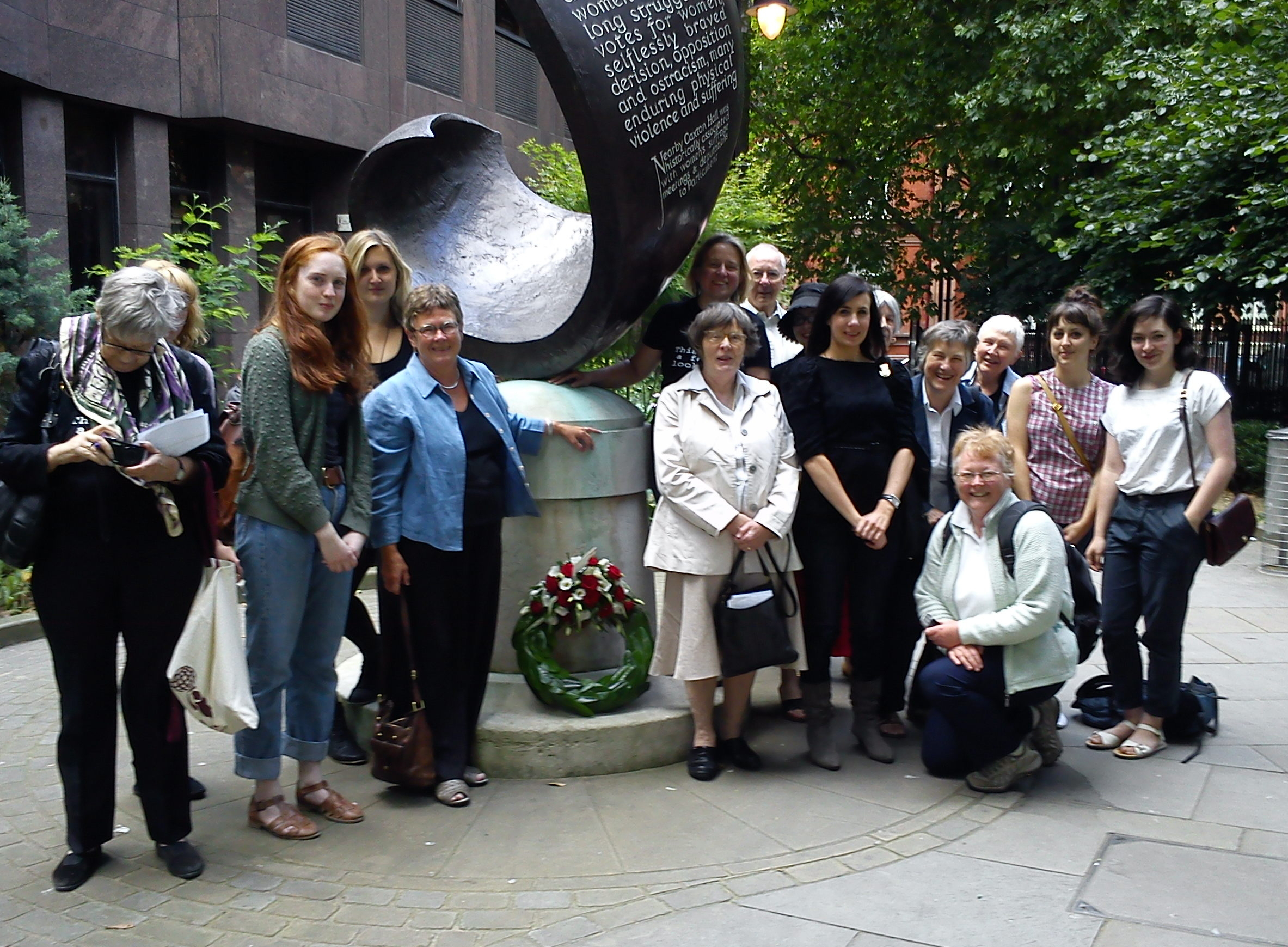
Millicent Fawcett remembered by Fawcett Society

To a brief but moving ceremony last night in Christchurch Gardens, Westminster, where the Fawcett Society, in a ceremony organised by the South London Fawcett group, held its annual commemoration of the work of Millicent Fawcett, laying a wreath at the foot of the suffrage ceremony.

(The event has traditionally been held in Westminster Abbey, but the Chapel of St George is currently closed for repairs – we’ll be back there next year.)

Angela Mason, chair of the Fawcett Society (which is the direct and continuous descendent of Millicent’s National Union of Women’s Suffrage Societies), spoke of how Millicent would have been astonished at the fight women were still having to wage for economic and political equality. She said that after such a long struggle, it is clear that it is no longer enough to keep asking for equality, in parliament and in boardrooms – quotas have to be applied.

A classic of Australian women’s history

First published on Blogcritics

The some 200 convict women who sailed to Sydney Cove on the Lady Julian might be considered the foremothers of the Australian nation – sent not only because Britain’s jails in the 1780s were packed beyond sense with women left without economic options by the return of tens of thousands of servicemen from the American War of Independent, and forced on the street by Prime Minister William Pitt’s tax on maidservants over the age of 16, but also because the penal colony’s founding governor had asked for a balancing of the sexes after the hugely male-dominated First Fleet.

Yet we don’t even know now exactly how many women were on the ship, or all of their names, but thanks for the classic work of popular, but very well-done historical reporting in The Floating Brothel we know some of their stories, and even for those whose identities are lost, have a sense of what their lives had been like, and how they might have ended up sentenced to seven years (or life) in Botany Bay.

Rees is a sympathetic but realistic guide to the lives of these women, so far removed from most of ours. They were mostly young, had spent much of their lives with no certainty of where their next meal was coming from, had often been brutalised into violence and thieving in a world where this was normal behaviour, and when placed in a situation where a sailor might choose them as a “wife” for many months of a voyage into the unknown would have little choice but to accept, or indeed to compete for the “privilege” of the extra protection and rations that it might offer them.

She’s also done a prodigious amount of research on the lives of the more exceptional women – almost by definition the ones’ whose lives are likely to be better documented, from “the most flamboyant” among them, Elizabeth Barnsley, a shoplifter who “stole from the best addresses”, and had been caught “lifting £6 worth of muslin from Hoggkinson, Warrener and Percival of Bond Street, to the pathetic 19-year-old Sarah Dorset, who had eloped from the home of her good family, but “had not been with the villain six weeks” before he abandoned her and “she was forced by want upon the streets”.

For the account of the voyage, Rees is heavily dependent on the memoirs, dictated 30 years later in Edinburgh, by the ship’s steward and cooper Jon Nicol, a curiously modern if rather pathetic figure, who fell in love with the convict Sarah Whitelam, and spent much of his life trying to get back to Sydney Cove, where they’d been forced to part when the Lady Julian sailed for Canton, not knowing that Sarah, no doubt very sensibly, had married another man the day he sailed out of Sydney Cove, which perhaps shows a lot about how most of the women regarded the liaisons they were forced into on the voyage and after.
read more »