Article first published on Blogcritics
If you ask people to imagine “an artist”, what you’ll probably get is an image of a Renaissance man in a linen smock, or a slightly modernised equivalent. What you’re unlikely to get is an Indian peasant woman in traditional dress perched on a rough country ladder, painting the side of her house.
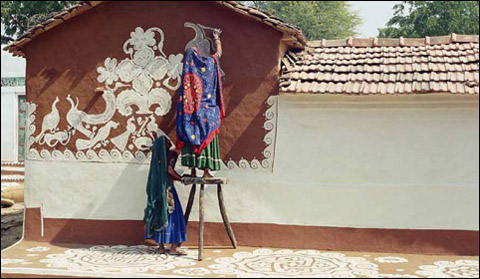
But browse through the pages of Nurturing Walls: Animal Art by Meena Women and the image in your head might well be changed.
Two short essays in the text explain and explore the women’s work, setting out how Mandana painting, as their work is term, is done by women from the Meena tribe in Rajasthan. It explains that the large tribe is concentrated as farmers in the Aravalli Hills, although they have a history as a warrior clan, which when overrun in the 11th century took to the hills as guerrillas, a role they maintained into the 20th century, leading to them being named by the British under the “Habitual Criminals Act” of 1930 as robbers and criminals whose movements needed to be curtailed.
Yet there’s nothing of this surely turbulent history in the images of this tradition, although perhaps a hint in the fact that it’s a temporary art, meant to be painted over again and again, as the chalk on mud fades. (Then again perhaps that’s simply a reflection of art has it has surely been through most of human history – a pleasurable creation to be immediately enjoyed, before we distorted it with the destructive effects of the market. And it gives a hint of how much of human artistic history we’ll never be able to recover through archaeology, except through the most unusual accidents of preservation.)
The style certainly broadly fits within that tradition somewhat patronisingly called “naive”, in that there’s no focus on realism, or the rules of perspective or many rules at all really (except one that’s probably largely practical – the great majority of the images are white chalk on brown walls).
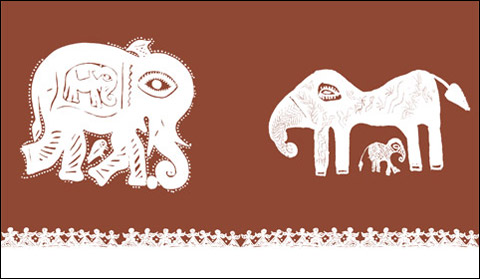
And the skill of the artists, as you’d expect, varies – but the best of it here is truly stunning – captivating in its depiction of a playful love between animal mother and child, innervating in its lithe energy.
read more

 About
About