Author Archives: Natalie Bennett

Weekend reading

* Australia is looking to moving towards gender-blind selection for all military posts – up to and including the special forces. The physical standards project is aiming to look at what each job requires. Currently women “make up more than 13 per cent of the Australian Defence Force, can serve in 90 per cent of its roles”. The first woman in the SAS will have a hell of a time – but no doubt it will happen.

* Also from Australia, a piece exploring the Aboriginal homeland movement and its relationship to recent moves on Aboriginal issues is a sensitive and nuanced exploration. Once again, as I learnt as a journalist covering these issues many years ago, there are no easy answers.

* Helene Pleasants wasn’t famous or rich, but as this piece from the New York Times shows, she certainly made an impact – being an editor’s editor.

* There are now women members of the MCC – just very, very few of them – and it is in no hurry to admit many more.

* And a belated pointer to last week’s Britblog roundup, over at Suz’s place – a rich seam of material.

The women are always there…

Of the 105 trades listed in Rose de Chantoiseau’s 1763 almanac of Parisian workshops, approximately two-thirds included widow mistresses…textile-type trades, such as bonnet makers, embroiders and drapers, included a large percentage of widows. However, several surprising trades included a large number of widows, such as glaziers, mirror-makers and book dealer-printers.
(From From Wives to Widows in Early Modern Paris: Gender, Economy and Law, Janine M Lanza, p. 129.)

A new look at markets

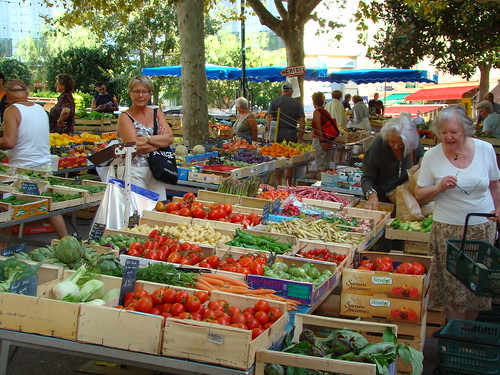
beaulieu-sur-mer market

The market in Beaulieu-sur-Mer last week

I’ll never look at a market in quite the same way again after reading Market Day in Provence, by Michele de la Pradelle. She made an anthropological study of three markets in the Provence city of Carpentras, in 1980 (the book has only recently been translated), looking at the wholesale market where farmers sold to wholesalers on the outskirts of the city, the traditional retail market, and the secretive but famous, although little observed by outsiders truffle market.

She finds, perhaps unsurprisingly, that although situated in a largely intact medieval city, most of the “historic practices” have in fact been reconstructed.

“In this age of supermarkets, the stallholder market distribution mode is necessarily perceived as archais, an impression reinforced by the way it is staged. The types of social relations induced by market exchange appear to actors to bear the mark of either a premodern or an exotic world. Calmly doing one’s marketing with one’s shopping bag on one’s arm while chatting from stall to stall with people one chances to encounter is also playing at being of another time…. A market is a collectively produced anachronism, and in this it responds to deeply contemporary logic.” (p.234-5)

She points out that the products almost invariably are exactly the same ones as youd buy in the market (look at the veggies above and you can see that), and even the “farm produce” or “home-made” ones are usually a carefully constructed fiction: “His stall is made of a simple plank of wood…he has carefully lined up a few bunches of leeks; handwritten on chalk on a small chalk board above them are the words: “leeks, untreated, 6F”… The nature that Roux stages is that of the Sunday gardener: cherries eaten straight off the tree, patiently transplanted lettuce whose progress is observed daily. These are patently healthy vegetables…” (Although Pradelle notes that this is more commonly seen at L’Isle-sur-la-Sorgue, “where the Sunday secondhand market pulls in a big tourist crowd”.

She also closely observes the interactions: “The joking is what gives the market exchange relation its specific form, turning a series of disparate customers into a small society of equals.” By contrast, she says, in a shop, the status of the customer is always carefully observed and reacted to. She also notes that close friends, who would usually have to go through elaborate rituals, can get by with a quick peck on the cheek in the market – the fiction (usually) that this is busy business allowing simple exchanges in complicated relationships.

We’re a complicated race, we humans…

What happened to 2m ‘surplus’ women?

I should have loved Virginia Nicholson's Singled Out. I love reading about, and then getting to write about in reviews like this one, women pioneers, women successes, women who beat all of the odds. And there are hundreds of stories like that here: Beatrice Gordon Holmes, suffragette, founder of the Association of Shorthand Writers and Typists, and tremendously successful city businesswoman; the middle-class young lady Victoria Alexandrina Drummond, who against fervent opposition became a marine engineer and in 1940 worked her ship to safety and won the Lloyd's war medal for bravery at sea; Mary Milne, who became matron of St Mary's Paddington, known, unusually for a woman in that role, for her sympathetic handling of trainees and junior staff.

But there are two reasons why, while glad to have read it, I thought that Singled Out was as a book something less as a whole than the sum of its parts. One isn't, perhaps, Nicholson's fault. She charts, fairly enough, the astonishing public hostility against these women – the Daily Mail figures prominently here; Lord Northcliffe, its owner, publicly referred to "Britain's problem with two million superfluous women". Plus ca change… Then there are authors such as Walter M Gallichan, who in The Great Unmarried (1916) wrote of the "modern woman":

Ideas are seething in her busy little brain. She is desperately intellectual. One day she tells you that she is prepared to die for the cause of Women's Suffrage. Next week she will be immersed in economics, or vegetarianism, or free love… 'I don't mean to marry,' she says, with a ring of disdain/ 'I want to live my own life…. She tried to disguise her sex attractions by dressing dowdily, neglecting her hair, wearing square-toed boots, and assuming inelegant poses.

It is souring to read such stuff; women being blamed for being in circumstances that were no choice of their own (they hadn't even had the choice of the politicians who took Britain into the war). You can't help getting angry (and reminded of all of the similar junk still thrown around today, often in the same places). Maybe there needed to be a taster here, but perhaps there's more than is needed.

The second problem is clearly Nicholson's – one of structure. There isn't a very clear one: we swing back and forth from the working classes to the privileged, revisit some women several times, such as the hugely impressive archaeologist Gertrude Caton-Thompson and the writer Vera Brittain, but I never really had a sense of where we were going, or why. And I'm not quite sure why we have to visit the horror of the trenches in the first chapter. Certainly, this was reflected back to the women, but surely that could come through their stories, rather than the men's.

Nonetheless, there's a lot to admire here – and particularly the oral histories, which Nicholson has captured at the last possible moment (many of her interviewees being around the 100 mark). She's great at painting short pictures of ordinary, extraordinary lives, such as that of Olive Wakeham, born in 1907, who spent much of her career as a nursery nurse, since her family couldn't pay for teacher training, was the centre of the lives of many of her 28 first cousins, then ended up as president of the Devon County Association for the Blind, and an MBE.

Then there's Evelyn Symmonds, who got her first job in 1922 at the age of 14, in the Post Office making her a "Civil Servant", a source of pride, then she was gradually promoted, passing exams despite very basic education, and after 30 years was an executive officer in the Accountant General's Department, retiring at 60 after 45 years in the post office. She told Nicholson: "We used to on holidays and please ourselves. We had good money, and I loved my job. I've thoroughly enjoyed life, I must admit…"

And the stark facts of the story are powerful in themselves. In 1911 there were already 664,000 more women than men in Britain – because girl babies are tougher and men were more likely to emigrate to the colonies. And in 1917 you can only admire both the courage and the clearsightedness of the senior mistress of the Bournemouth High School for Girls who stood before the assembled sixth form and told them: "Only one out of ten of you girls can ever hope to marry. This is not a guess of mine. It is a statistical fact. Nearly all of the men who might have married you have been killed. You will have to make your way in the world as best you can." By the 1921 census her words were born out – there were 19,803,022 women in England and Wales and only 18,082,220 males. And this in a world where at the turn of the century less than 30% of women had jobs – and virtually all of these in the traditional housework, childcare or factory roles.

read more »

A marvel of prehistory, the Tende museum

Only one hour by a slow train from Vintimille, just across the border in Italy, you’re in another world – Tende, which has a very Alpine feel (it seems that everyone under the age of 60 in the town wears walking boots, and looks like they use them in anger). And the tourist office boasts pamphlets about what to do if you encounter a guard dog with its flock.
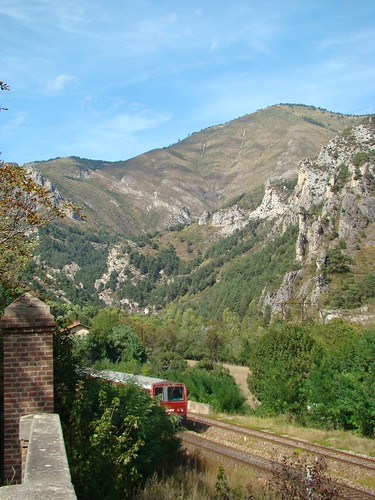
tende france

It doesn’t feel very French – perhaps not surprising since it was Italian until after the Second World War. It seems it has always been an amazing area – so close to the Med yet so cut off from the world. In the 14th century, I learnt from the display in the tourist office, muleteers brought salt trains through the valley of the Roya up to Piedemont. The Duke of Savoy, Charles-Emmanuel I, improved ties between Nice and Piedmont, allowing for other forms of transport.

But what’s really amazing about the place, and what took me there, were some 40,000 carvings, all around the tallest mount here, Mont Belgo, the bulk of them made between c 3,200 and 1700BC. That’s inspired the local “Museum of Marvels”, where most of them have been moved for safekeeping.
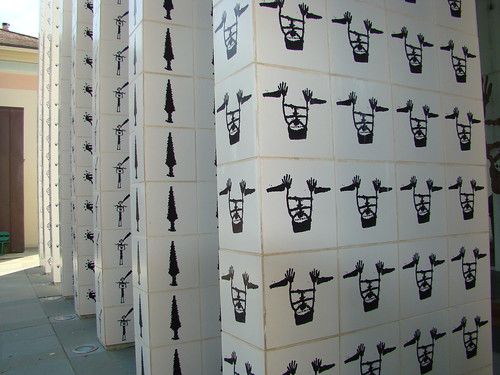
tende museum

There’s a big, detailed display on Otzi, the Austrian ice man, who at 3,300BC almost touches on the period of the carvings. The museum isn’t big on lots of the media claims about his death, saying firmly “we have no idea about the circumstances of his death, although he did have human blood on his jacket and on the blade of his knife and and an arrow in the left shoulder” – circumstantial evidence about which a certain amount of speculation might be reasonable. What’s fascinating is how carefully tailored to their characteristics his skin clothes are. So his hat and the soles of his shoes are bearskin, loincloth and shoe uppers deer, leggings and jacket goat, and he wore a calfskin leather belt and carried a quiver of chamois strung with linden fibre. You feel that there was a reason for each of those choices. And he stood 1.6m tall and weighed about 40kg (which makes us all look pretty darned fat today – although I suppose you wouldn’t want to carry too much extra weight if you spent your life tramping around these mountains.

Then you get into the rock carvings themselves, which are spectacular, although when I look at them I was reminded of the theory about the Lascaux and similar cave paintings – that what mattered was the creation, not the actual existence of the work (quite a lot cut over the top of older work, or are created very near it but in no apparent relation to it.

I also have some problems with the interpretation of the museum. In its words: “In the early bronze age a division of labour probably led the men of the village to become responsible for the worship of the gods, hence the Mt Belgo carvings, since they visited the sacred mountains when taking their herds to alpine pastures.”

Sorry, but I really can’t see where the evidence is in this statement. Sure that’s what happened in historical times, but why assume that’s the case thousands of years before?

And there’s more. The museum identifies four types of carvings from this period: horned figures, geometric designs (identified usually with fields), anthropomorphic figures, and weapons (useful for dating by means of their shape – and the one that look remarkably like a golf flag is actually a halberd, which I will believe).

And it also suggests in at least one place that all of the figures are male. Sorry, but if you look closely at this one (which just happened to be one of the postcards I bought), this is clearly a female figure.

And you can differentiate male and female quite clear (although quite a lot have no sex organs). Now I’m not going to venture into guessing what that means, but I do think it shoots some holes in the museum interpretation.

Despite that, however, it is a very fine, fascinating display (although being quite new again plagued by the French habit of leaving you stumbling around in the dark when not immediately in front of an exhibit – and rock carvings certainly don’t need to be protected from light.)

The museum does also ventures into the ethnographic, covering the transhumance lifestyle followed until early in the 20th century. And it has the inevitable recreation of a 19th-century shepherd’s house “the walls painted blue to keep out insects”. Huh? Can anyone explain that one?

And there’s also a spookily effective mannequin with a holographic face telling old mountain stories about witches, foolish shepherds and the like, in four languages, which is rather fun…
Sex and space

A post on Comment is Free about sex work has topped the 1,000-comments mark, and (perhaps not typically) for its depth, knowledge and thougtfulness, deserved all the attention. It is from a sex worker, and she not only neatly points out the extraordinary methological flaws on a recent, much-reported study (if you ask brothels the age of their workers, do you really believe the answers?), but explains why she chose sex work, and why she doesn’t want this option taken away from her.

Also at the Guardian, a fascinating piece about how urban design is done by men, for men.