Author Archives: Natalie Bennett

The good, the bad and the ancient

I caught the fossil-hunting bug during a visit to Lyme Regis a couple of years ago. My table is now decorated with quite a few ammonites, what might (or might not) be a dinosaur coprolite, and fistfulls of belemnites. (Their fossils are casts of their internal cavity, so the are simply a narrowing rod of stone. I think everyone gets bored with picking them up eventually, they are so plentiful).

But I guess I’ll have to go back now, since a new cliff-slip has exposed what is expected to be a rich new field. Someone in the “how to collect fossils” group I went out with found an icthyosaur vertebrae – now I really would like one of those.

Elsewhere, in the “it was bound to happen” category, Jane Austen is to be repackaged as “chick-lit”; and an American woman soldier’s account of Iraq is also being sold by the sex, although it appears to be about a lot more.

And, surprise, surprise, Western science has found evidence that acupuncture works.

Researchers found that an acupuncture technique using deep needling led to the deactivaton of part of the brain’s limbic system, which helps the body to be conscious of pain.
Neuroscientists believe that the findings show that acupuncture has a measurable effect on the brain and that the study could provide a possible mechanism to explain how acupuncture can relieve pain.
The research was carried out on a set of volunteers by scientists at Hull York Medical School as part of a new BBC TV series called Alternative Medicine: The Evidence, to be broadcast on Tuesday evening on BBC2.

It would be kind of odd if the Chinese had been using it for thousands of years and it didn’t have some effect …

And finally, the only real story in the UK this weekend is the whale in the Thames. Whether it makes it or not (and the radio news is not very positive just now), while some might say this is a disproprotionate response, I still think it is a positive aspect of human nature that such efforts should be made to save another creature, and such interest be shown in those efforts.

The flavours of India in Hampstead

There are some moments from Tamasha’s production of A Fine Balance, which has premiered at the Hampstead Theatre, that I will remember for long time. There’s the opening scene, of a legless beggar, who skims around the stage seeking alms amid an imaginary traffic jam, evoked by a soundscape and smellscape that immediately transported me to Calcutta, the site of my first encounter-shock with the sub-continent. Then there’s the stunningly effective puppetry that solves the problem of animal and child characters – the “death” of one animal puppet produces an almost audience-wide audible gasp.

Yet these excellent moments are blended to produce a dull, if worthy, whole. The play is based on the eponymous Booker-shortlisted novel by Rohinton Mistry, one of those classic Indian sprawling epics, in this case exploring the impact of Indira Gandhi’s 1975 Emergency, which imposed martial rule on the world’s “largest democracy”.

The story, by and large, is of the effects on the poor – the slum-dwellers thrown out of their homes and driven into pointless stone-breaking, morale-sapping labour; their employers, only marginally more economically secure, left without workers; the men and women sterilised by force … the novel is a great sweeping tale. The play takes in all of their stories, yet while it leaps from drama to drama, from crisis to crisis, the action on stage is slow, even langorous. This is a neat synopsis of a play, but the heart, the soul, is missing.

Part of the problem is that none of the characters is developed – they are more archetypes than people. I naturally sympathise with Dina Dalal (Sudha Bhuchar). We meet her as a sweat-shop employer, but she gradually emerges as a struggling woman, a widow, determined to maintain her independence in a male-dominated world, if only to remain out of the uncaring clutches of her bullying brother. But she is a stereotype, if an admirable stereotype; we never learn more. What was her relationship with her husband; what gave her the steel to battle on to the bitter end? (The book answers these questions; the drama does not.) READ MORE

A new blog and a new name

… well both new to me anyway.

Winter Evenings, or Lucubrations on Life and Letters, being posted by Radgeek, is what she has labelled a “retroblog”, being the words of the Rev. Vicesimus Knox (1752-1821).

It seems to consist – well has so far anyway – of those literate, neat, what you might call Ciceronian, formal essays, which you seldom see today.

Here, very neatly, is an essay about the appropriate form for an essay:

Every mode of introducing an air of novelty has been tried by the periodical writers. Allegories, Diaries, Eastern Tales, Little Novels, Letters from Correspondents, Humour, Irony, Argument, and Declamation, have been used to vary the form of conveying periodical instruction. These contrivances were successful, till the repetition of the same modes of diversification caused a nausea.

Well worth checking out … and I think the “retroblog” term is also well worth adopting …

Meanwhile today my own retroblogger, Francis Williams Wynn, is reporting on the accounts she heard of the death of the Russian Emperor Paul I (son of Catherine the Great), recollections occasioned by the death of his successor, Alexander I. It was a bloody, chaotic scene:

Paul resisted stoutly, attempted to conceal himself, &c.; and they seem to have hacked him most cruelly. At last Beningsen and Ouwarow took the sash of one of the sentinels on duty and closed the scene by strangling him, but not till he had received some tremendous blows on the head, and not till one of them (Beningsen, I think) had trampled upon him, and had with his sharp spurs inflicted two wounds in his stomach.

Her account seems to be based in part on the accounts of two English governesses at the court, a Mrs Browne and a Miss Kennedy, who had a pretty scary time of it:

Miss Kennedy with her young charge slept in the room immediately over that of the Emperor : she heard the violent uproar (‘ row,’ Lord Dillon called it), trembled, quaked, got the infant out of its own bed into hers, and with him in her arms lay expecting some horrible event. This dreadful interval lasted more than an hour, when Madame de Lieven (the mother of the Prince Lieven who was ambassador in England, and then grande maitresse of the Empress) rushed half dressed into the room, and desired Miss Kennedy to bring the Grand Duke to his mother instantly, if she wished to save his life and her own.

Miss Williams Wynn’s account seems to square broadly with this account of the life of Paul, which says of his death:

On the night of March 12, 1801, Pahlen, Count Bennigsen, and the Zubov brothers Nikolai and Platon entered the Mikhailovski Castle with the assistance of a co-conspirator, an unfaithful aide-de-camp of Paul’s. They found the tsar’s bed empty. The conspirators, who were drunk, found their head of state hiding behind a screen in his chamber. In an alcohol induced frenzy, they proceeded to murder the man to whom they had sworn their loyalty. Thus died Pavl Petrovich Romanov, who left the world in circumstances as lacking in love as his entrance.

Friday dog blogging

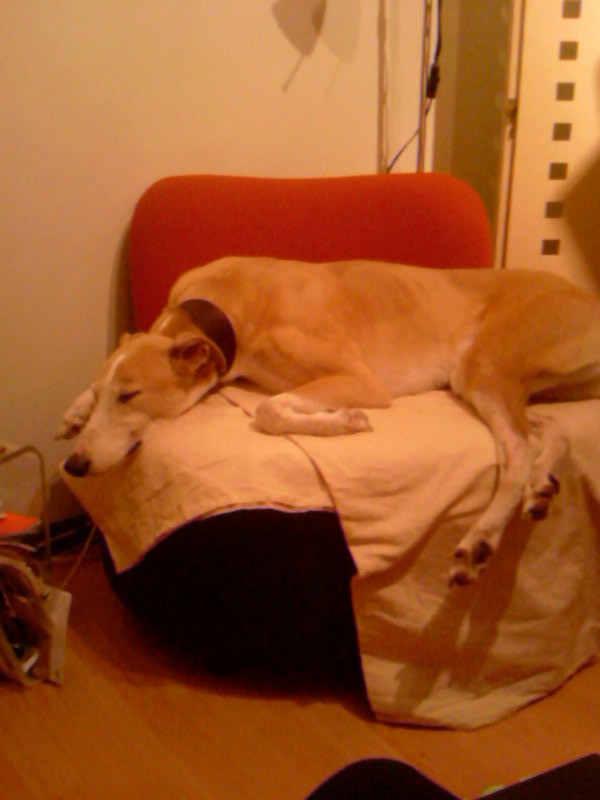
I started off with a “not on the sofa” rule, but how could one resist a 33.4kg (weighed at the vet’s this week), long-legged dog so determined to sit on a small lounge chair:

The satisfaction seems to be worth the careful adjustments required …

The “not on the bed” rule will, however, remain.

Click and pay

I think you could say online shopping has come of age:

A total of 24 million UK consumers shopped online last year, spending an average of £816 each during the year and £208 over the Christmas period. Sales peaked in the week starting December 5, when £653 million was spent online.

I heard a speaker on Today saying this was 10 per cent of total spend.

Well I do my bit – I’d reckon 90 per cent plus of what I spend is online.

I was thinking about the environmental effects of this – has anyone seen any analysis? It has to greatly cut journeys of consumers to the shops, and mean at least one less journey (from warehouse to shop). It also, presumably, cuts impulse buys and hence consumption. And eBay means that many things are “recycled”.

Then a small piece of good news out of Malaysia – a senator has got himself into trouble by divorcing his wife by text:

The prosecuting sharia officer, Mohamad Yusof Sulaiman, had asked for a heavier sentence, saying it would better highlight the seriousness of the offence.
“Cases such as this are happening often these days,” he said.
“Even [non-government organisations] have been critical of Islamic laws lately, especially on matrimonial matters which are said to favour certain parties.”

Should not horses be treated equally to dogs?

The story about the ridiculous offence of calling a police horse gay prompts me to ask, why is it that dog owners must clean up after their pet or face a fine/hearing (fairly enough), police horses can go around dropping shit all over the place (gosh, can I say that? is that impolite to the horse?) without any attempt being made to pick it up?

Sure if they are in “hot pursuit” it might be excused, but when they are just going for a pleasant morning amble – as I’ve seen them doing regularly from my last two central London residences, why can’t they clean up after themselves?

This is definitely discriminatory …