Author Archives: Natalie Bennett

Joining the Greens for the new year

I made a resolution many years ago not to make new year’s resolutions, and I’ve kept it pretty successfully, but I decided this was a good point to put off procrastinating and join the Green Party.

I’ve been thinking about it for a while, hanging back because I don’t really see myself as the joining sort, and, let’s face it, they do have a very specific image that I don’t quite see myself as fitting – but the need to do something drastic about global warming is just becoming overwhelming.

The Guardian today has a fascinating interview with a palaeoclimatologist, whose speciality is the Jurassic.

“A few years ago people were saying, ‘OK, well, we’ll look back a million years or so, something like that, to see the effects of climate change’,” she explains. “They thought that we’d still be in the kind of world that we currently know. But now we think that for a vision of what the Earth’s going to be like in a couple of hundred years, we may have to go back to a time before the ice, to when it was a greenhouse world. Because if you look at the figures on carbon dioxide in the atmosphere, it’s rising very, very fast. It’s beyond the levels of CO2 that we classically know from before the last ice age. If it keeps accelerating at this rate then in a matter of just a couple of hundred years we’ll have levels of CO2 that we last saw at the time of the dinosaurs.”

And when I wrote to Camden Council as a leaseholder in one of their blocks – in response to a statement that they were going to let an electricity contract – asking about using green alternatives, I got back the standard letter about it being too expensive but they were still looking at it. So they’re going to let a five-year contract to traditional suppliers.

I look around at all of the flat roof-tops around me, from four storeys to 17 storeys, and wonder how many wind turbines (and solar panels) you could put on top of them that have – according to this site – at least neutral cost implications, and considerable environmental benefits.

There’s a council election next year; I think a few Green councillors would be a very good idea. Might concentrate some minds among the staff.

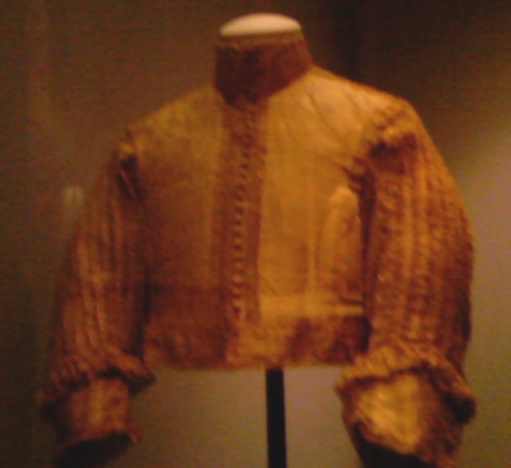
Party-time, 17th-century style

Having spent the afternoon at the V&A, I can report on the perfect style for a party – perhaps now to see in 2007. It has recently acquired two spectacular pieces of 17th-century wear, now on display in the fashion section:

At the top is a women’s jacket dated 1630-40. The colour is quite subdued – a soft beige (assuming this is original), which allows all of the focus to be on the spectacular silver thread embroidery. There must have been many, many hours of work in that – and really skilled work. No wonder clothing was so expensive.

The men’s doublet is possibly even finer, dated 1650-65 – I’d reckon it must be after 1660; it has a definite Restoration look about it – foppish is hardly the word. The description says it is made of very fine Italian silk, woven with silver gilt thread.

(Apologies for the quality of the photos – the lighting is understandably dim.)

Just what the UK needed

In a country already obsessed by football (mainly) and to a lesser degree other sports, the New Year’s Honours – to every sportsperson the government thought it could get away with – is just what was needed – NOT.

If this, and the Olympics, were going to encourage people to play sport, well it might be defensible – but what is far more likely is that it will encourage people to spend even more time slumped in front of their televisions.

I can look out my kitchen window into a run of windows in flats some 50m away. I’m fascinated by one in which it seems at night (you can’t see through the curtains during the day) the television is always on – and usually on sport. (The screen is so large that even from this distance I can see it quite clearly.)

Meeting Sir Stamford Raffles and hearing tall tales

Miss Williams Wynn is today meeting Sir Stamdford Raffles, and hearing some tall tales of Sumatra – including cannibalism of living bodies, with a side dish of salt and spices. Well I guess one of the rewards for enduring obscure foreign climes is being able to tell weird tales afterwards.

She does also, however, hear quite an accurate account of the “mermaid” (manatee).

Then for light relief she comments on a family of English aristocrats said to have tails like monkeys ….

(More on Raffles.)

A faithful greyhound

In 1400 a French knight, Chevalier Masquer, killed his erstwhile friend Aubrey de Montdidier, and in secret buried his body. But the dead man’s faithful greyhound, called Verbaux, led one of his friends to the grave and scratched the ground to expose the body.

Then, whenever the dog saw Maquer he attacked him, although his temperament was otherwise good.

When the king learnt of these events, he ordered a trial by combat to allow God to decide the situation.

Beside Notre Dame, Maquer was buried up to the waist and armed with a stick and shield (the same arrangements were also used for trials between men and women). The dog was let loose and seized him by the throat. The knight screamed for mercy and promised to confess his crime. The dog, presumably, was dragged off – or else super-intelligently let go – and the knight was later hanged.

No record survives of the dog’s fate, but one hopes he had the best spot by the fire and a nice meal every night.
(From Duel: A True Story of Death and Honour, James Landale, Canongate, Edinburgh, 2005)

There’s a longer version of the story here.

I find it hard to imagine my faithful greyhound doing likewise – as I gather is typical of modern greyhounds he’s definitely on the timid side; still you never know, he might be more of a guard dog than he looks.

*****
Since I’m on (possibly shaggy) dog stories, a holiday ahhh tale – Keela, a 18-month-old spaniel and police sniffer dog earns more per day than the chief constable who employs her.

Her sense of smell, so keen that she can sniff traces of blood on weapons that have been scrubbed after attacks, has her so much in demand by forces up and down the country that she is hired out at £530 a day, plus expenses.

Essential Reading: Rape in South Africa

A full, expert analysis of the problem of rape in South Africa – a reminder of the fact so often denied or rejected, that the crime is about power, not sex.

They were also “desperate protests against men’s loss of control” over women. Over the past century, radical changes in South Africa’s economy have profoundly affected gender norms and expectations and altered the balance of power between the sexes. In reaction, violent men were reviving old “scripts of male domination” with deep historical resonance.

The cultural relativist would deny it, but there are some cultures that don’t deserve to survive, due to their damaging, dysfunctional nature. The problem is how to change them with as little damage as possible.

(Via The Rhine River.)