Author Archives: Natalie Bennett

My Lord and Laddy

I’ve said before that the chilled manner in which Britain has taken civil partnerships for gays and lesbians in its stride has been an illustration of what I love about the place, and there was a further example this morning.

I woke to Radio Four, and an only slightly tongue in cheek discussion about what you should call the civil partner of someone with a title. Laddy, for the male partner of a lord, was one of the better suggestions. (Doesn’t seem to be on the web unfortunately, although you can find Today here.)

A golden age of bookshops?

Somehow it seems, wherever and whenever you visit a place, you’ve just missed a golden age. You always should have found this Thai island 10 years ago, “when it was paradise”. And when you read 84, Charing Cross Road, it seems as though just after the Second World War was a paradisiacal age of bookselling, when dedicated experts spent their days sifting through classy hardback editions of obscure classics, just waiting to fill the orders of a New York woman – Helene Hanff, who describes herself as “a poor writer with an antiquarian taste in books”.

She complained, in a letter of October 5, 1949, to Marks & Co Booksellers at 84, Charing Cross Road, that decent editions were impossible to obtain in America. That was the start of a beautiful, long-distance friendship between herself and the staff of the shop, and, finally, their relatives, that continued into 1969. Together the collection of the correspondence forms one of the finest epistolary books I’ve ever read.

In such few words, a lasting bond was form, cemented with American food parcels that Hanff sent to obviously hungry post-war Britain. She’s certainly the strongest personality in the book. You can only imagine the reaction in “proper” London of 1949 to the epistle that started: “Kindly inform the Church of England they have loused up the most beautiful prose ever written, whoever told them to tinker with the Vulgate Latin? They’ll burn for it, you mark my words.”

Frank Doel is the chief correspondent from the bookshop side. He starts out all proper, professional English gentleman, but gradually unwinds, while Cecily Farr steps into an immediately friendly relationship and is soon sending detailed instructions for the proper preparation of Yorkshire pudding, to someone who has never seen and tasted it.

It is one of those books that should be on anyone’s must-read list, but perhaps it would be better to read it after visiting the modern Charing Cross Road. While it is still one of the primary clusters of bookshops in London – rivalled only by the group of second-hand/specialist stores around the British Museum, just to the north-east, it has fallen prey to the untender grasp of commercialism and development. READ MORE

A highly paid barrister is, ah, highly paid

The London Evening Standard has outdone itself this evening. Its splash is just what the headline says. Of course the barrister in question happens to be the wife of the PM, but there’s no suggestion there’s anything else unusual about it.

Wonder if it was the husband of the PM, would it get the same attention?

Story not on the web – perhaps they were too embarrassed. No, I didn’t buy a copy – I refuse to these days, since it has become Daily Mail-lite – but read it going past the newstand.

But she’s certainly lost the turkey vote, with the No 10 Christmas photo op.

Merry Christmas

The figures say that the average Briton (not sure if this also includes babies) is this year spending £366 on Christmas presents. That’s an enormous sum, particularly since there must be an awful lot of people spending only a fraction of that, like me.

And lots of those items will be clothes, many of which won’t stay in wardrobe until next Christmas. The link above discusses the widespread environmental and economic effects – including the fact, which I hadn’t thought about, that the export of second-hand clothes prevents the development of indigenous clothing industries in Third World countries.

But on a more cheerful note, if you’re engaged in nefarious pursuits, watch out for the carol singers. Showing a rare intelligence, police in Dorset dressed up to get close to a suspected drug den. The door opened and a woman “she would give us a pound to go away”. Sounds like they were authentic then.

One the science side, satellite photos seem to show what happened to Beagle 2 on Mars – an unlucky landing in a hole. And there’s a new, high theoretical theory, about the origin of life. Life may have emerged from the quantum realm directly, without the need for chemical complexity. No, I don’t claim to understand this.

Not shelving the question

Take a look at your bookshelf. What do you see? Bindings, titles, paperbacks …? No, I said take a look at the shelf. The furniture not the contents. It is not something I’d paid much attention to, but after reading The Book on the Bookshelf by Henry Petroski, I’m looking at the lines of steel and wood with new eyes.

His books is, put simply, a history of the bookshelf. Must be short, you might think, but the story is considerably longer and more complex than you’d think.

First, of course, came the scroll. Not, on the whole, terribly convenient. The Iliad would have filled a dozen rolls, “nearly 300 running feet of papyrus” in total. Which provides an explanation of why the separation of words by spaces did not become general until after the invention of printing; it would have added 30 feet to Homer.

The valuable scrolls had their own slip-cases, sets were usually kept in boxes “not unlike a modern hat box”, while a “library” had a series of pigeonholes. But in one of those wonderful ancient/modern parallels, Seneca the Younger complained about the “evils of book-collecting” -:

“It is in the homes of the idlest men that you find the biggest libraries – range upon range of books, ceiling high. For nowadays a library is one of the essential fittings of a home, like a bathroom … collected for mere show, to ornament the walls of the house.”

I’ve read elsewhere that the Christian preference for the codex helped it defeat the pagan, scroll-based religion, but here is an earlier story. Papyrus was for many centuries the writing material of choice, but when Ptolemy Philadelphus in the second century BC forbid its export, Pliny’s Natural History reports that King Eumenes II of the Greek Kingdom of Pergamun, who wanted to establish a grand library, instead ordered the preparation of sheepskins to be used instead. The material was called charta pergamena, which led to the word “parchment”. (It had, however, been known earlier, if less used.) And parchment could be sewed to hold the codex together, which papyrus could not.)

In storage of codexes first came the books chest. It could be locked – frequently with multiple locks, and different monastery officials each had a separate key, so all had to jointly agree to get out a book, and witness its removal. Often it was set on a rack, so that the front edge was at a convenient height for resting a book on while reading. But if a book was being set out for regular reading, it would be placed on a slanted lectern – a word that comes from the Latin legere “to read.

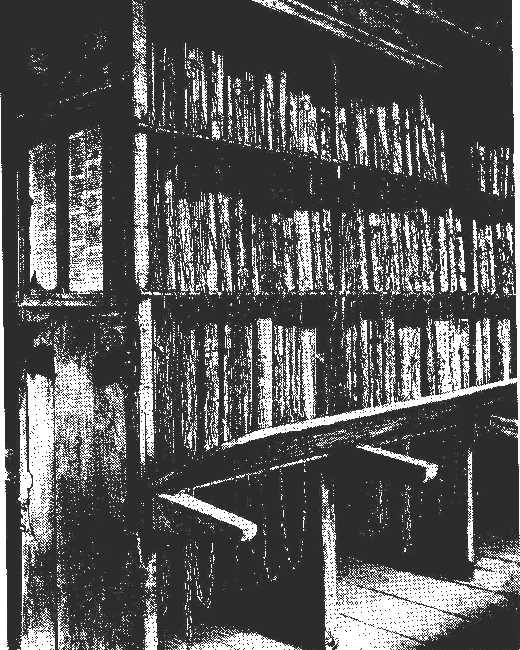
The next step was an armarium, more or less a chest sitting on its end, with the “lid” forming the door, and shelves dividing it, each holding one book, with its cover, often highly decorated, facing out. There was a problem as these multiplied, however, because you couldn’t put more and more into a room, as they would block each other’s light, and the librarian couldn’t keep a stern eye on his charges. So instead books started to be arranged on long, wide lecterns. For further security, and to ensure they stayed in place, each book was chained in its place on a lecturn. This avoided the need for complicated arrangements of keys and locks, allowing broader access to the books, and more books to be made available.

Chains were attached to a ring on the coverboard of the book, often near the clasp which, on the opposite side to the spine, held it closed. But, as all we booklovers know, the number of books you own inevitably multiplies and exceeds the storage place. (Had the 17 million books in the US Library of Congress in 1999 been so placed, they would require about 2,000 acres, or three square miles of floor space.)

Then came the stall system. Two facing lecterns were placed a little apart and a shelf run between them. Books could be placed on this, still chained to the original lecterns rail, but placed down on the lectern only when needed. Then after one line of stalls, why not two? If you feel like the story has been a long one thus far, and we’ve only just arrived at something looking like a bookshelf, well we’re now in the late 16th century. Pretty recent really.

But remember these books were still chained, and the chain was attached to the side opposite the spine. So the spine went into the depths of the book stall – now increasingly called a press, with the pages facing outwards. As at the 16th-century library in Hereford Cathedral …

As printing developed, and books became far less valuable, the chain started to become an unnecessary nuisance, and was dropped for the cheaper books, they were still placed this way, because that’s what had always been done. But with more books, even the spaces under the lectern, or desk as it increasingly became, were utilised for storage. Here, books were vulnerable to kicks and scuffs. Turning them around, with spine outward, provided some protections.

So finally, in the 17th century, we’ve arrived at the bookshelf as we recognise it. But it isn’t, Petroski makes clear, in any way inevitable. It is a wonderful lesson in the ways in which we think practices that are “natural”, “obvious” and “the only way to do things” often aren’t.

You sometimes feel that Petroski is living in another world – “modern” and “hat box” is not a phrase I’d be likely to form (don’t think I’ve ever seen a hat box), and sometimes he gets bogged down in rambling philosophical debates, such as that about “which came first” of the standing or the sitting lectern. But this is a fascinating book, the product of a truly original mind. If you consider yourself a bibliophile, you should have it on your shelves.
How to fold your Metro

I seldom catch the Tube at peak times – being an Australian I don’t cope well with personal space slightly smaller than the width of my shoulders – but I did this morning, and marvelled anew at the British ability to develop new social rules for changing circumstances.

Metro is a free newspaper picked up at Tube stations and usually left by users on the train. (Its articles are, to be polite, brief, and largely based on wire copy, but do give you the basics of the day’s news.) It started no more than two, or perhaps three, years ago, and there are now, I realised with an anthropological eye on the Northern Line this morning, all sorts of “rules” about its use.

When leave it you should carefully fold it in half – preferably still in pristine condition – as though your butler had just ironed it, as tradition says aristocrats used to get their Times. It can either be left on the seat, or the ledge behind them, although the seat seems preferable. It is then allowable for someone who wants to read it to select this seat, although normally you can get nasty looks if you leap down the carriage for a particular position.

But the protocol suggests you should wait until the person who left it has got off the train before leaning over from another seat to pick it up, it seems.

I’m always amazed when people suggest that Londoners are rude and abrupt – having moved here from Bangkok, I’ve always found them to be astonishingly polite and mannered.

And if you want people to smile at you, get a dog. On the way home from Battersea this afternoon (laden with Battersea logo bags and with Prince) I struck up two conversations with total strangers, and exchanged smiles with several more.