Author Archives: Natalie Bennett

Don’t believe everything you read …

… even in the archives.

That was the message of an excellent “masterclass” I went to at the Centre for Lives and Letters this week.

(I’ve never heard of the format, but it involved the teacher, the biographer Stella Tillyard, giving the tutorial class to a small group of students, while about 50 of us watched. (Rather hard on the students, but they loosened up by the end.)

We started with a handwritten letter, read it out and deduced what it was about. It was a pleading letter in which a queen begs her husband, the king, to allow her to defend herself against calumnies, and the charges she is obviously facing.

We were given the background – this is Queen Caroline Matilda of Denmark, the younger sister of George III, who’d gone there to be married at the age of 16 to Christian VII, who was already suffering a severe mental illness. The scandalous eventual results, which fascinated Europe of the time, are recorded here.

But years later, when her son at the age of just 16 seized the throne, he ordered all papers about his mother (he’d last seen her at the age of three) gathered together into a secret archive, Papers Concerning the King’s Mother. Which was where this letter came in.

We then looked at a contemporary memoir published in London within a year or two of her death, actually an epistolary novel whipped up by some Fleet Street hack. (As they say, there’s nothing new in the world.) It was very successful, and went into several editions.

But what was surprising is that here was the letter, very nearly identical letter, yet how could the hack have got hold of it? The answer was he (I guess it was a he, although of course it might not have been) , of course made it up.

But when the young king was ordering papers about his mother collected, some Danish diplomat, whether honestly or desperately, had collected this “letter”, written it out in his own hand, and hence, there it was in the archive.

It was a powerful lesson not to believe everything you read, even in a handwritten archive of the right age.

(The theoretical background was Carolyn Steedman’s Dust, which I keep encountering in various areas; it has now leapt up the “must read” list.)
,

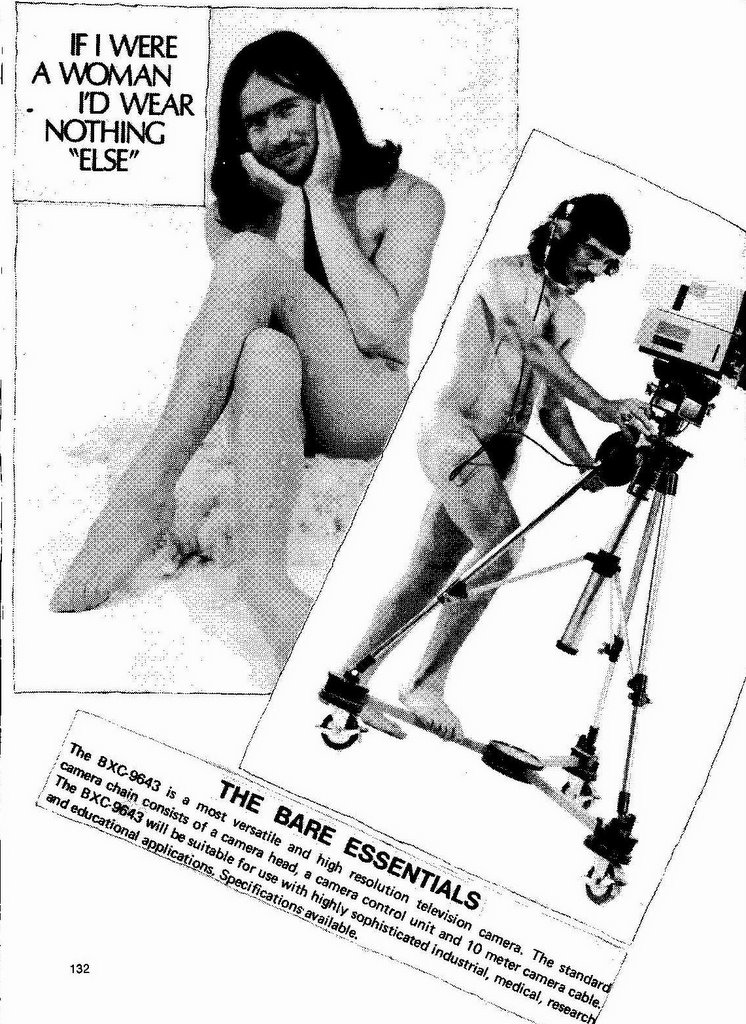
A bit of Seventies cheese(-cake)

Well since you insisted … just one image from Media She for now. One section of the book (and I suspect it would have been rather shocking at the time) has men posed in adverts used in the same way was women. Hence, this:

Take the quiz: is your husband treated as a child?

A recent post of mine about the weaknesses of men has been picked up by the very reasonable Hugo Schwyzer, who disagreed with my conclusions about the effects of early marriage in infantilising men. Some of his commenters have, however, got rather more hot under the collar.

I was looking around for some material for a post on Seventies feminism (for the upcoming Carnival of Feminists on Sour Duck – check out the call for nominations) when I came across one of my all time second-hand bookstores best-buys, Media She, by Patricia Edgar and Hilary McPhee, published by Heinemann Melbourne in 1974. (It was practically falling apart when I bought it, but for $2 – even then – was a bargain.)

Very much a product of the early Second Wave feminism, it charts the rampant, open misogyny then to be found in the media, advertising, and other public arenas.

I’ll probably be quoting more of this soon, but for an example of how society encouraged men to behave like children, I present this quiz, about “how good a wife are you, and could you manage paid work and a husband?”. You are supposed to answer to each question with one of: never, sometimes, average, often, always.

1. Do you keep his clothes clean and mended?
2. Give him a good breakfast on time – and share it?
3. See he gets plenty of rest and sleep?
4. Relax with friends in the day so you can do things he enjoys together at evenings and weekends.
5. Make him feel you are really interested in his work – not jealous.
6. Co-operate sensibly in handling the pay packet?
7. Praise his accomplishments and keep quiet about failures?
8. Help when he has homework or overtime by avoiding complaints?
9. Finish as many chores as you can so he doesn’t have to do them?
10. Greet him with a smile and a kiss instead of moans about your day?
How to score: Never 0, Sometimes 1, Average 2, Often 3, Always 4. You can hardly give yourself the perfect 40, can you? At best, you will probably score somewhere between 20 and 30. So pick out your low scores and go to work to improve them. And then, maybe, go out to work.

My first thought is “who was your slave last year?” my second “this is a description of a mother (of a small children), not a wife”.

Now of course this is a silly magazine quiz, but it is also a careful reflection of society’s expectations.

If someone continued to do all of these things for you well into adulthood, or you even thought they should, you’d probably find it pretty hard to learn to take responsibility for yourself.

(In case you are wondering, the original source is not given.)

, , .

Poor Jordan

I was sad but hardly surprised to see that Amman has been the latest target for presumed al-Qa’ida bombers.

I have very fond memories of travelling in Jordan – the whole process was delightfully easy, you could trust people – even ticket touts, taxis had meters, and there was almost no hassle travelling as a woman on your own. And in the whole of the Middle and Far East it is the only place I know (well, except Singapore) where drivers don’t perpetually have one hand on their horn. (Althought the traffic is still pretty crazy.)

Most people go for Petra, which is the most astonishing place – no photo can really do it justice, but there’s much more. Jerash is a spectacular Roman site every bit as well preserved as Ephesus – giving that magical feeling that you are not in a ruin, but in a very nearly living city.

And Amman itself, although the modern city is nothing to write home about, has a magnificent archaeological museum (I particularly remember some great late Neolithic statues the like of which I haven’t seen elsewhere), and a nice neat little Roman theatre with a fun folklore museum.

I’m going to see if I can scan a few of the pictures I took and post them, but anyway, I’d recommend that if you were thinking about travelling there, or just looking for somewhere to go, don’t overlook Jordan, even now. As we all know, these things can happen anywhere.

, .

The Dan Brown embarrassment

I got rid of my copy of the Da Vinci Code by the simple expedient of leaving it in Australia, with someone else who wanted to read it (so environmentally sound recycling), but London By London has a suggestion for those who haven’t been able to avail themselves of such an opportunity to remove the embarrasssment from their bookshelves.

“LbL is giving you a chance to unburden yourself of your Dan Brown trash-lit guilt by swapping any old dog-eared Dan Brown book for a shiny LbL one [the old edition of their guide, which has been supplemented by a new one]. Free. Gratis. No catches. No questions asked. No judgements made. Just hand over Brown and we’ll give you LbL.”

I thought it was rather clever – unfortunately I haven’t got one to swap, or I would.

,

A brave woman stands up to Napoleon

My Lady of Quality is today reporting on a woman, one of Lucien Bonaparte’s daughters, Charlotte, who is said to have stood up to Napoleon. Miss Williams Wynn says:

Napoleon sent for one of Lucien’s daughters, offering to marry her to the Prince of Spain (Ferdinand), or to the Prince of Wirtemberg (Paul). … When the poor victim arrived at St. Cloud, where the Emperor was, she was immediately presented to him; and as she knelt to pay her obeisance, he said, ‘ Levez-vi princesse.’ [Arise princess]
She had the courage to reply, ‘Non, sire, je ne suis pas princesse; je ne suis que Charlotte Buonaparte: permittez-moi, sire, de retourner mon pere.” [No, I’m not a princess, I’m Charlotte Bonaparte. Allow me, sire, to go back to my father.]
This permission was granted, and intended Queen of Spain (afterwards Princess Gabriella) was, when this story was related, living with her parents at Ludlow.

Charlotte (1795-1865) went on to have an adventurous life, living for three years in New Jersey. (This link includes one of her quite respectable sketches of there, and there are other works here.)

She later lived, it seems, in Belgium, before marrying an Italian and eventually, as Miss Williams Wynn says, ending up a princess anyway. Her second marriage was also in Italy and she was buried there.


You might have noticed that I’ve adjusted posting of the diary to about three times a week. Trying to do it daily was more than I could keep up with, and anyway I think this gives people more time to find – and hopefully respond to – the posts.)

,