Category Archives: Miscellaneous

Miscellaneous

Now I’ve done it

I’ve been planning it, then drawing back from it, getting excited, then getting cold feet, but I finally handed in my resignation at work yesterday. So soon (well probably in three months – that’s the contract period) I’ll be out on Grub Street, trying to earn a crust with whatever ideas for stories I can dream up (and, hopefully, some time soon, a book contract!)

Wish me luck – I’ll need it.

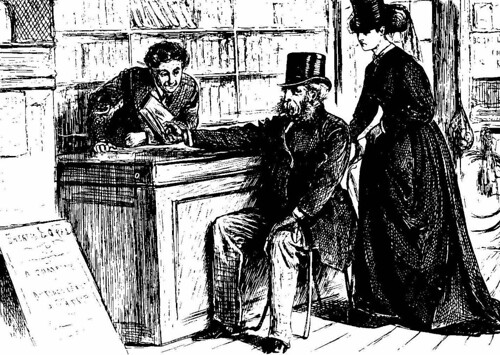
(The image above is from a Punch cartoon – my source simply dates it as “Victorian”. The text underneath says: Old-fashioned Party (with old-fashioned predjudices). “Ah! Very clever I dare say. But I see it’s written by a lady, and I want a book that my daughters may read. Give me something else!”)

Miscellaneous

Goodbye Sir Ian Blair

Fearless prediction of the day: Sir Ian Blair, Chief of the Metropolitan Police (London), won’t be in his post in a month. That follows his astonishing inept handling of the aftermath of the shooting of the innocent Brazilian Jean Charles de Menezes.

It probably won’t be the disgraceully hysterical policing that led to the shooting down of an innocent man by police that does for him – though it should. The inquiry will be dragged out long enough, and the water muddied enough (where did those CCTV tapes go?) that the media will have him out before then for his personal actions. (This post* does an excellent job of outlining what went wrong, so I won’t go over this ground again.)

But the man who keeps questioning why “so much fuss” is being made over the police shooting rather than the criminal bombings (Excuse me – you’re the state and you killed one of your own citizens for no reason at all) and who makes an unbelievable joke of his response when told – he says 24 hours after the shooting on learning of the mistake he thought “Houston, we have a problem” – is sure to keep making so many errors that the politicians already emerging like football chairmen to express “total confidence in the manager” will soon be changing their tune.

There’s only one thing I’m worried about. I’m agreeing with Tim Hames. That’s never happened before.

* Found on Britblog Roundup No 27, in which yours truly also has a humble part.

Miscellaneous

Theatre review: Antigone at Hell’s Mouth

A joint production with the National Youth Theatre, a musical comic/tragic updating of an ancient Greek classic – introducing Antigone at Hell’s Mouth, at the Soho Theatre in London like that will make most people run a mile. It sounds like a production you’d be dragged to kicking and screaming only because a Significant Other has a starring role. Yet the fact is Mike Shepherd’s production is good, very good – a mature, sophisticated show to which the traditional youth adjectives of “energy-packed” and “vibrant” can also be fairly applied.

Nick Darke’s story for the Cornish Kneehigh Theatre company has the Kernow Liberation Front finally deciding to throw out the colonisers and their second homes, taking back possession of the land, the sea and the very air for the people of Cornwall. The initial clash takes a youthful form, in a doubly fatal game of “chicken” with stolen cars. The rebel’s champion was “Johnny Throttle”, and while his opponent and brother, entombed still in his crushed vehicle, is to be given a state funeral in London, the bones of Johnny are to be thrown to the gulls. But his sister Gonnieta (Kate Hewitt) has already secured “Johnnny Throttle’s Throttle Foot” as a holy relic and is, of course, determined to secure the rest for a decent burial.

On the other side the new “Duke of Cornwall” (Mike Davis), resplendent in beauty pageant-winner’s sash, is just itching to exercise his newfound power, which includes the right to inflict capital punishment – such a step-up from being a singer in a fifth-rate cover band with a dubious family past. He’s backed by a ridiculous pirouetting brigadier from London and a Machieavellian secretary who coaches him into his role. The members of his former band form his reluctant and ridiculous bench.

Yet interspersing these dramatic scenes of confrontation, which end in genuine tragedy, just as an Antigone should, are delightful comic interludes. Definitely the best are those of the Second Home Owners’ Wives chorus, boasting faux posh accents, fluffy lapdogs on sticks, and a nice line in handbag swinging. But Zeus the dog – the Duke/Prince/King’s human hound – played in fine playful Jacobean jester style, is another highlight.

The serious side of the chorus is a collection of blind, mystical archaeologists in boiler suits and gas masks. I wasn’t sure about their opening of the play, but in its closing they provide a logical finality, and they settled comfortably within the simple but effective staging – the dust to which all will eventually fall plays a central part. The music too is evocative but never overwhelming.

There’s barely a weak link in any aspect of this production. Check the full talent list; you’ll read most of the names again soon.

The only other review I’ve found is here.

Miscellaneous

Review: Digging the Dirt

Archaeology has to be central to our understanding of ourselves and our world – will help us to keep our feet literally and metaphorically on the ground, Jennifer Wallace argues in Digging the Dirt: The Archaeological Imagination. Well she would say that, you might respond – her background is in archaeology.

Yet she makes a persuasive cases that enmeshes the reader in accounts of post-modern theory, Romantic poetry, Victorian treasure-hunting, Freudian psychology and popular science. In the wrong hands this mix would be a half-baked mish-mash, hidden behind a palisade of incomprehensible jargon, but Wallace writes simply, directly, and with informative brevity, while often allowing her key figures to speak for themselves.

She is particularly taken with figures who operate in productive, even paradoxical, binaries, rather than the traditional definitive forms. So she introduces the poet Margaret Keogh, who immersed herself in the classical world of Pompeii from her English home. “Pompeii was impossibly distant for her and so it became a place of desire … She feels dead whereas Pompeii is paradoxically vivid and alive; she is grey and sad while Pompeii is sunny and happy … Men would travel to Pompeii and include it on their Grand Tour; women had to stay home and read about it.” (p. 86)

Wallace makes an argument for archaeology forcing a materialistic, practical view of the world, which she calls “scepticism” and compares to Hamlet’s experience in the graveyard scene, saying “the literalness of the dying process … runs counter to any possible religious interpretation … when faced with withered fragments of bone and tooth and hair … worse when those remains are mingled with the dust”. (p. 130) Yet she also asserts its importance as an indelible record, particularly in its modern use in forensic science: the undeniable witness at war crimes trials around the world.

These conflicting views of archaeology are at the heart of early Christianity, Wallace says, comparing Eusebius’s discrete refusal to acknowledge Helena’s rediscovery of the “True Cross” with the nun Egeria’s enthusiastic embrace of a physical religion of place, “that it was at these spots that the stories cohered and where they appeared to make most vivid sense”. Wallace admits the logic and reality of Walter Benjamin’s explanation of the “aura” of archaeological objects, and, implicitly place, yet also drily points out that ” hills of the Golan, for a start, are not as they would have been in Jesus’ time, being studded with landmines”. (p. 169)

The study of archaeology and, in particular ancient history, frequently appears innately conservative, with its roots in that old standard “The Classics”, but Wallace says that: “Stratified history is necessary for an effective, grounded, radical politics” (p. 20). She goes back to a National Assembly deputy who used it as proof that regimes could and did fall, grouping that view to Shelley’s Ozymandias.

Wallace accepts the view of Deleuze and Guattari, that: “Stratigraphy … enables knowledge, and it only through knowledge that we can organise political campaigns, establish communities, create a vibrant culture.” (p. 187) But these she says, following these two authors, are in fact only useful fictions, a view also shared by post-modern archaeologists: “archaeology should move away from the hierarchical privileging of depth over surface and examine rather surface sites, delimited areas, nebulous spaces. It should be prepared to leave objects without a definitive explanation. And it should see archaeology as a form of rhetoric, rather than ‘reflection’ upon this world”. (p. 189)

If you’re interested in history and archaeology, and particularly their place in the world of thought, this is a book you should read.

But don’t be put off by the theory. If you’re just interested in the history of archaeology and society’s interaction with it, there are also many great tales. I was particularly taken with the story of the plundering of Milton’s grave as an example of what might be called the “naive” archaeological imagination.

Another review here.

,

Miscellaneous

We have come a long way

It is sometimes easy to forget that we have come a long way in a few decades. I was pulled up short by the information that “as recently as 1974 there was correspondence in the Lancet about why flowers handled by a menstruating woman should wilt”.

Odd how many florists are female then …

(From Gender, Sex and Subordination in England 1500-1800, Anthony Fletcher, Yale University Press, New Haven, 1995, p. 63)

Miscellaneous

What’s your cup?

To the Victoria and Albert today – and one of those annoying times when I was waiting to meet someone while they were waiting somewhere else. (He didn’t have a mobile – still this must have happened an awful lot more before they existed … )

So I spent the afternoon with the Tudors – something I should have done long before; I’ve had a bit of a mental block on the V&A and the whole “decorative arts” business: I spent too much of my childhood being dragged around antique shops that bored me silly. (Odd that seems now, but there were never any stories attached to things, only prices.)

The collection of textiles is truly astonishing. Not perhaps the royal stuff – that the marriage suit of James II should have survived, albeit without the waistcoat, is no great shock, but I was impressed by some of the humbler costumes, such as the embroidered lying-in smock dating back to 1630 using patterns from A Schole-house for the Needle by Richard Shorleyker (1624) and the jacket of Margaret Laton, whose portrait also survives.

I was also taken by a posset cup, looking rather more like a teapot, but with the spout instead meant as a straw. The V&A example looks not unlike this one, although not quite so elaborate. The V&A said that these were used for “warm nutritious drinks, often given to women after birth: milk beaten with eggs, sugar and spices and curdled with ale or sherry”.

It hardly seems that women would have these just for the odd occasion they needed them, so I wondered if they might not be part of a midwife’s kit, at least among midwives catering to the higher classes. Anyone come across this?

There’s more about possets, and a recipe, here. Not altogether sure about sherry AND ale in it – otherwise it is more or less an alcoholic egg nog, which sounds fine to me. This article suggests these were not for new mothers, but rather for convivial suppers, with the liquor drunk from the spout and the “custard” eaten from the top.

According to this ballad, it certainly was ceremonial fare …

The candles being light againe,
And things well and quiet,
A goodly posset was brought in
To med their former diet.
Then Robin for to have the same
Did turn him to a beare;
Straight at that sight the people all
Did run away for feare.

While in my cups, I also learnt another new term: fuddling cup. The root of the term is the same as “befuddled”, and was an elaborate drinking joke, of the “fart cushion” sort that I suspect the Tudors would have found hilarious, and us in general less so.

Several vessels were linked together in a ring and the drinker would have required greater manual dexterity than is common late in the evening to end up with the liquid in his mouth rather than on his shirt. (There’s an example here.)

A reminder of other differing sensibilities comes in the locket commemorating the birth of John Monson in 1597. Annoyingly, as in the case of many other characters in the gallery, the V&A tells you no more about him – a little biography please! He presumably is the same John Monson reported on this website as marrying Ursula Oxenbridge in 1627 and had a son John, later “Sir John” in the following year. He was the grandfather of the “1st Lord Monson” (b. 1693).

Nothing unusual in that, you might say, except this heart-shaped locket was made to hold the caul, which covered the baby’s head when he was born. It was dried and placed in it. That’s what you call a personal momento.