Category Archives: Miscellaneous

Miscellaneous

Women and learned helplessness

I’ve been pondering lately how women were, and it seems in some cases still are, taught to be, and rewarded for being, utterly helpless and hapless, as though this were an admirable trait.

The topic came up one night when I had a lot of ironing, which I did while watching a rather inane British commercial television show, Midsomer Murders, set in stereotypical current-day home counties villages in which every male is a solicitor or in the City, or a retired minor TV star, while the women are “homemakers”, spending all that money on huge fancy homes, mostly set around the village green on which cricket is being played.

It is not quality television, but nonetheless one scene really left me fuming. The main detective and his young sidekick are locked in a cellar with a woman of the “homemaker” type. (Her husband has been involved in a scam; she thought there was something wrong, but “thought it better not to ask about it”.) There’s a bit of discussion about whether there’s enough air, will they die etc, then the woman lies down and goes to sleep, leaving it to the men to try to saw their way out through the door.

Now, yes, this is a silly show, but some writer must have thought that this was believable behaviour for this sort of character. (And she wasn’t central to the show so no particular point was being made about her as a character.)

Then I had cause to meet (and I’m anonymising here because I don’t want anyone to be identifiable) a woman who must be in her early 40s, married to a considerably older man in a socially important well-paid job requiring a very high degree of education. Her manner could only be described as fluttery – in the best Victorian form – and when confronted with even a minor problem her reaction was to ask me, who she scarcely knew, to solve what was really quite a personal familial issue. I couldn’t help feeling that if faced with a real crisis her reaction would probably be to faint gracefully.

These incidents coincided with my reading of Susanna Moodie’s Roughing It in the Bush (1852), an account by one of the sisters of Agnes Strickland of being a gentlewoman pioneer (and eventually a very poor one) in Canada.

She has to do at times quite rough work, and cope with extremely difficult circumstances, yet she reports, indeed celebrates, her helplessness in many situations.

Fairly early on, Moodie, now probably in her late 20s, reports she “found myself at night in a house entirely alone. [Actually her child is sleeping, but I don’t suppose that counts.]

“Hour after hour wore away, and the crowing of the cocks proclaimed midnight,and yet they came not. [Her husband and their servant] I burnt out all my wood, and I dared not open the door to fetch more. The candle was expiring in the socket, and I had not the courage to go up into the lost and procure another before it went finally out. Cold, heart-weary, and faint, I sat and cried. …” (p. 196)

Later she reports of her fear of walking through the woods alone with her sister, although she admits there is no rational basis for this. “This foolish dread of encountering wild beasts in the woods I never could wholly shake off, even after becoming a constant resident in their gloomy depths … The cracking of an old bough, or the hooting of the owl, was enough to fill me with alarm, and try my strength in a precipitate flight.” (p. 260)

And she never gets over her fear of cattle. After some years in the woods one day she is forced to do the milking, “when a very wild ox we had came running with headlong speed from the wood. All my fears were alive again in a moment. I snatched up the pail and, instead of climbing the fence and getting to the house, I ran with all the speed I could command down the steep hill towards the lake shore; my feet caught in a root of the many stumps in the path, and I fell to the ground, my pail rolling many yards a-head of me.” (p. 370)

Now maybe Moodie was just conforming to Victoria stereotypes of womanhood here, but I don’t think so; the passages just ring too truly. But it does demonstrate what damage learned helplessness can do in making people live a life of fear.

How many women are living this way today? Probably more than I’ve previously imagined, I’ve now concluded.

(Quotes from Virago edition of 1986)
Miscellaneous

Two pounds well spent

.flickr-photo { border: solid 2px #000000; }.flickr-yourcomment { }.flickr-frame { text-align: left; padding: 3px; }.flickr-caption { font-size: 0.8em; margin-top: 0px; }


london, originally uploaded by natalieben.

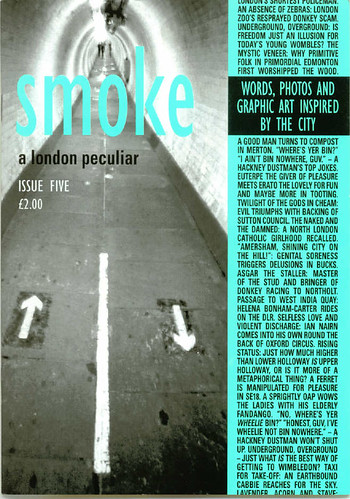
An impulse purchase at the London Review of Books bookshop turned out well.

This little publication is packed with articles, stories and pictures of the less-fashionable parts of London and interesting facts, surprisingly well edited and put together*.

The contents of Smoke: a london peculiar include

* a history of elephants in London – the first was in 1255, a present from Louis IX to Henry III.

* “Rodent Rovings” – in Philpot Lane there is apparently a 19th-century building bearing a carving of two mice nibbling cheese – apparently a builders’ initiative to commemorate the plague they had to work through. (Have to go looking for that.)

* There’s a warehouse of the north circular between Walthamstow and Edmonton that has a regularly changed feature “Veneer of the Week”. Apparently there’s 70 to circulate among.(I used to drive this road quite often, but never noticed this “feature”.)

* I learnt about Northolt, on one of the ends of the Central Line: “It’s not even a non-place, to use Auge’s term, just a bus stop on the way to Heathrow. Northolt has good company in the excised remains of the county of Middlesex, though. JG Ballard’s Shepparton is on the other side of the airport catchment area and somewhere in the Enfield enclave is a place called Ponders End, from where Norman Tebbitt hails. And I’m sure Stevie Smith was talking about Northolt when she made the jibe about what Town Hall terms “greater metropolitan areas” being all sub and no urb. It is enough to make Henri Lefebvre weep into the lap of one of his secretaries.” (From “Flight Paths”, Paul Castro)

********************
*No I don’t know the editors, nor am I being paid by them.

More here.

Miscellaneous

Soane’s renaissance

Yesterday afternoon to Sir John Soane’s Museum on Lincoln’s Inn Fields. It is one of those wonderfully idiosyncratic, personal collections, maintained much as he left it in the early 19th century, that have a charm no professionally curated exhibition can match.

My favourite area was “the crypt”, done up to feel like a mausoleum, packed with mainly Roman funerary monuments and plaster models of “modern” graves, but at its centre is the spectacular stone sarcophagus of Seti I, carved from a single piece of calcite.

It is enclosed in its own glass carriage, complete with wheels, which is presumably how it arrived in 1824, when Soane bought it after the British Museum declined to pay the discoverer, Giovanni Belzoni, a circus strongman and “archaeologist” (they don’t make ’em like that any more), the £2,000 he wanted for it.

You can just imagine it being formally wheeled into place, with Soane and his invited guests (1,000 came over three evenings) watching by the light of candles and lamps – more than a little spooky.

You’d think someone would have painted the scene, but the museum attendants didn’t think so. A web search produces a catalogue of the museum, which indicates there is a folder of 53 drawings of the sarcophagus by Joseph Michael Gandy, an employee of Soane’s, but I have a feeling these may be recordings of the item itself, rather than of its arrival.

Soane died in 1837, so living, just, into the Victorian era. It is interesting, however, that this is very much a Renaissance house – everything is assembled on the basis that the ancients, particularly the Greeks and Romans, are the model from which all inspiration should spring. I suspect by the time of his death Soane was very old-fashioned, but it is still a reminder how close we are to a time when the past was seen as more advanced than the present.

Miscellaneous

A touch of Orientalism

.flickr-photo { border: solid 2px #000000; }.flickr-yourcomment { }.flickr-frame { text-align: left; padding: 3px; }.flickr-caption { font-size: 0.8em; margin-top: 0px; }


india, originally uploaded by natalieben.

I blogged a few days ago about the postcards I am buying as presents (for several people now; if you have a good idea why not use it more than once.)

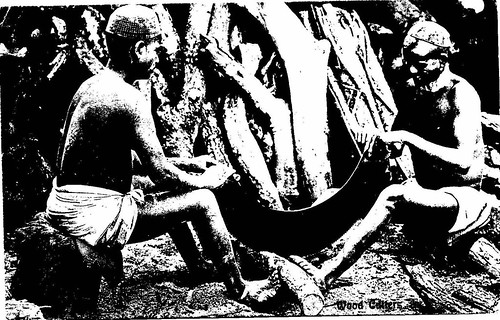
Above is one of the results, a lovely little piece of Orientalism produced by “The Phototype Company Bombay”, labelled “wood cutters”,
and posted from India in 1915 to Miss F. Birch, 6 Rockingham Parade, Uxbridge, Middlesex.

Part of the discussion that arose around my last post was how such cards were used as a cheap form of communication for prosaic matters, and this one certainly lives up to the billing.

It reads:
Dear Flo, Have run out of PCs. [presumably postcards] Will send them as usual next week when I shall have obtained a fresh supply. Love to all, Perle (?).

You’d reckon the recipient would be a bit disappointed with that, although perhaps they really just wanted the picture.

The other thing that leaves me wondering is the shape of the saw. I’ve used a (straight) cross-cut saw, worked by two people, which is a very effective tool, but I can’t understand why you would want to make it this shape. (Yes I do ponder some peculiar things.)

Miscellaneous

Net nuggets No 4

Making babies
* Unimpressed.net describes how the idea that life begins at conception is a misogynist one, assuming that what is important about the child comes from the male contribution of chromosomes, thus ignoring all of the work that the woman does with her body to produce the baby.

News is all a matter a perspective
* From Iviews – “Christian Suicide shooter Kills Innocent Americans: Experts also believe that the inspiration for the terrorist act came from the belief that the killing would be forgiven.” (Hat-tip to Slit.)

In the House, but why?
* Women now hold a quarter of the seats in the Australian House of Representatives, and a third of those in the Senate, the Sydney Morning Herald reports. What a pity its headline is “Women the power behind the PM”.

No bag thanks
* Also in Australia, supermarkets have cut the number of plastic bags they hand out by 30 per cent, although other shops have barely started on this blindingly simple, obvious, and even cost-saving environmental measure. So why has this move not even started in Britain? I spend an amazing amount of time telling shop assistants, often two or three times: “No bag thanks. No, really. No bag!” Most look as though no one has ever said that to them before.

Miscellaneous

Me, ambitious? … nervous giggle

Towards the end of True North, the second volume of her memoirs, Jill Ker Conway gets to her research work on American women who pioneered access to tertiary education and the professions, which was later published as The First Generation of American Women Graduates.

My post on the first part of the memoir is here.

She writes of her subjects, who include Jane Addams, Florence Kelley and Ellen Gates Starr:

“Every one … had been a rebel, either refusing marriage or insisting on a very unconventional union. They had all founded institutions or professions for women, and … they had all been powerful social critics. … Some were privately conscious of a drive to power. …
In real life their language was pungent, their schedules were enough to daunt a professional athlete, and, for those who worked with them, their force of character was something of primal dimensions.
… but when time came for each of these women to write her memoirs, each presented herself as the ultimate romantic female, all intuition and emotion, tugged by the heartstrings to random encounters with the important causes, which, in reality, this group of women had discovered and led.”
(p149-150)

She looked to other periods and found the same pattern. In the 1960s, she says, the explanation she devised was that “the social system operated not merely to repress libido (as Freud thought), but to repress other powerful human feelings, and to prevent them from being brought to consciousness. That would mean that a woman could live her whole life seeking power and influence for the causes she favored, but not be conscious of any but the approved spectrum of emotions allocated her in the patterning of gendered temperaments.”

Later, she says, educated by her own experience, “I also learned that in American society, a woman who does not fit the romantic stereotype of the female has difficulty mustering public support. Then I understood that it was possible my subjects told their story the way they did because they didn’t want to damage the public response to their reforms.” (p. 151-2)

After all of that, how does she describe her entry into public life, as vice-president of the University of Toronto? “Although I thought of myself as a mature professional, with aspirations to make a difference in the scholarly profession in whish I had worked. it had never entered my mind that I had any talent for running things.” (p. 205)

As she takes on the role, “I was startled to discover that I was also a symbol for legions of other women … Without planning to I’d become a public person.” (p. 215)

Again, when she goes to Smith College, it is because a friend nominates her, and so out of politeness she goes to see the “Search Committee”. Then, what do you know, she has the job.

You’d think an academic would see the pattern, but then again maybe I am being too hard on her. Maybe it was her Freudian explanation, maybe it was because even in 1994, when she was writing True North – and maybe still in 2005 – it is unacceptable for a woman to declare ambition, for fear it might harm her cause.

******************

In my posts on Ker Conway I may not have provided an overall coherent biography – my aim was rather to speak of the elements of her life that interested me most; there’s a good summary overview here. And I discover from this there is a third, relatively recent (2002) volume, A Woman’s Education covering the Smith years. Standby for a commentary.