Category Archives: Miscellaneous

Miscellaneous

There was movement at the station …

… for the word had passed around
That the colt from old Regret had got away,
And had joined the wild bush horses — he was worth a thousand pound,
So all the cracks had gathered to the fray.

… I could go on – I checked this morning on the Tube – I was the muttering woman between Farringdon and Euston Square at about 10.45 – and I can still recite the whole lot. It’s here if you’re interested.

(And if you’ve seen the movie you still have the read the poem – there’s only a faint relationship between the two.)

I’m no man from Snowy River, having fallen off more than enough horses to prove that, but I am deeply enmeshed in a likely move between flats at present, and the poem brings to mind rounding up estate agents, for which the phrase “mustering wild cats” might have been invented.

So blogging has been a bit quiet lately, but I was inspired today by an article on Banjo Paterson, which contains a full account of the origins of Waltzing Matilda, the unofficial national anthem. It has Scottish/German/left-wing union roots – don’t tell John Howard!

(That link will only work for a couple of days.)

Miscellaneous

Memory meme

I should be sleeping, but after a rough day have been distracted by the excellent meme, via Purple Pen

Which authors have you read more than ten books by?

Mine are (or those I can remember thus far, roughly in the order in which I read them) …

Enid Blyton
Arthur Ransome
Elyne Mitchell (particularly her brumby books. (Brumbies are wild horses.)
Ruby Ferguson (of the “Jill” pony books – more here)
“Jean Blaidy”
Zane Grey (and probably several other writers of Westerners I’ve now forgotten)
Patrick O’Brian (and probably several writers of war novels of varying eras whose names I’ve forgotten)
George Macdonald (Yes the Flashman series; I’m bring brutally honest here – and I was only about 13)
Alastair MacLean
James Michener
Agatha Christie
James Herriot
Dick Francis
John Francome
Peter Corris
Sue Grafton
Colleen McCullough
Lindsey Davis
Anne Perry
Dorothy L Sayers
Elizabeth Peters
Kerry Greenwood (on whom I posted here
Marele Day (a rather good Australian writer of feminist detective stories))
Peter Ackroyd

Some more are sure to pop to mind now I’ve started this … but obviously the way to sell lots of books is to write long series of detective novels or thrillers, or at least that is what this list would suggest.

And if you haven’t got a dog from whom to get a good cuddle, for some Wednesday canine blog comfort check out this pic, from Living in Egypt, a brilliant blog.

Miscellaneous

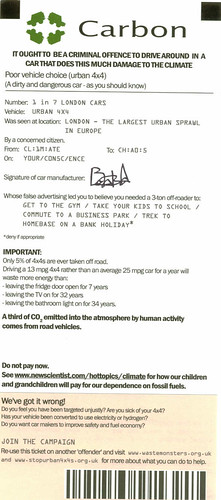
Ticketing 4WDs

.flickr-photo { border: solid 2px #000000; }.flickr-yourcomment { }.flickr-frame { text-align: left; padding: 3px; }.flickr-caption { font-size: 0.8em; margin-top: 0px; }


ticket, originally uploaded by natalieben.

I mentioned a couple of days ago that I’m a cyclist. One of the banes of my existence is ridiculously large vehicles, particularly 4WDs. (SUVs in American parlance.)

Many of their drivers seem utterly unaware of the poor visibility of these hulks, or indeed even of their real size – near had my shoulder taken off by a Hummer – yes a HUMMER! — in central London in the early hours of one morning.

But now I’m fighting back!

Above is a “parking ticket”, to be put on 4WDs – and I’ll be out on the prowl soon …

You can get your own copies from Alliance Against Urban Four x Fours.

There’s more good news on other fronts. In Sydney, a local council will charge more for parking 4WDs.

For a further take on the issue, the Sydney Morning Herald’s Spike column is running a series of reader comments. The best I’ve seen:

“Bill Rayner – after noting that a 2.6-tonne 4WD travelling at the speed limit has the same momentum as a 1.3-tonne sedan travelling twice as fast – had a question: ‘If a LandCruiser doing 70 kmh in a 60 zone can do the same damage as a mid-sized car going 140, why isn’t [the driver] thrown in jail for it?'”

And you don’t want to think about the damage it would do to a cyclist. Susoz pointed out in the comments on my last post on cycling that the home page of the lovely funny article to which I pointed explains that the author had been killed by a drunk driver. As she says, it does make your blood run cold. Then again even if you are in a steel-sided vehicle it may well not offer much protection in those sort of circumstances.

Miscellaneous

This week’s acquisitions

* The Emperor’s Giraffe and other Stories of Cultures in Contact, by Samuel M Wilson.

You can read his giraffe story, in which one is shipped from Bengal and the other from Africa to China here. It deals with the way in which China, apparently having the military/economic power to conquer the world, instead decided to draw back into itself. (A story also fascinatingly, if controversially, explored in Gavin Menzies’s 1421: The Year China Discovered the World, which concludes the Chinese fleet completed a global circumnavigation.)

The blurb says the book overall examines 23 moments in history “when two cultures previously unknown to each other, first came into contact. Focusing on individuals caught by chance in pivotal times and places, Wilson explores the ways in which seemingly small decisions made during the initial contact period between two cultures have had a huge impact on the course of history.” … not quite the “Great Man” theory of history, more like the “bumbling man”.

* Young Medieval Women, Katherine J. Lewis, Noel James Menuge and Kim M Phillips, which contains the delightful quote from a York ordinance of 1301: “No one shall keep pigs which go in the streets by day or night, nor shall any prostitute stay in the city.” (p. 172)

* The Creation of Feminist Consciousness: From the Middle Ages to 1870, Gerda Lerner

* The Diary of a Provincial Lady, E.M. Delafield, Virago, 2003, originally published in 1930, which is my current bedtime reading, a delightful text for that. Inevitably Delafield is billed as the “Bridget Jones” of the time, but she’s a much better writer, and very clearly feminist.

She is delightfully caustic about human behaviour (including her own) and the book is a wonderful lesson that you can write a great book about anything at all, even the most apparently dull, provincial life.

A sample:

“Receive a letter from Mary K. with postscript: Is it true that Barbara Blenkinsop is engaged to be married? and am also asked the same question by Lady B., who looks in on her way to some ducal function on the other side of the county.

Have no time to enjoy being in the superior position of bestowing information, as Lady B. at once adds that she always advises girls to marry, no matter what the man is like, as any husband is better than none, and there are not nearly enough to go round.

I immediately refer to Rose’s collection of distinguished Feminists, giving her to understand that I know that all well and intimately, and have frequently discussed the subject with them. Lady B. waves her hand – (in elegant white kid, new, not cleaned) and declares That may be all very well, but if they could have got husbands they wouldn’t be Feminists.

I instantly assert that all have had husbands, and some two or three. This may or may not be true, but have seldom known stronger homicidal impulse. Final straw is added when Lady B. amiably observes that I, at least, have nothing to complain of, as she always thinks Robert such a safe, respectable husband for any woman.

Give her briefly to understand that Robert is in reality a compound of Don Juan, the Marquis de Sade, and Dr Crippen, but that we do not care to let it be known locally.

Cannot say whether she is or is not impressed by this, as she declares herself obliged to go, because ducal function “cannot begin without her”. (p 56-57)

A tag:

Miscellaneous

Debt to the Arabs

Most of us learnt at some early stage that we use “Arabic numbers”, as opposed to the clunky Roman system of putting together Xs and Is. But from Jerry Brotton’s The Renaissance Bazaar I have just learnt just how great a debt our maths (and indeed accounting) owe to the East (and that they should apparently be called Hindu-Arabic numbers).

The man who brought many of the concepts and symbols to Europe was Leonardo Pisan, known as Fibonacci, who is 1202 completed is Liber annaci. He explained:

“I joined my father … as an officer in the customhouse located in Bugia [in Algeria] for the Pisan merchants who thronged to it. He had me marvellously instructed in the Arabic-Hindu numerals and calculation. I enjoyed so much the instruction that I later continued to study mathematics while on business trips to Egypt, Syria, Greece and Provence and there enjoyed discussions and disputations with the scholars of those places. Returning to Pisa I composed this book of 15 chapters which comprises what I feel is the best of Hindu, Arabic and Greek methods.”

He brought to Europe not only the numbers, but carefully explained the decimal point system and methods of addition, subtraction, multiplication and division – (he also brought the signs for these operations to Europe), and their application to commercial problems such as weights and measures, bartering, interest and currency exchange.

The term “algebra” comes from the Arabic for restoration “al-jabru”. The term “algorithm” comes from the Latinised name of the Persian astronomer Abu Ja’far Mohammed ibn Musa al-Khowarizmi.

(Pages 42-44)

A tag:

Miscellaneous

Beware Kyphosis Bicyclistarum

I’m a recent convert to cycling. I was lucky that my former employer was – once my fitness level and skills got to a reasonable level – only 20 minutes or so from home on two wheels, faster than any other method except for a taxi on a Sunday.

Then when I changed jobs it upped to 30 to 40 minutes, which covers about 5 miles. Hah, I hear the enthusiasts say, that’s crawling.

Well there are around 20 sets of traffic lights along that route, plus a section of the Thames path littered with dogs, tourists and small children. Some people do cycle it at road pace; I don’t trust my reflexes.

And the rest is through central London traffic – which is not as much of a problem as some suggest, since it is seldom going at any great rate, but between bendy buses (a nightmare – that is definitely not joined-up governmental thinking) and taxis that stop suddenly, to get a straight 500m run is a rarity.

To say cycling has changed my life would be a slight overstatement, but it has made me fitter than I’ve ever been before (not that I claim that is saying a lot), healthier, and generally happier. I cycle in any conditions short of icy – my “magic” fleece balaclava soon warms me up, and if I’ve worn it on an insufficiently cold day, cooks me.

Even on those days it is hard going, it is nice when you stop. That’s an emotion beautifully summed up by Zen and the art of fixing a flat tire [tyre]. (A belly-laughing hat-tip to One more cup of coffee, who is a real cyclist.)

It was from him that I also learned about the dreaded Kyphosis Bicyclistarum caused, they said in the 19th century, from bending over the handlebars.
From Manufacturer and builder
Volume 25, Issue 8, August 1893

“A word of warning is uttered by the well-known medical authority, London Lancet, which young men, and boys in particular, who have the ugly habit of riding the bicycle with a forward stoop, will do well to take seriously to heart. This pernicious habit is by some acquired unconsciously, and by others (and these constitute the larger number of examples) in foolish imitation of the stooping, or humped, posture of the professional racer. For those who are old enough to understand and appreciate the evil consequences of this unwholesome posture in wheeling, which robs the exercise of all its hygienic value, will need no persuasion to break themselves of it at once; while for the thoughtless boys, among whom the habit is most common, and, because of their immaturity, most injurious, the intervention of parental authority is urgently called for. “

There’s nothing new about health scares.

Luckily I’m safe from the affliction, since my back only allows me to ride in a “sit up and beg” posture. Looking on the Zen side, I say this is guaranteed to maximise wind resistance and therefore excercise.

Two tags: