Category Archives: Miscellaneous

Miscellaneous

This week’s acquisitions

The book sale is still on at the British Museum, and they’ve got lots of new stock …

* Oral and Literate Culture in England 1500-1700, Adam Fox, OUP – which was on my Amazon “to buy” list anyway – surprising that it is being remaindered.

*Philip Sidney: a double life, Alan Stewart, bought mostly because I’m interested in his sister, Mary, Countess of Pembroke, the poet.

From it I learned that their grandmother “had been a learned woman, taught by the famed Spanish humanist Juan Luis Vives. In 1553 she commissioned two tracts by the scientist John Dee: ‘The Philosophical and Poetical Original occasions of the Configurations & names of the heavenly Asterisms’ and ‘The true cause & account (not vulgar) of Floods & Ebbs.’ Evidently encouraged by her mother, the young Mary Dudley [the poets’ mother] was taught penmanship and learned Latin and French (as witnessed by her annotations on her copy of Hall’s Chronicles). She also spoke fluent Italian and, like her mother, corresponded with Dee.” P. 40

I also note that one of Philip’s tutors in 1572 and 1573 was “Mistress Maria, the Italian” – interesting a woman tutor (p. 41)

* Shame and Necessity, Bernard Williams. He takes on what he describes as the “progressivist” view of philosophical development – “the Greeks had primitive ideas of action, responsibility, ethical motivation and justice, which in the course of history have been replaced by a more complex and refined set of conceptions that define a more mature form of ethical experience”. (p. 5)

He says in the introduction that Nietzsche has a lot to offer on the subject, in addition to the famous “The Greeks were superficial out of profundity”, noting that: “One thought that impressed Nietzsche was that in lacking some kinds of reflection and self-consciousness the Greeks – whom he was willing to compare to children – also lacked the capacity for some forms of self-deceit.” (p. 10)

But, “rejecting the progressivist view … had better not leave us with the idea that modernity is just a catastrophic mistake and that outlooks characteristic of the modern world, such as liberalism, for one are mere illusion. As more than one philosopher has remarked, illusion is itself part of reality, and if many of the values of the Enlightenment are not what their advocates have taken them to be, they are certainly something.” (p. 11)

Isn’t it wonderful – and oh so rare – to read a philosopher writing in comprehensible English!

My evening is now mapped out … with Bernard.

Night!

P.S. Should add, in case I sound excessively scholarly, my final purchase of the week was Colin Watson’s Coffin Scarcely Used, a pleasant rush through a Thirties English body-strewn town – plot definitely Christie-ish, but with wry, subversive humour all his own. He’s not nearly as good as Dorothy L. Sayers, on whom I have rhapsodised elsewhere, but miles above most of his contemporaries.

And that’s what I spent the first half of the evening reading, while recovering from a squash game.
(a tag)

Miscellaneous

Feminist miscellany

First and most importantly, defending abortion. Below is posted, as advised by Rad Geek, a small contribution to a “Google bomb” to get an appropriate Google response to the search “Roe v Wade”.

Anti-abortion ideologues beware: I’m promoting objective, factual information on:
Roe v. Wade
abortion

You can too. Join me in Bombing for Choice.

America is the obvious example of why women have to be vigilant in defending abortion rights, even when they have seemingly been secure for decades, but Australia provides a further warning.

************

More cheerfully, some women who really made the news, often against all of the odds:

“… Despite the fact that women were restricted from applying for some jobs ( the ban on female General Trainees was only lifted in 1960) they were responsible for some of the BBC’s most famous news programmes.

In 1950, Grace Wyndham Goldie pushed the BBC into covering the General Election, she championed the first party political broadcasts and Budget programmes before re-launching Panorama in 1955 and developing Tonight in 1957.

In radio, two women (Janet Quigley and Isa Benzie) saw through the development of the Today programme which was launched in 1957. Isa Benzie was the first producer and inventor of the programme’s title.

It was in 1957 that the first woman read the news in the BBC Television Service: Armine Sandford, one of a team of four who presented the West Region’s daily television news bulletins from the Bristol studios.

But it was a long while before women were allowed to read the national news. Nan Winton was tried as a newsreader in June 1960 but soon axed. …”

************

How did the “Victorian” change into the “modern”? This essay about Kate Chopin’s 1899 novel The Awakening suggests one woman writer of the period might have some of the answers …

For feminist scholars, the text is especially rich because its female author explores and negotiates a fluid border of literary tradition — examining and playing with, alternately embracing and backing away from, the Victorian literary foremothers’ version of “domestic fiction” and the up-and-coming, largely male-dominated, Modernist movement. Chopin as an author, like Edna as a character, is a woman caught in the borderlands between the literary traditions assigned to her as a nineteenth century female writer and the mores of a new era.

************

I’m not really a fan of the Impressionists, but if you are, as well as knowing about Monet, Renoir, et al, you should also know about Berthe Morisot. There’s a new exhibition about her at the (American) National Museum of Women in the Arts.

************

If you are planning to read Simon Goldhill’s Love, Sex, and Tragedy. How the Ancient World Shapes Our Lives, which I am one of these days, an essential accompaniment and corrective, it seems, is this excellent review. Also a useful response to the claim we “don’t need women’s history now, because it is included everywhere”.

************

For anyone alarmed by the Telegraph story about women in Germany being “forced” to work as prostitutes or face a benefit cut, here’s a pretty reasonable debunking. The old story, if you think an account is unbelievable, it probably is.

************

Whew, now I’m on top of my inbox again …

(a tag)

Miscellaneous

Not for cat-lovers

.flickr-photo { border: solid 2px #000000; }.flickr-yourcomment { }.flickr-frame { text-align: left; padding: 3px; }.flickr-caption { font-size: 0.8em; margin-top: 0px; }


cat, originally uploaded by natalieben.

Yes, Friday cat blogging, but not as you know it. Be warned!

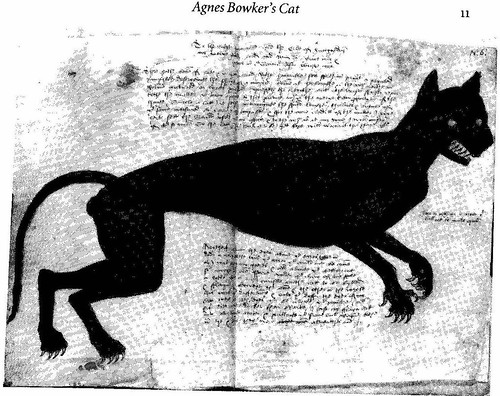
It was 1568. Agnes Bowker, 27, daughter of the late Henry Bowker of Harborough, Leicestershire,, a spinster and domestic servant in the same town, found herself with a difficult, but hardly unusual problem – she was pregnant.

Cast out by her employer when her predicament became evident, she seems to have wandered the countryside until on the 16th of January the following year she gave birth, after an apparent gestational period of 53 weeks, with in attendance a midwife and several “gossips” (female matrons).

This, however, is where the story gets very strange indeed. For she gave birth, it seemed, to a “monster”, as she called it, or what was clearly a cat, as forensic examiners saw it.

Based on her later testimony, the father might have been another servant, Randal Dowley, who suspiciously fled the area and was never heard from again, it might have been an apparently shape-shifting beast that assumed the form of a cat, a bear or a man, or a sinister schoolmaster, Hugh Brady.

It seems pretty clear, to me anyway, that she was covering up either a late abortion or infanticide. Panic-stricken, she doesn’t seem to have thought that this was not a way of quietly covering up what she had done.

That, tragically, in 2005, some girls or women should still find themselves in the same situation is evidenced by the recent discovery of a baby’s body on Teeside. I heard on a radio that a girl, 15, had come forward.

But anyway, back to the history – Agnes’s tactic eventually worked, in that she escaped punishment – which could have been the rope for infanticide – and disappeared back into history.

One of the remarkable things about this case, and there are many, is the way the local official charged with investigating the case, Anthony Anderson, went about his work.

His is the drawing of the “monster” above, done with meticulous forensic care. “This picture … containeth the full length, thickness and bigness of the same, measured by a pair of compasses.”

The townsfolk had already dissected it, and found a piece of bacon in its throat that obvious convinced most of the men that this was just a piece of trickery.

Now the official charged that another cat be killed and flayed, so that its shape could be compared to the “baby”. He found the only difference was in the colour of the eyes. “I cast my flayn cat into boiling water, and pulling the same out again, both in eye and else they were altogether one.” (p. 21)

Surprising is the matter of fact “scientific” way he attempted to establish the facts. Was this the perhaps surprisingly early spread of the scientific method out into the countryside, or simply an application of rural commonsense?

Less unexpected was the political use that the appearance of this “apparition” was put; with Elizabeth only uncertainly on the throne, and religious uncertainty still rife, Such births showed something was wrong in the nation, and God was sending a sign to say: “Fix it.”

This is the title story in the book by David Cressy from which I posted that nice collection of curses yesterday.

Sharon asked me a couple of weeks ago what I think of it. Well it has some wonderful stories and period detail, as this story suggests, but I do find it curiously lacking in theory or even a coherent approach.

There’s a nod to “postmodernism” at the start, but it seems to take this to mean just presenting competing narratives without attempting to draw any distinctions between them, a rather simplistic idea of the approach.

Associated is an expressed desire not to draw conclusions, although as the book progresses it is increasingly dotted with them, often it seem to me on very flimsy grounds.

On factual topics on which I have some knowledge I also have some doubts. e.g. on p. 66-67 “A variety of medicines was used ‘to bring down or provoke a woman’ flowers’, to stimulate menstruation, or ‘to hasten the bringing forth’ of a child from the womb and this knowledge was widely distributed through printed herbals and through women’s lore.”

The reference given for this is John M Riddle, Contraception and Abortion from the Ancient World to the Renaissance; and possibly David Cressy, Birth, Marriage and Death: Ritual, Religion and the Life Cycle in Tudor and Stuart England 47-50).

But this seems to contradict everything I’ve read on this issue, which says while the midwife’s oath included a promise not to use such substances – suggesting they were known to exist – such dangerous, illegal knowledge was never written down.

Can anyone comment on that?

A tag:

LATE ADDITION: I notice that “Ephelia” has just posted on another similar case, that of Mary Toft, who claimed to have given birth to rabbits (having apparently experienced a series of miscarriages).

Miscellaneous

Have a good swear

Was woken this morning by a phone call about a problem at work, sleepwalked my way through a yoga class, and am now wondering what life would be like without living in a perpetual state of sleep-deprivation.

I can remember waking up about three weeks ago one day before the alarm went off, having had more than nine hours sleep and it really felt odd – good, but odd. I don’t get many opportunities to follow Isobel’s advice.

So that might be influencing this post, although hasty reassurance to any workmate reading, this is not directed at you.

Agnew Bowker’s Cat: Travesties and Transgressions in Tudor and Stuart England, by David Cressy, has a lovely little collection of the abuse vented by clergymen at their congregations in the 17th century:

* Directed at someone who put his hat on during a sermon (maybe his head was cold?): “lob, saucy goose, idiot, widgeon and cuckoo, scabbed sheep, none of my flock”

* The whole congregation: “sowded pigs, bursten rams and speckled frogs”; or, “black mouthed hell hounds, limbs of the devil, fire brands of hell, plow joggers, bawling dogs, weaverly jacks and church robbers. If I could call you worse I could.”

* When members protested about ceremonial changes: “black toads, spotted toads, and venomous toads, like Jack Straw and Wat Tyler”. (all p. 157)

Nice to know they were restrained by being “men of God”.

Translations: lob – a lazy, clumsy person, a lout; widgeon – a type of duck (although I don’t know why it is a term of abuse); “bursten ram” – perhaps a reference to diseased genitals?; plow joggers (a term of abuse that continued into the 19th century and I guess means roughly “peasant”; weaverly jacks????

This reminds me of an Australian play that I read for my HSC. I can’t of course remember the title or the author, but I do remember it was set in the early 20th-century federal parliament and involved lots of unparliamentary language of a colourful sort. It was where I learnt the world scrofulous, which does roll off the tongue beautifully as an insult. Anyone recognise the play?

A tag:

Miscellaneous

Why so mean?

Fitting in neatly with the book I discussed yesterday about the “school slut” is another, a recent academic remainder purchase, Odd Girl Out: The Hidden Culture of Aggression in Girls, by Rachel Simmons.

It argues that arising out of the strong pressures on girls to be “good” and “nice” is a resultant inevitable nastiness, in the form of bullying as a means to express anger. This takes the form not of physical or even direct verbal aggression, but the use of “sly”, “mean” tactics – being nice to someone for one day then cold-shouldering them without explanation, spreading rumours (eg about sexual behaviour, as per yesterday’s book) about someone behind their back.

What makes this so particularly damaging is that the victim of the bullying feels that she must have done something wrong, there must be something wrong with her, to attract this sort of behaviour from her “friends”.

A sixth-grader is quoted: “Most teachers think, ‘Oh well, she’s not hurting you. Don’t worry about it.’ But really they are hurting you. They’re hurting your feelings.” (p. 47)

The book argues: “We need to freeze those fleeting moments and name them so that girls are no longer besieged by doubts about what’s happening, so that they no longer believe it’s their fault when it does.” p. 37.

Definitely a book teachers, and probably parents of girls, should read – not that it offers many helpful suggestions about what that can be done about it. But it might at least help adults to understand why the problem is so serious for the victims.

I largely avoided this problem by dropping out from all contact with my peers from about grade four onwards, but as an “outsider” over the years I was sometimes the person the bullied victim came to as a “safe haven”. At my private all-girls’ high school the interaction was frequently vicious.

(a tag, if I’ve understood the explanation properly!)

Miscellaneous

The school slut

Now I think about it, every school, college and similar collection of adolescents or young adults with which I have been involved had a school slut, or, to be more precise, had a girl or woman identified as such.

At primary school, there was Sharon* who, reputedly, would let you watch her kissing boys if you paid her. She was the only one of us who came from a working-class, perhaps even under-class background. She was different, and was so labelled.

At high school, there was Melinda, who when I look back now was almost certainly a victim of some form of abuse. She claimed never to be able to do PE because she wasn’t wearing any undies (knickers), claimed to have had sex with boys in railway waiting rooms. She disappeared for unexplained reasons in Year 11.

Later, as a tutor in a university college, I overheard a young man of 20-odd hotly denying that he had intercourse with Sue, the college slut, supposed to have slept with just about every male there, and usually seen in a angry drunken condition very early at any event. He had a reputation as a lady-killer, and that was all to his benefit in the student hierarchy, but he obviously thought sleeping with Sue would lower that. “She only slept on my floor,” he said. He obviously wasn’t believed.

I was moved to muse on this by Fast Girls: Teenage Tribes and the Myth of the Slut, by Emily White, which documents the phenomenon in America. She documents how girls who develop secondary sexual characteristics earlier than their peers, those who are, like Sharon, of a different class to their peers, who have unusual family set-ups, who stand out even in ways that would seem to have no particularly link to sexuality, can suddenly be labelled; the same stories – particularly “the football team myth” told about them.

It is The Lord of the Flies, with sex.

And of course there is so much around today, as always, to support this demonisation, while a boy who sleeps around is utterly different, a Don Juan, as in my college case, someone to be admired.

White quotes the alarming example from 1930 of the Catholic “philosopher” Dietrich Von Hildebrand, who wrote In Defense of Purity that the “loose” woman is indulging in a “significant squandering of self” and when a man sleeps with a loose woman he enters a “mystery of terrible sin” in which he is in danger of losing his soul. “In this black-hearted woman’s embrace, man is in the grip of a ‘diabolically evil lust’.” (p. 90)

It is noticeable that White doesn’t quote modern authors along these lines – although reading all of the posts Feminist Blogs about abstinence-only sex “education” in the US I bet she could have found plenty. If she was trying to avoid controversy and to get the book read in places where it might do some good, I can only sympathise.

Some of White’s case studies just make you want to cry. She’s reporting on a boring school assembly at which the pupils start to talk among themselves.

“The rumour goes like this: Heather Adams masturbates. Pass it on!

The rumour begins among the jocks behind me. Soon it has been heard by a dozen kids or more. Pass it on, pass it on. Over and over the phrase is repeated, cupped hands touching ears, the whisper as loud as a stage whisper: “Heather Adams masturbates. Pass it on!”

“Gross!” says the female recipient of this news, a red-faced beanpole. She hesitates for a moment, then whispers the news into the ear of the girl sitting in front of her . “Are you kidding?” the girl shouts. “She is soooo sick!”

The rumour moves west through the crowd. The point of the rumour, its defining quality, is that it moves. The rumour can’t stop. It’s a hot rock that must be passed quickly before it begins to burn.” (p.33-34)

When I compare this to my post a couple of days ago on ancient Roman sex – a gift of Venus to be enjoyed by all – I can only think that Christianity has an awful lot to answer for.

*It was a long time ago, but I’ve changed all these names just in case.