Category Archives: Miscellaneous

Miscellaneous

Christmas at Sevenoaks

I spent the festive days with the family of a friend at Sevenoaks – lovely food, wine and company – and excellent presents, books and the makings of some seriously luxury baths. It was the first Christmas I’ve done in about 10 years, so quite a novelty.

I also learnt a little about the history of a town now known most as a commuter suburb of London. (It was the only place I know of in Britain where the trains were running on Boxing Day – such an odd concept there is of stopping public transport on the days when many people just have to get around.)

There’s an outline of Sevenoak’s historyhere. Most famous is Knole House, best known as the home of Vita Sackville-West, although it has plenty of other historical associations.

There are many Tudor notes in the region – it was handy for London but definitely “country” then, and from those times onwards everyone who was everyone seems to have passed through.
Miscellaneous

Christmas at Sevenoaks

I spent the festive days with the family of a friend at Sevenoaks – lovely food, wine and company – and excellent presents, books and the makings of some seriously luxury baths. It was the first Christmas I’ve done in about 10 years, so quite a novelty.

I also learnt a little about the history of a town now known most as a commuter suburb of London. (It was the only place I know of in Britain where the trains were running on Boxing Day – such an odd concept there is of stopping public transport on the days when many people just have to get around.)

There’s an outline of Sevenoak’s historyhere. Most famous is Knole House, best known as the home of Vita Sackville-West, although it has plenty of other historical associations.

There are many Tudor notes in the region – it was handy for London but definitely “country” then, and from those times onwards everyone who was everyone seems to have passed through.

Miscellaneous

Jane Austen, aged 12

.flickr-photo { border: solid 2px #000000; }.flickr-yourcomment { }.flickr-frame { text-align: left; padding: 3px; }.flickr-caption { font-size: 0.8em; margin-top: 0px; }


Austen, originally uploaded by natalieben.

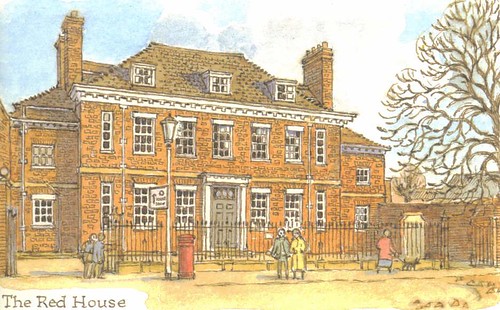
… was one of Sevenoaks to-be-famous visitors, staying with her uncle, Francis Austen, at The Red House, above, in 1788.

The house dates to 1686 and between 1688 and 1734 was home to a Dr Fuller, famous for personally testing all of his remedies before he used them on his patients.

From a book of watercolours, Ann Kearn’s Sevenoaks, text by Patrick Harper, Foxprint, 1992.

Miscellaneous

Jane Austen, aged 12

.flickr-photo { border: solid 2px #000000; }.flickr-yourcomment { }.flickr-frame { text-align: left; padding: 3px; }.flickr-caption { font-size: 0.8em; margin-top: 0px; }


Austen, originally uploaded by natalieben.

… was one of Sevenoaks to-be-famous visitors, staying with her uncle, Francis Austen, at The Red House, above, in 1788.

The house dates to 1686 and between 1688 and 1734 was home to a Dr Fuller, famous for personally testing all of his remedies before he used them on his patients.

From a book of watercolours, Ann Kearn’s Sevenoaks, text by Patrick Harper, Foxprint, 1992.

Miscellaneous

A bit of convict blood

… actually I almost certainly haven’t got any (unfortunately, since it is now fashionable), but having just finished the Australian seasonal phone calls I thought I’d share this lovely story of a woman probably fairly described as “spirited” who twice cheated the hangman before making a success of life in Australia.

Margaret Catchpole was the sixth child of a labourer in Suffolk, and she became a servant of John Cobbold, an Ipswich brewer, promptly saving one of his children from drowning. But she then fell in love with a boatman whose day job disguised his smuggling. To keep a tryst in London she donned sailor’s clothes and stole a horse from her employer’s stable. She was caught as she sold it in London.

Back in court in Bury she was sentenced to death, but her employer’s vigorous intervention had that converted to seven years in jail. Three years into that sentence, with the aid of her lover, she broke out, “in a very bold manner” letting herself down from the spikes on the wall. She was about to board her lover’s vessel – probably in male disguise – when a scuffle broke out in which her lover was killed.

Once again she appeared before Bury Assizes and once again Chief Baron Macdonald sentenced her to death, but again this was commuted, now to transportation for life. She sailed for Botany Bay in May 1801.

There she eventually married a prosperous settler, but she did not forget her old friends, sending back curiosities from Australia, and she remains locally famous in Ipswich, with – that ultimate English fame – a pub named after her. In Australia she has the wing of a maternity hospital, for it seems there she became a midwife.
(Taken from The English Abigail, Dorothy Margaret Stuart, Macmillan, 1946.)

More here and here. And it seems the story was made into a movie in 1911 and inspired a play.

Miscellaneous

A bit of convict blood

… actually I almost certainly haven’t got any (unfortunately, since it is now fashionable), but having just finished the Australian seasonal phone calls I thought I’d share this lovely story of a woman probably fairly described as “spirited” who twice cheated the hangman before making a success of life in Australia.

Margaret Catchpole was the sixth child of a labourer in Suffolk, and she became a servant of John Cobbold, an Ipswich brewer, promptly saving one of his children from drowning. But she then fell in love with a boatman whose day job disguised his smuggling. To keep a tryst in London she donned sailor’s clothes and stole a horse from her employer’s stable. She was caught as she sold it in London.

Back in court in Bury she was sentenced to death, but her employer’s vigorous intervention had that converted to seven years in jail. Three years into that sentence, with the aid of her lover, she broke out, “in a very bold manner” letting herself down from the spikes on the wall. She was about to board her lover’s vessel – probably in male disguise – when a scuffle broke out in which her lover was killed.

Once again she appeared before Bury Assizes and once again Chief Baron Macdonald sentenced her to death, but again this was commuted, now to transportation for life. She sailed for Botany Bay in May 1801.

There she eventually married a prosperous settler, but she did not forget her old friends, sending back curiosities from Australia, and she remains locally famous in Ipswich, with – that ultimate English fame – a pub named after her. In Australia she has the wing of a maternity hospital, for it seems there she became a midwife.
(Taken from The English Abigail, Dorothy Margaret Stuart, Macmillan, 1946.)

More here and here. And it seems the story was made into a movie in 1911 and inspired a play.