Category Archives: Miscellaneous

Miscellaneous

In the flesh

.flickr-photo { border: solid 2px #000000; }.flickr-yourcomment { }.flickr-frame { text-align: left; padding: 3px; }.flickr-caption { font-size: 0.8em; margin-top: 0px; }
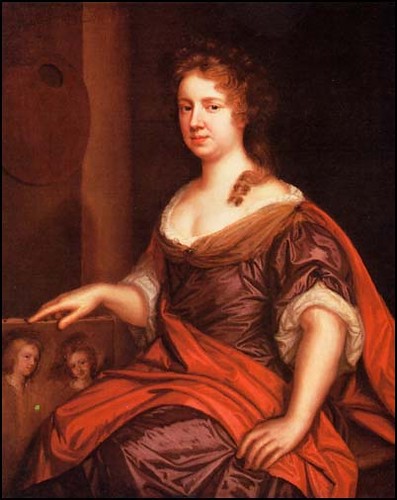

beale, originally uploaded by natalieben.

Popped into the National Portrait Gallery today for half an hour to commune with the Stuarts, and was rewarded with the discovery that they’ve hung this self-portrait by Mary Beale, the first professional female painter in England.

I’ve only previously seen it in reproduction. The first surprise was its size – this is a huge, impressive canvas (an impression magnified by the heavy gilt frame).

The drapery of her dress and shawl is impressively detailed – it is thick, stiff and shiny. Would you call it a taffeta? If so a little research suggests it would then have been made of silk and very expensive.

The painting is subtly lit from the right of the frame (as you look at it), and a shadow thrown on the wall to the left.

This was painted, it is thought, as a showpiece for her work, just before she set up her professional studio, which was managed by her husband – you could almost call him one of the first house husbands. The companion painting of him is in Bury St Edmunds.

And what I find surprising is that none of their friends, in the clergy or the Royal Society, seem to have found it odd that she was effectively supporting him financially.

But she’d be pleased to be hung in such august company today – Room 6 — with Boyle, Harvey and other scientific luminaries.

She has other works in the National Portrait Gallery.

She is also supposed to have painted a portrait of Aphra Behn. If anyone knows anything about that I’d love to hear it.

Miscellaneous

America’s non-existent ‘war on terror’

An informative interview with Michael Scheuer, who served in the CIA for 22 years, until this year. He was the Chief of the bin Laden Unit at the Counterterrorist Center from 1996 to 1999.

“I think al-Qaeda is probably in good shape. One of the problems facing the U.S. intelligence community is that it continues to regard al-Qaeda as a terrorist group rather than an insurgent organization and we have never really constructed an order of battle for the organization. We only know of the leadership. And when U.S. politicians say that we have destroyed two thirds or three quarters of the leadership, what they are really alluding to is al-Qaeda’s casualties based on the information available in the immediate aftermath of 9/11. There are a lot of people who we just don’t know about and moreover al-Qaeda has demonstrated a remarkable capability to replenish its losses.”

“I don’t think Afghanistan and Pakistan are denied areas to al-Qaeda. There are very few U.S. troops in Afghanistan and the warlords control many of the areas. The tribal areas in Pakistan, save for South Waziristan, are not controlled by the Pakistani government. You can make the assumption that Afghanistan and Pakistan are denied areas but really the only thing you can be sure of is that they are not where U.S. forces or Pakistani forces are. I mean al-Qaeda and the Taliban can operate with relative ease in the tribal areas of both countries. And because a lot of national reconnaissance systems have been focused on Iraq, we don’t have that many resources to track these people from space.”

“This is perhaps my wishful thinking, but I think if we made some tangible changes to our relationship with Israel, started a serious discussion on securing alternative energy resources and refused to gratuitously support Putin’s actions in Chechnya, that would give America an opening. Maybe then people would actually start listening to what we are saying. The problem is we don’t even have an audience in that part of the world right now.”

“We appear to be in a temporary phase where the current Administration looks at the world as it wants it to be and not as it is. Likewise, the Administration seems to be making it clear that it is not interested in analysis from its intelligence community if that analysis doesn’t mesh with or support the Administration’s views, policies, and perceptions. As a result, open-source publications have become by default the conveyor to the public of information and analysis on what is really happening in the world. America’s citizens certainly need this information. I also believe that many professional intelligence officers will welcome such publications because they themselves are unable to present the world as it is to senior government officials.”

Miscellaneous

Good news!

From the Sydney Morning Herald:

“A ban on smoking on Sydney’s popular Bondi, Bronte and Tamarama beaches came into effect today and may be extended. Waverley Council Mayor Peter Moscatt said under the ban, one of the first in Australia, smoking on the sand will be prohibited but other nearby areas may follow.”

Having just about lost my voice and suffering from creaky-feeling lungs, the effects of the smoke level at the office party last night, I can only croak: “Yippee.”

I’ve been saying for years that governments would finally ban all public smoking only when I was just too old to enjoy it, but maybe I’ll get a few years of clean-air pubs and restaurants – the Blair government being timidly headed in that direction.

Then if they’d just ban smoking on pavements (footpaths), so that when cycling peacefully along the road you don’t suddenly cop a lungful …

Miscellaneous

An independent-minded woman

Today I met Mitbahiah, a 6th-century BC Jewish woman living in southern Egypt. She lived in a remarkably egalitarian world: “a woman could readily divorce her husband, with or without his consent. From other documents, we know that a woman could exercise this right by “standing up in congregation and merely declaring ‘I divorce my husband’.”

Mitbahiah, who seems to have been a shrewd investor, also had a full economic life; lending money to her father that was eventually partially repaid by the transfer of a house. She also did rather well out of her three marriages, the middle of which was outside her community, to an Egyptian official. She got to keep all of the wealth she had taken into the union, and half of his when she left, after less than 12 months.

From Al-Ahram Weekly, via The Head Heeb, a fascinating occasional blog by a scholar studying Jewish history.

Miscellaneous

Meme of misery

From Early Modern Notes, described as a “meme with a difference”:

1. Grab the nearest book.
2. Open the book to page 123.
3. Find the fifth sentence.
4. Post the text of the sentence in your journal along with these instructions.
5. Don’t search around and look for the “coolest” book you can find. Do what’s actually next to you.

So I did: from Diary of Mrs Kitty Trevylyan: A Story of the Times of Whitefield and the Wesleys, 1866: I’ve bolded the relevant sentence but left in those around it for context.

“This morning two gentlemen who were calling on papa were lamenting the degeneracy of the times.

One was an old general, and he said —

“We have no heroes now — not a great soldier left. Since Marlborough died, not an Englishman has appreared who is fit to be more than a general of a a division ….

“My great-uncle, a Fellow of Brazennose, took up the wail. ‘No indeed he said; the ages of gold and iron and brass are over; the golden days of Elizabeth and Shakespeare, and the scattered Armada; the iron of the Revolution (for rough as they were, these men were iron; the brass of the Restoration ; and now we have nothing to do but beat out the dust and shavings into tinsel and wire.”

“We have plenty of wood at least for gallows,” interposed my brother Harry. “Cartloads of men are taken every week to Tyburn. I saw one myself yesterday,”

“For what crimes?” asked the general.

“One for stealing a few yards of ribbon; another for forging a draught for £50,” replied Harry.

“Ah,” sighed the general, “we have not even energy left to commit great crimes!”

Oddly enough, Sharon also managed to get to a hanging, or at least a sentence therefor.

Perhaps others can find something more cheerful, although this passage does make me think about something universal in human nature – the memories of the “good old days”.

Miscellaneous

The damage done by sexual repression

To the Almeida theatre this evening, for The Earthly Paradise:

“June 1871. William Morris spends summer in Kelmscott, Oxfordshire in the company of Dante Gabriel Rossetti and their beloved Janey – the wife of one and muse of the other.

It seemed that they had found their ideal, in harmony with nature, a garden of earthly delights. But cynics whispered that the move from London was to conceal the very Pre-Raphaelite affair between Janey and Gabriel… ”

An excellent, if very showily theatrical show. If you are planning to go, you might want to stop now …

If not, then I can say that although it focuses for much of its length on the two men, the enthusiastic, boyish Morris, and the self-consciously arty, dramatic Gabriel, it turns out in the end to be largely about Janey, and how both have treated her for their own ends. William wanted to self-sacrificingly throw her into his friend’s arms (he only married her originally because the already committed Gabriel couldn’t). Gabriel wanted to worship her “purely” from afar, and reacted to the opportunity by pushing her away, driving himself mad in the process.

(Of course in the background is his relationship with his dead wife Lizzie, to which there is a famous story attached – he buried the only copy of his poems with her, guilty over neglecting her for his work when she lived, then seven years later had her exhumed so he could get them back.)

Janey is, we eventually learn, tormented by this – tormented by her desire for Rossetti (which she is not supposed to feel as a Victorian woman), and also tormented by her feelings of being out of place, since she was dragged up from being a stableman’s daughter to being a “lady” by these two men for their own purposes, having had no real say in the matter herself.

This of course is the (male) playwright’s view – and quite a feminist one it is too. But it seems to be close to the facts, at least in outline, see for example here.

See also the Rossetti archive. I found one webpage about her.

P.S. I should say that after my brief post on Aphra Behn, Sharon on Early Modern Notes compiled a whole web bibliography – definitely worth checking out.