Category Archives: Miscellaneous

Miscellaneous

Gwen John, adventurer

To the Tate Britain for the Gwen John and Augustus John exhibition, much and justly praised, for its art and its social documentation.

He was, of course, much the better known and regarded during their lifetimes – all sorts of extravagant praise was heaped on him (no doubt to his detriment), but to my eyes, while he could certainly draw, most of his paintings are no better than local “art show and fete” jobs. (He is support for the theory, which I learnt about here, that technical skills are not necessarily good for an artist at the start of their career.)

She, however, from quite early on, was striving towards the intellectually original and technically perfect, as is now being recognised.

It seems odd in some ways, that what she arrived at was small, “domestic”, self-contained scenes, often described as very prim and “womanly”, while she was actually living a life of almost total freedom. She was a model for and lover of Rodin, and in her adult life always lived alone, by choice, supporting herself by her art and her nude modelling for artists. (Even today many still find this desire to live alone odd; I know I’m regularly told so!)

A review of the exhibition can be found here.

I was unable to resist the biog in the bookshop (Gwen John, a life, by Sue Roe, Vintage, 2002), an author who must have had a wonderful job, since huge quantities of her letters and those of her circle survive.

One of her earliest oils was of Mrs Atkinson, the cleaning lady. “She used to greet her affectionately with a kiss, shocking Edna Waugh’s sister Rosa into … ‘All barriers of differing class and occupation were silently shattered by the sight of that simple act.’ (p. 21)

She and Dorelia, her brother’s mistress, set out together to walk to Rome. “Augustus … thought they should pack a pistol. But Gwen would not listen ‘she never did.’ They set off that August ‘carrying a minimum of belongings and a great deal of painting equipment’. … They began the long walk up the River Garonne … Gwen sent home evocative accounts of their journey, lyrical descriptions of the evening light along the west coast of rural France; incidents involving the locals and bizarre, nocturnal adventure. In the villages they drew the locals for a few centimes … They lived on bread, grapes and beer, and spent their time fending off strange men who tried to take them on detours.” (p. 38) This, for a solicitor’s daughter in 1903 (albeit one who had a relatively unconventional, motherless childhood) is amazing stuff!

The painting she did of Dorelia, entitled “The Student”, after they had settled briefly in Toulouse, is one of the finest of her early works. They didn’t make it to Rome, however; but headed instead for Paris (probably because of a man Dorelia had met, although Gwen later helped get her back for her brother.)

A collection of her work can be found here.
Miscellaneous

Keeping up with the 15th century

Proving there is nothing new about keeping up with the Joneses …

A letter from Margaret Walkerne to her stepfather, Robert Armburgh, c. 1430:

My dear and well beloved father, I commend me to you, doing you to wit that I have but a little while to go and am like within a short time with the grace of God to be delivered of child.

And for as much as ladies and gentlewomen and other friends of my mother’s and mine are like to visit me while I lie in child bed and I am not purveyed of honest bedding without the which my husband’s honest [honour?] and mine may not be saved, and also my friends have been put to so grievous costs and importable changes through entangling of their adversaries, and my husband is new come into his lands and is but bare and as yet hath little profit taken thereof and hath laid great cost on his husbandry that they may not acquit your good fatherhood that you would vouchsafe in saving of mine husband’s worship and mine to lend me two marks [13s 4d] or twenty shillings unto the next term [rent[ day that my husband’s farm comes in, and then with the grace of God you shall be well and truly paid again. I can no more at this time.

(You can take a breath now – they weren’t big on full stops then.)

From Letters of Medieval Women, A. Crawford (ed) Sutton, 2002, Thrupp, p. 39-40.

The commentary says it is not known if her stepfather was able to oblige, since “he and her mother were in serious financial difficulties over a legal case and the expense of Margaret’s wedding, so she may have had to put a brave face on it and receive her visitors with what she had”.

For those not up on these times it is worth noting that clothing (and bedding) then was very expensive, particularly the fine stuff Margaret obviously wants.

Much more could probably be found in The Armburgh Papers: The Brokholes Inheritance in Warwickshire, Hertfordshire and Essex, c.1417-c.1453, Woodbridge, 1998.

Miscellaneous

Friday cat blogging

.flickr-photo { border: solid 2px #000000; }.flickr-yourcomment { }.flickr-frame { text-align: left; padding: 3px; }.flickr-caption { font-size: 0.8em; margin-top: 0px; }


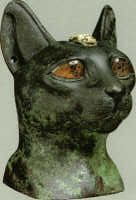
egyptiancat, originally uploaded by natalieben.

I’m far more of a dog person than a cat person, but since it is a blog tradition, I thought I’d share this late Egyptian example. (I’ve misplaced the original image but it was either 24th or 26th dynasty.) This is from the exhibition on which I posted earlier in the week.

Should you prefer the dog option, Barista pointed me to a wonderful OTT dog blogging site here.

Or you can visit the Battersea Dogs’ Home rehoming page – as I wistfully do regularly. My Beanie died in February and I’m really ready for another dog, but practical reasons mean I should wait another five months. Should I suddenly start dog blogging in earnest, you’ll know, however, that practicality lost.

(So as not to be speciest, I’ll also point you to the cats for rehoming. I should also say that the dogs advertised on the site are the most difficult to rehome – you can also get poodles, spaniels, labradors etc there.)

Miscellaneous

Advertising women’s efforts in 1898

An advert in this week’s London Review of Books took my fancy. It was for Transforming the Public Sphere: The Dutch National Exhibition of Women’s Labor in 1898, by Maria Grever and Berteke Waaldijk.

From the blurb: “In 1898, the year Queen Wilhelmina of the Netherlands was inaugurated, five hundred women organized an enormous public exhibition showcasing women’s contributions to Dutch society as workers in a strikingly broad array of professions. The National Exhibition of Women’s Labor, located in The Hague, was attended by more than ninety thousand visitors. Maria Grever and Berteke Waaldijk consider the exhibition in the international contexts of women’s history, visual culture, and imperialism.”

Antoinette Burton, from the introduction: “Despite the veritable explosion of historical work on exhibitionary culture in the last decade, relatively little attention has been paid to the role of women in organizing the transnational spectacles that dominated the culturescapes of imperial modernity . . . . Transforming the Public Sphere . . . offers an important corrective to this oversight.”

So often we talk about women being excluded from the public sphere, yet here was a very public demonstration of their economic roles.

For once this is an “academic” book that is not ridiculously expensive – £18.50 on AmazonUK and $23.95 in the US.

More on the book here, and an essay by one of the book’s authors on an aspect of the exhibition here. And another essay is here.

Wikipedia also tells me that: “The first scientific society for women was founded in Middleberg, a city in the south of the Dutch republic, in 1785.” I couldn’t find any more; anyone know a good general source (in English) for the Dutch women’s movement?

Miscellaneous

A family of strong women

I’ve been a bit quiet lately – rough couple of days – so I decided to find a nice positive tale.

So to the story of Eleanor Bennett of Lyme Regis, who was left a widow with six children, three boys and three girls, the oldest 11 and the youngest just one, on 17 May 1837, when her husband John and his friend Henry Jefferd, proprietor of a baths in Lyme Regis, were drowned in a sailing accident. (Stay with me; it gets more cheerful.)

Luckily, Eleanor, who was aged 37 or 38, already had a well-established business in straw bonnet-making. The census of 1841 shows her living with five of her six children as well as a lodger, a servant and two employees. Probably after the town’s big 1844 fire she moved to Malabar House (a still-surviving substantial dwelling).

Twice a year she would travel to London, after which she would invite her customers in the seaside resort to view the “newest and most fashionable assortment of goods” that she had brought back. “An author of 1895 wrote: “On one occasion Mrs Bennett brought back from London grasses with little dewdrops at the point of each! was there ever anything so pretty? and next Sunday at Church there were the grasses shedding their little dewdrops over every bonnet in all the pews”.(pp. 77-78) Well I guess tastes change – luckily.

Her first daughter Ellen Kate married a solicitor’s clerk and they eventually moved from Norfolk to London, her second, Maria, a London cheesemonger (now if anything could tempt me into marriage that might be it!), and Rose a Lyme ironmonger’s son – and they too moved to London. One of Eleanor’s sons, Joseph, became an apothecary, another, Charles, emigrated to Australia in 1852 but was killed in a shooting incident on Christmas Day 1860, while the third John, who became a coal merchant in Devizes, was married in Hackney in 1870.

Maria was widowed by TB, bearing her fourth child, like her mother did, after his father had died. She returned to her mother’s home and also worked in the business. By 1866 she had taken over, but she died of typhoid in 1868, leaving four orphans aged from five and eleven – Eleanor had got herself a whole new family (and she gave up her business, presumably to care for them). In 1871 her eight years-younger sister Elizabeth joined the household.

Eleanor died in Malabar House on 28 April 1873, aged 74. The orphans went to her daughter Kate in London, who already had four children of her own. Her two daughters never married but lived together in London, Rosalie to the age of 94.

What strikes me about this account is how a family of strong women seems to have got along extremely well with the men making generally minimal contributions, carried off by mishap or illness.

(Take from The Bennetts of Lyme Regis 1762-1911, by Jill Warner and Pam Bennett Gupta, 1997, Dovecote Press, Stanbridge. I was unable to resist this while visiting the excellent Philpot Museum in Lyme Regis – since I have very little family history I might need to adopt someone else’s.)

Miscellaneous

Helena, politician and Christian

My recent Byzantine history postings have left me musing on how little known many of the powerful, interesting women of Byzantium are today, so I’ve decided to start an occasional series of posts on them.

The logical place to start is Helena, mother of Constantine the Great, who is probably one of the best known, yet still much about her life remains obscure.

She’s been, inevitably, captured by the Christians as the mother of the “first Christian” emperor (well, he was more a man hedging his bets in truth), but she does seem to have been genuinely converted in later life, although seems to have been a “heretic” in church terms, being at least strongly sympathetic to Arianism.

Her journey to the east of the empire in 327-328 was probably not, as described by Eusebius, a pilgrimage, but a political expedition to dampen down disaffection there about the suppression of pagan cults. She was, as befits the mother of an emperor, a political animal.

A good place to start is the biography on Feminae Romanae. She was, of course, created a saint, so this is the Catholic view.

An interesting sideline is Evelyn Waugh’s short novel Helena, which he considered his best work, although few critics agreed. It is a good read – he makes Helena into a old woman pursuing a singleminded mission, a captivating character. There’s an excellent essay on the novel here.