Category Archives: Arts

Books Women's history

Women of the Revolution

When it comes to most of the major events of history, you have to go looking for the women, have to hunt in the darker corners of the archives, seek their behind-the-scenes presence. That's not, however, the case with the French Revolution. From the legendary revolutionaries Theroigne de Mericourt and Olympe de Gouges, who had hoped that the new regime would extend some of the rights now being given to men to their wives and sisters, to the tricoteuse watching heads roll from the guillotine, women's role was very public, if very controversial, and anyone who's studied the Revolution at even the most basic level will have some sense of it.

But there's far, far more to know – and for an overview you couldn't do any better than Marilyn Yalom's Blood Sisters: Women of the French Revolution. She's collected all of the revolutionary memoirs of women known, and sorted and sifted them into one neat, accessible volume. Yalom provides a certain amount of academic framing for this, noting particularly the way in which women jump from the personal to political and back again, giving equal importance to each, while also often putting themselves into the background and their male relatives (whose defence is often the putative aim of making a record). But mostly she simply lets the women tell their stories, while providing enough context to explain and amplify them.

The aristocratic women are here. There's the Duchesse de Tourzel, the famously level-headed and sober figure from the mad court of Versailles who was on the fateful flight to Varennes that sealed the fate of the royal family. She was an acute observer; as Yalom records, she noted that as the family was returned to Paris: "Following the order of Monsieur de La Fayette, everyone had his head covered, he had also enjoined them to remain absolutely silent to show the King, he said, the feelings his trip had inspired. His orders were so strictly observed that several scullery-boys without hats covered thei heads with their dirty, filthy handkerchiefs.

And almost at the other end of the social scale, yet servant too at the very end to Marie-Antoinette was Rosalie Lamorliere, a humble servant who told her story to one of the queen's early biographers. Yalom notes that here is a simple but seemingly honet witness who "spares us nothing — neither the queen's last bowl of soup not the vaginal hemorrhaging to which she was subject".

So too are the Revolutionaries– Madame Roland, who in the five months in prison before her execution wrote, Yalom says, "the work that would become the most famous eyewitness chronicle of the Revolution", to Charlotte Robespierre, who late in life wrote a hagiographic memoir attempting to exonerate and explain her brother.

But as so often it is the humbler stories that are really gripping. I found most powerful, and astonishing here that of Renee Bordereau, whose life was preserved in a "47-page poorly printed pamphlet" (which might so easily have been entirely lost). As Yalom says, in translation, where the French genderised language is lost, you might think this was a male tale:

Arriving near the Loire, I destroyed five of my enemies, and finishing off the day, I broke my sword on the head of the last one… Seeing only one horseman near me, I doubled back to our army. I alone, killed twenty-one that day. I'm not the one who counted them, but those who followed me, and if they hadn't said so, I wouldn't have spoken about it myself.

It sounds like grandiose boasting, yet Yalom reports there are multiple corroborations of the tale, including in two of the other accounts that she records of the extremely vicious "Vendee Insurrection" (which occurred when this isolated, traditional region refused to accept Revolutionary rule).

And this was not some hardened to insensitivity soldier: Bordereau reports the killing of four republicans one day after seeing "one of them had a child of about six months stick on his bayonet with two chickens." An image that she later repeats as obviously haunting her. She survived the war, Yalom tells us, was imprisoned by Napoleon for six years, and did not gain her liberty until the return of Louis XVIII in 1814, when she was also granted money.

It's a story that begs for a grander telling, a complete book, for Yalom has space for little more than a taster. But for an overview for women in the Revolution, this is a great start – a guide to further reading. And if you want to feel like you've got a decent historic grasp of the Revolution, you certainly can't leave out women's place in it.
Books Science

Myxomatosis in Britain

Over on Blogcritics I’ve a review of a book on the introduction of Myxomatosis into Britain in the 1950s. Not the most riveting thing I’ve ever read (by some distance), but some snippets of interest.

Books Women's history

Milton, mmm

Over on Blogcritics I’ve a review of Neil Forsyth’s John Milton: A Biography. Decent enough short popular history, pity its subject is such an unpleasant misogynist chap.

Books Women's history

The women are always there…

Of the 105 trades listed in Rose de Chantoiseau’s 1763 almanac of Parisian workshops, approximately two-thirds included widow mistresses…textile-type trades, such as bonnet makers, embroiders and drapers, included a large percentage of widows. However, several surprising trades included a large number of widows, such as glaziers, mirror-makers and book dealer-printers.
(From From Wives to Widows in Early Modern Paris: Gender, Economy and Law, Janine M Lanza, p. 129.)

Books Travel

A new look at markets

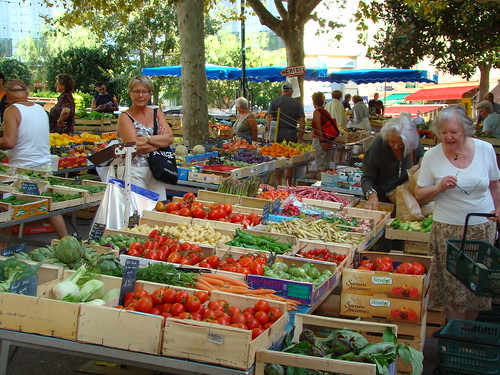
beaulieu-sur-mer market

The market in Beaulieu-sur-Mer last week

I’ll never look at a market in quite the same way again after reading Market Day in Provence, by Michele de la Pradelle. She made an anthropological study of three markets in the Provence city of Carpentras, in 1980 (the book has only recently been translated), looking at the wholesale market where farmers sold to wholesalers on the outskirts of the city, the traditional retail market, and the secretive but famous, although little observed by outsiders truffle market.

She finds, perhaps unsurprisingly, that although situated in a largely intact medieval city, most of the “historic practices” have in fact been reconstructed.

“In this age of supermarkets, the stallholder market distribution mode is necessarily perceived as archais, an impression reinforced by the way it is staged. The types of social relations induced by market exchange appear to actors to bear the mark of either a premodern or an exotic world. Calmly doing one’s marketing with one’s shopping bag on one’s arm while chatting from stall to stall with people one chances to encounter is also playing at being of another time…. A market is a collectively produced anachronism, and in this it responds to deeply contemporary logic.” (p.234-5)

She points out that the products almost invariably are exactly the same ones as youd buy in the market (look at the veggies above and you can see that), and even the “farm produce” or “home-made” ones are usually a carefully constructed fiction: “His stall is made of a simple plank of wood…he has carefully lined up a few bunches of leeks; handwritten on chalk on a small chalk board above them are the words: “leeks, untreated, 6F”… The nature that Roux stages is that of the Sunday gardener: cherries eaten straight off the tree, patiently transplanted lettuce whose progress is observed daily. These are patently healthy vegetables…” (Although Pradelle notes that this is more commonly seen at L’Isle-sur-la-Sorgue, “where the Sunday secondhand market pulls in a big tourist crowd”.

She also closely observes the interactions: “The joking is what gives the market exchange relation its specific form, turning a series of disparate customers into a small society of equals.” By contrast, she says, in a shop, the status of the customer is always carefully observed and reacted to. She also notes that close friends, who would usually have to go through elaborate rituals, can get by with a quick peck on the cheek in the market – the fiction (usually) that this is busy business allowing simple exchanges in complicated relationships.

We’re a complicated race, we humans…

Books Feminism Women's history

What happened to 2m ‘surplus’ women?

I should have loved Virginia Nicholson's Singled Out. I love reading about, and then getting to write about in reviews like this one, women pioneers, women successes, women who beat all of the odds. And there are hundreds of stories like that here: Beatrice Gordon Holmes, suffragette, founder of the Association of Shorthand Writers and Typists, and tremendously successful city businesswoman; the middle-class young lady Victoria Alexandrina Drummond, who against fervent opposition became a marine engineer and in 1940 worked her ship to safety and won the Lloyd's war medal for bravery at sea; Mary Milne, who became matron of St Mary's Paddington, known, unusually for a woman in that role, for her sympathetic handling of trainees and junior staff.

But there are two reasons why, while glad to have read it, I thought that Singled Out was as a book something less as a whole than the sum of its parts. One isn't, perhaps, Nicholson's fault. She charts, fairly enough, the astonishing public hostility against these women – the Daily Mail figures prominently here; Lord Northcliffe, its owner, publicly referred to "Britain's problem with two million superfluous women". Plus ca change… Then there are authors such as Walter M Gallichan, who in The Great Unmarried (1916) wrote of the "modern woman":

Ideas are seething in her busy little brain. She is desperately intellectual. One day she tells you that she is prepared to die for the cause of Women's Suffrage. Next week she will be immersed in economics, or vegetarianism, or free love… 'I don't mean to marry,' she says, with a ring of disdain/ 'I want to live my own life…. She tried to disguise her sex attractions by dressing dowdily, neglecting her hair, wearing square-toed boots, and assuming inelegant poses.

It is souring to read such stuff; women being blamed for being in circumstances that were no choice of their own (they hadn't even had the choice of the politicians who took Britain into the war). You can't help getting angry (and reminded of all of the similar junk still thrown around today, often in the same places). Maybe there needed to be a taster here, but perhaps there's more than is needed.

The second problem is clearly Nicholson's – one of structure. There isn't a very clear one: we swing back and forth from the working classes to the privileged, revisit some women several times, such as the hugely impressive archaeologist Gertrude Caton-Thompson and the writer Vera Brittain, but I never really had a sense of where we were going, or why. And I'm not quite sure why we have to visit the horror of the trenches in the first chapter. Certainly, this was reflected back to the women, but surely that could come through their stories, rather than the men's.

Nonetheless, there's a lot to admire here – and particularly the oral histories, which Nicholson has captured at the last possible moment (many of her interviewees being around the 100 mark). She's great at painting short pictures of ordinary, extraordinary lives, such as that of Olive Wakeham, born in 1907, who spent much of her career as a nursery nurse, since her family couldn't pay for teacher training, was the centre of the lives of many of her 28 first cousins, then ended up as president of the Devon County Association for the Blind, and an MBE.

Then there's Evelyn Symmonds, who got her first job in 1922 at the age of 14, in the Post Office making her a "Civil Servant", a source of pride, then she was gradually promoted, passing exams despite very basic education, and after 30 years was an executive officer in the Accountant General's Department, retiring at 60 after 45 years in the post office. She told Nicholson: "We used to on holidays and please ourselves. We had good money, and I loved my job. I've thoroughly enjoyed life, I must admit…"

And the stark facts of the story are powerful in themselves. In 1911 there were already 664,000 more women than men in Britain – because girl babies are tougher and men were more likely to emigrate to the colonies. And in 1917 you can only admire both the courage and the clearsightedness of the senior mistress of the Bournemouth High School for Girls who stood before the assembled sixth form and told them: "Only one out of ten of you girls can ever hope to marry. This is not a guess of mine. It is a statistical fact. Nearly all of the men who might have married you have been killed. You will have to make your way in the world as best you can." By the 1921 census her words were born out – there were 19,803,022 women in England and Wales and only 18,082,220 males. And this in a world where at the turn of the century less than 30% of women had jobs – and virtually all of these in the traditional housework, childcare or factory roles.

read more »