Category Archives: Books

Books Politics

Why is Britain doing so badly in international education tables?

Post first published on Blogcritics

There were two reasons why I really had to read Wendy Wallace’s Oranges and Lemons: Life in an Inner City Primary School. The first is that the school whose life it covers, Edith Neville, which serves three to 11-year-olds, is about 50 metres up the road from my home, and many of the children who live around me attend it. The second is that I’m a school governor at a very similar school not far away.

The reason why everyone should read it is to understand the enormous disadvantages many children in Britain today face, and the desperate need for resources (many of which are now at risk of being snatched away, where they currently exist – like Plot 10, the 40-year-old Somers Town institution that provides pre- and after-school care that’s now under threat) to support children and families.

Somers Town was traditionally home to the railway workers who served the trains at St Pancras/King’s Cross and Euston stations, between which it sits. Most of those jobs hae gone now, but it is still a very poor community, probably the last one left in central London, sandwiched between the posh and increasingly institutionalised Bloomsbury to the south, and Camden Town to the north. Most of the housing is council and former council flats, so has to a large degree escaped the gentrification of surrounding areas.

But as author Wendy Wallace explains, anything outside Somers Town is foreign territory for many of the pupils at Edith Neville, whose only excursions outside Somers Town – indeed sometimes outside their own usually small homes – come through the school.

Wallace spent a year at the school, and chooses to focus on a small selections of pupils and staff. They, and their parents, all have their own stories – Najreen, whose mother only speaks Bengali and appears depressed, caring for three small children. One of the success stories – by the end of a year at nursery she’s progressed for almost catatonic silent terror to full interaction with other children and teachers in two languages.
read more »

Books Feminism

Reclaiming the F Word – a survey across, but not judgement of, contemporary feminism

First published on Blogcritics

I read Reclaiming the F Word, the much-awaited book by the former editor of the website The F-Word, some months ago when it first came out, indeed even went to the launch in a West End club, but hadn’t found time to write up a review (not enough long train trips recently – at least not ones where I’ve been fit to do any more than sleep).

It wasn’t what I expected – I’d been predicting something more analytical, which tried to present a path forward for feminism and a vision of the future. That’s definitely not what it is.

Rather it’s a snapshot of today – based heavily on a survey of 1,265 feminists, self-described (I was one of them). There are descriptions of types of feminism of today, and surveys of views, but very little in the way of judgements of worth or value.

But provided you take the book for what it is, it’s a valuable work – certainly highly useful as an introduction to modern feminism, and as a guide for those thinking about becoming involved in feminism work but not quite sure where to start. (And with the detailed result presented in an appendix, no doubt invalulable to future historians, and as a source for present-day sociologists.)

It’s also heavy of pointers to further reading, namechecking many of the feminist books and writers of the past decade or so. There’s also plenty of basic facts and figures on women’s status and position, if sometimes they feel a little random,

Adding to the “introduction to feminism” feel,each chapter finishes with a list of possible actions the reader might take, ranged across levels of radicalism and effort.

The focus is slanted towards the UK and the West, but there’s enough discussion of the critical problems of women in the developing world to ensure that any reader new to feminism at least gets a sketch of the international dimension.

But if you’ve been around for a long time, as I have, you won’t find much to surprise you.

It was in the appendix that I found, for me, the most valuable data. The survey question that asked feminists to rank their concerns by importance put inequality in work/home/education top, with well over 600 respondents, and “violence against women” at about 600. “The body”, primarily abortion and reproductive rights was third.

All of these were well above “popular culture” including responses relating to objectification/sexualisation, the issue that I think is consuming far too much time and energy in current feminist efforts.

While I’d class myself, when pushed, as a radical feminist, rather than as a Marxist/socialist one, I think these campaign in attacking the end result of hyper-capitalism are failing to get anywhere near our real problems, which lie in our extreme consumerist culture, for which the use of sex as a commodity to sell pretty well anything at all is merely a logical outcome.
read more »

Books Feminism

Being positive about feminism: a new academic study

I learnt about the existence of Jonathan Dean’s new book Rethinking Contemporary Feminist Politics, from an interview with the author on The F-Word. That great group blog is one of its three specific subjects of study, the others being Women’s Aid and the Fawcett Society. Since I’ve just become a trustee of the latter, it seemed essential to lay hands on a copy. I blanched, however, when I looked at the price on Amazon – £54. £54! Luckily, as a member of the London Library I had a plan B, which was to get them to buy a copy (also fitting in with my ongoing campaign to ensure it has a good feminism collection.)

That’s a pity, for while this is clearly an academic book, with a conclusion dense packed with political theory that’s going to be accessible to only a few (I may come back to it if I can find a time when I’m less tired – a debate about Deleuzianism, “Lacanian theorists of lack” and post-Gramscian political theory” extending my knowledge of political theory into 21st-century debates with which I’ve not previously engaged), the bulk of the text, the study of the three feminist institutions, is perfectly readable, useful and well worth the attention of anyone involved in contemporary feminism.

That’s particularly because this is broadly a positive story. Dean sees a strong resurgence in UK feminism particularly in the past half-decade. He in part accepts the broadly charted narrative of decline up to that point, although he does see it as being based on somewhat simplistic and problematic definitions of what an authentic, radical, autonomous feminist movement is and might be, suggesting that there’s been too strong a focus on what the feminist movement of the early to mid-Seventies was as a perfect model, any deviation from which has automatically been defined as a decline.

Using radical as a term for demanding significant change, rather than the specifics of “Radical Feminism”, he finds elements of real strength and drive in each of the three institutions that he studies. He also notes that a more recent model for identifying an authentic political action, as advocated by Zizek and Badiou among others, which is “a ‘heroic’ conception … predicated upon sudden rupturing and clearly visible instances of political contest; anything else is implicitly viewed with suspicion and risks being cast as ‘inauthentic’.” Dean adds that this approach “betrays an almost theological – and undoubtedly resolutely masculinist – standpoint” and “a political purism which strikes me as ill-equipped to grasp the locatedness and inevitable messiness of processes of feminist political articulation”. (p. 170)

On Fawcett, he says:

“…there are two main logics at work within the organisation …At one level, the organisations is strongly underwritten by a political logic of claimmaking directed at political elites in which – one may argue – a more radical feminist critique is absent. However, by contrast, the eveness of this logic is undermined by a logic of radicalistion that has become especially apparent since late 2005. This logic of radicalisation… refers in particular to Fawcett’s recent efforts to cast their demands within the context of a broader intervention into the public gender debate, situated within a more forthright affirmation of feminism.” (p64-65)

On The F-Word, he finds that while it is open to criticism of being very individualised and lifestyle-focused, he sees an increasing trend over its development whereby “the self-identity as feminist need not occasion a drift into apolitical complicity with logics of individualisation but, rather, translates into a more engaged political awareness, feeding into increased radicalism”. (p. 162)

On Women’s Aid, he’s also broadly positive, but in a passage that I found very interesting, for it reflects much of the difficulties I have in engagements with much local “community consultation” (indeed a meeting I was at all this morning on the future of the King’s Cross area with Camden officials and local volunteers), Dean looks at, however, engagement in government processes is, for “Women’s Aid as expert” problematic.

“I want to raise the question whether the organisation’s enthusiasm for multi-agency work, coupled with its position as an ‘expert’ voice, renders them partiallty complicit with the logics of what we might call ‘interest group pluralism’. In a manner that may curtail the organisation’s vitality and radicalism. … interest group pluralism refers to a mode of governance in which various actors are engaged in processes of making political claims which are then adjudicated by the government apparatus, and is thus symptomatic of what Zerilli and Arendy refer to as the domestication of politics to ‘the social’. A further dimension of interest group pluralism, as Iris Marion Young has pointed out, is that it tends to reduce politics to a process of rule by experts who are delegated responsility for particular issues.” p. 121

read more »

Books Feminism

A great women’s art

Article first published on Blogcritics

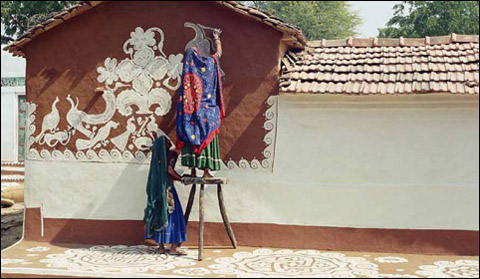
If you ask people to imagine “an artist”, what you’ll probably get is an image of a Renaissance man in a linen smock, or a slightly modernised equivalent. What you’re unlikely to get is an Indian peasant woman in traditional dress perched on a rough country ladder, painting the side of her house.

But browse through the pages of Nurturing Walls: Animal Art by Meena Women and the image in your head might well be changed.

Two short essays in the text explain and explore the women’s work, setting out how Mandana painting, as their work is term, is done by women from the Meena tribe in Rajasthan. It explains that the large tribe is concentrated as farmers in the Aravalli Hills, although they have a history as a warrior clan, which when overrun in the 11th century took to the hills as guerrillas, a role they maintained into the 20th century, leading to them being named by the British under the “Habitual Criminals Act” of 1930 as robbers and criminals whose movements needed to be curtailed.

Yet there’s nothing of this surely turbulent history in the images of this tradition, although perhaps a hint in the fact that it’s a temporary art, meant to be painted over again and again, as the chalk on mud fades. (Then again perhaps that’s simply a reflection of art has it has surely been through most of human history – a pleasurable creation to be immediately enjoyed, before we distorted it with the destructive effects of the market. And it gives a hint of how much of human artistic history we’ll never be able to recover through archaeology, except through the most unusual accidents of preservation.)

The style certainly broadly fits within that tradition somewhat patronisingly called “naive”, in that there’s no focus on realism, or the rules of perspective or many rules at all really (except one that’s probably largely practical – the great majority of the images are white chalk on brown walls).

And the skill of the artists, as you’d expect, varies – but the best of it here is truly stunning – captivating in its depiction of a playful love between animal mother and child, innervating in its lithe energy.
read more »

Books Feminism

Thoughts on Before I Go…Reflections on my life and times by Mary Stott

The London Library copy of Before I Go…Reflections on my life and times, by the late Guardian women’s editor Mary Stott, was last borrowed in 1998, and only a couple of times before that.

It’s a pity for her 1985 memoirs have much to offer the reader of today, and have many reminders that many of the issues with which we’re wrestling politically – from voting systems to maternity leave – have been the subject of furious debate for decades.

Born in 1917, she’s something of a bridge between the First Wave feminists and the Second Wave, which she viewed from a place of mature professional power and influence (one of the few women in that position at that time) with some understandable bemusement. By modern standards she’s unsound on the subject of “Ms”, she hated it, and rather unsound on homosexual rights, but given the world she grew up in, she’s humane, commonsensical and remarkably clear-sighted, while being self-effacing and alost frustratingly humble.

She’s much to say on feminism that still has powerful resonance today, for example:

“The spate of books on women’s subjects in the last few years has been extraordinary. Too many, in my view, have been inaccessible to me, who left my grammar school at 17, and to the girls who leave their comprehensives at 16 – not to mention many others in between. I think it is time to concentrate more attention on the writing, on the simple, comprehensible exposition of ideas rather than on the bibliography.”

She’s also interesting as a defector from Labour to be a founding member of the SDP in 1981, and a member of its executive in 1982, a self-identified political neophyte:

“…it takes a very strong and politically idealistic spirit to survive bickering over procedural hassles. Procedure has to be sorted out, but perhaps the political novices, ‘the nice people’, the ‘wets’ have a role in indicating, now and then, when we can summon courage to tackle the technicians, that ‘ends’ are really what matter and what keep enthusiasm alive, and, even, that means can corrupt ends. Sometimes I fear that the more ‘political’ one becomes, the more one is likely to lose sight of the goal that made one join a party in the first place.”

Today, as the conservative government talks much of Big Society, while also slashing funding for the institutions that might support it, she reports on the president of the National Council of Women, Helen Waldsax, asking “that the government should ‘acknowledge in some constructive form the public service given by so many voluntary organisations to this country’ and warned that unless this was done, many organisations would have to function at half strength, or even disappear, which would mean the loss of ‘the source of supply of many specialist skills’. She added, ‘a very important democratic principle is at stake here’. But there has been no sign that Prime Minister Thatcher, who so heartily approves, she says the voluntary principle, has taken any notice.”

But perhaps the most pervasive sense one gets from this book is the modestly and self-deprecation of a woman who was obviously powerful and exceptional. It’s a reminder of how women were taught to be – and must never allowed to be again.

Books Feminism

Nina Power’s One-Dimensional Woman

Article first published on Blogcritics.

Nina Power, if placed in a classification of feminists, would clearly fall within the socialist/Marxist camp, seeing the oppression of women arising chiefly from the economic base. But this is a sophisticated, nuanced form of this analysis, that is sensitive to the developments of the superstructure, as well as the base, of the past couple of decades.

Her One-Dimensional Woman is only about 50 actual pages of text, almost more pamphlet than book, but there’s a lot packed in, not all of it making an obviously coherent whole.

The title comes from Herbert Marcuse’s 1964 One-Dimensional Man, who is “fully immersed in the promissary world of liberal democracy and consumerism, and yet ‘the spontaneous reproduction of superimposed needs by the individual does not establish autonomy; it only testifies to the efficacy of the controls”. For women today, Power says, “what looks like emancipation is nothing but a tightening of the shackles”.

She begins with a brief exploration of the Sarah Palin phenomenon, which is something of an outlier, if a topical one. The conclusion: “She turns maternity into a war-weapon, inexperience into a populist virtue and feminism into something that even the Christian Right could approve of.” Power makes the point that if we allow the term “feminist” to be captured by such women, progressive women concerned about basic rights from access to abortion onwards will have to disown it – it is worth defending.

In a similar vein is the chapter on the attempt to justify the Iraq war, and particularly the Afghan war, by the claim that its purpose (so historically nonsensical) is to free the local women. The answer to this is easier, really, just listen to the local women, who are very clearly saying “get out”.

Then Power gets into the meat of her argument, that the workforce has indeed been feminised: “work is generally more precarious and communication-based, as women’s jobs tended to be in the past… Alternatively, we could turn this around and talk about the labourization of women – the way in which females are cast as worker first and only secondarily as mother or wife, or any other identity position not linked wiith economic productivity.”

Much of this has affected both sexes. So Power says: “The demand to be a ‘adaptable’ worker, to be constantly ‘networking’, ‘selling yourself,’ in effect, to become a kind of walking CV is felt keenly.” But for women this plays on older stereotypes to particularly focus on their looks, their clothes, their body, which bleeds into woman as consumer, and the claim that any consumer purchase – from lipstick to chocolate, is feminist indulgence, because you’re worth it.

On this, Power gets particularly strong: “Stripped of any internationalist and political quality, feminism becomes about as radical as a diamante phone cover.” (Here she’s being, I think on balance unfairly, strongly critical of Jessica Valenti.)

But perhaps the most original part of this text is the exploration of pornography, on which Power argues for historical perspectives. As she briefly alludes to, it is well worth remembering that pronographic images were used as a form of political communication during and around both the English Civil War and the French Revolution, but “the ahistoricism of the anti-pornography movement takes as its presupposition the idea that men will always nurture a violent desire towards women and that porn is merely a reflection of this”.

Power argues, however, that before WWII, porn lacked the mechanistic, highly specialised characteristics of today, in older forms, particularly French films, “sex isn’t just a succession of grim orgasms and the parading of physical prowess, but something closer to slapstick and vaudeville”. The performers, she says, genuinely appear to be having fun, and the “plot” not infrequently runs around men’s difficulty in “performing”. Very different she says, from sex that is clearly work in contemporary porn.

So there’s a lot here, but ultimately what it fails to do is really provide a road-map, a way forward. Power has entirely justifiable criticism of what is being presented to us today as “feminism”. But she doesn’t really tell us what her own looks like.