Category Archives: Feminism

Feminism History Women's history

Why do we need feminist archaeology?

Because it is not what you find, but the questions you ask about the determine the conclusions you’ll reach.

I’ve been reading, in my odd spare minute, the fascinating Findings: The Material Culture of Needlework and Sewing, by Mary C Beaudhry. She’s interested in the physical evidence of the craft that is found on archaeological sites, and has some fascinating conclusions, and an awful lot of confusion from (frequently) male archaeologists who lacked basic knowledge of the craft that might have set them straight.

So there’s a whole chapter on “the lowly pin”, going back to what have been identified as “dress pins” from a royal tomb in Bronze Age Turkey (Alaca Hoyuk). But, Beaudhry says: “These have flat ends and hence are far more likely to have been spindles than pins.” (p. 11)

The most common for millennia were probably wooden pins, although they are only rare survivals in boggy ground – among the oldest from a Neolithic site at the Sweet Track on the Somerset Down, but by the 15th and 16th century, in London at least, metal pins become common.

In April 1440, two galleys outfitted on behalf of seven Venetians merchants docked at Southampton on their return voyage from Flanders carring 83,000 pins as part of their cargo.”

These were mostly straight, made from fine wire and with small heads – an artefact of fashion since they were used to fasten women’s veils; “the trousseau of Edward II’s daughter, Prince Joan, whose wedding took place in 1348, included 12,000 pins for fastening her veils” (p. 13)

And they continued to be the fastener of the poor – cheaper than buttons – into the 17th century. And they were used to fasten the clothing of infants! From the 18th century: “As to the head, it is covered with two or three biggins [bonnets], the first of which is of linen, and the others woollen, and these are tied beneath the neck. In many places they add a stayband or a kind of headdress with two ends which hang down the side of the head and are fastened on the breast with pins in order to meet the infant hold its head straight.” (p.14)

Yet it seems many archaeologists tend to interpret the presence of pins as evidence of sewing, and women. Which must have meant some confusion when 1,575 pins were recovered from the 16th-century Free Grammar School in Coventry (all male pupils – the pins would have been used to hold their ruffs in place. (p. 22)
Feminism

Trying again

“Equality of rights under the law shall not be denied or abridged by the United States or by any State on account of sex.”

Yep, a campaign has begun, again, to bring America at least into the 20th century, by reviving the Equal Rights Amendment.

Feminism

Yeah Spain…

Another exciting sign that some of the priest-infested parts of Europe are breaking out in a big way – Spain has passed a dramatic equality law that will force political parties to ensure 40% of candidates are women, demands business take steps toward gender equality, and provides real provision for paternal leave at birth, has passed in the parliament.

Worth noting at this point that the current Spanish cabinet is 50% female – as opposed to the British, ahhh, not very many…

Arts Feminism History Women's history

Giving the women a place at the museum

It might have a slightly dismissive title “decorative arts”, it might be focused on the domestic and small scale, but at least a new museum in Paris introduces a great range of female characters, and gives them what should be a permanent place on the tourist trail. I’ve provided what is probably an overly detailed account on My Paris Your Paris.

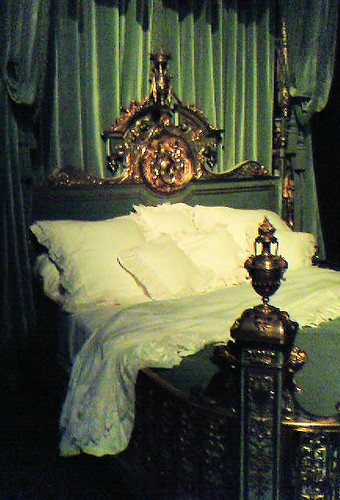
And my favourite single woman, well a Parisien courtesan, of course, Valtesse de La Bigne. This was her bed, tailor-made, of course:

bed

Well, you do want to make your workplace just so…

Feminism

Making a stand in Iran

Iranian women are bravely continuing their struggle to express their anger and frustration, despite a government crackdown.

Demonstrators Sunday carried signs pointing to articles in the Iranian Constitution that guarantee the right to peaceful protest. Activists said the arrests were made to preempt another gathering they had planned for Thursday. “They are afraid of the women’s movement, because there are some links between them and journalists, nongovernmental organizations, and they cooperate with [foreign] NGOs,” says Isa Saharkhiz, a former editor and reformist.

Feminism

Not a post-feminist age

Over on Comment is Free I’ve a piece about Saturday’s Sheffield feminist conference – its thesis that if there ever was a period of conflict between feminist generations, it seems to have passed, and this age of young feminists is more aware of issues of race and class than perhaps were their foremothers.