Category Archives: History

Lady of Quality

18th-century letters

My 19th-century blogger, Miss Frances Williams Wynn, is today musing on how manners of the day have declined from those of the 18th century, and in the process reproduces a couple of little gems from that era.

The first expresses concern about the danger of the road between St Albans and London in 1714 – with word around that “Prichard the Highwayman” is on the prowl.

The second is from 1729, early in the reign of George II, when much scorn is being expressed about the “German” economies being practiced at court.

History

In the nothing new file…

“The defence offered in a High Commission hearing of 3 May 1632 by a countryman caught “pissing against a pillar” in St Paul’s en route to his wedding – that he did not realize that he was in a church – has sometimes been cited as evidence of the cathedral’s secularization, but the case itself more importantly reveals Laud’s insistence on rigorous enforcement.”

p. 58, in Crankshaw, D.J. “Community, City and Nation, 1540-1714,” pp. 45-70
p. 53, Keene, D. Burns, A, Saint, A (eds), St Paul’s: The Cathedral Church of London 604-2004, Yale Uni Press, New Haven, 2004.

Cycling History

Garden of England Cycle Route: London-Dartford

Tempted by a map I found in Stanfords, of the Garden of England Cycle Route , yesterday I set out from my front door in Regent’s Park to tackle the first bit. I was hoping for Rochester, about 50 miles, but didn’t get quite that far, due to a combination of late starting, slow going (cobblestones and blind corners on the Greenwich to Woolwich section), and threatening weather.

Still, it was an interesting ride, and flat: always a bonus.

The route to Greenwich, about 12 miles, is familiar, but after that it was new territory. I expected post-industrial ruin, and there was plenty of that – great timbered wharfs melting gently into the Thames, and also of course the post-post-modern of the Millennium Dome, which appears to be rusting gently into its carparks. (Great cycle path around it though!)

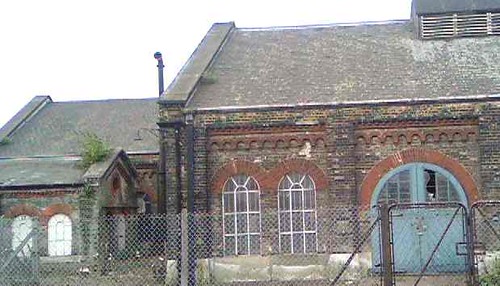
A little further downriver there was this stunningly detailed Victorian(?) warehouse complex – just look at the fancy coloured brickwork. Parts of it appear to have been used as an industrial museum, but it looked in a pretty bad way.

victorian

read more »

Women's history

The 16th-century ‘true crime’ genre

Call me an unsophisticated lass from the colonies, but I still get a buzz from artistic crossing of the centuries, so I really enjoyed last night seeing a production The Tragedy of Master Arden of Faversham. Published in 1592, it closely follows the “true-life” crime of 1551.

I reviewed it over on My London Your London.

Of course the “true-life” angle is thought-provoking – I woke this morning thinking about poor Alice, the real-life one, who paid the ultimate price for “petty treason”, being burned alive.

And at least one modern writer, has exonerated her:

Thomas Ardern, Orlin shows, was a broker of dissolved monastic properties who learned the art from some of the age’s most rapacious courtier-officials, Sir Edward North (Alice Ardern’s stepfather) and Sir Thomas Cheyney. As Cheyney’s steward in Kent, and as a customs collector for the vicinity of Faversham, Arden was, much to his own advantage, deeply involved in the conveyance of church holdings into private and state hands. Memories were long in Kent: people knew whence Ardern’s wealth had come, and, perhaps more dangerously, Ardern knew whence had come the wealth of many others. I will not give away Orlin’s solution to Ardern’s murder; suffice it to say that among the possible motives for Ardern’s murder, those of his wile Alice were by no means the most urgent.

(From: Recent Studies in English Renaissance, Lawrence Manley; Studies in English Literature, 1500-1900, Vol. 36, 1996, referring to Lena Cowen Orlin’s Private Matters and Public Culture in Post-Reformation England.)
Women's history

Those amazing Tudor women

Over the whole period “between 12 and 19 per cent [of those whose letters survive] wrote all their own letters …. the number of women for who there is evidence of their actually writing letters rose from 50 per cent in the 1540s to some 79 per cent by the end of the 16th century … the proportion of women for whom no holograph letters survive fell from 28 per cent in the first decade of the period to an estimated 17 per cent by the years 1600 to 1609.” (p. 96)

From Women Letter-Writers in Tudor England, James Daybell, OUP 2006 (found today on the “new books” shelf at the London Library – which can be a really treasure.)

An nice example, Elizabeth Bourne, “wife of Anthony, the son of John Bourne, Mary I’s principal secretary of state”. Some 70 of her letters survive, written in holograph in several different hands. She also wrote original poetry and sometimes used the pseudonyms Frances Wesley and Anne Hayes, which she called her “secrete syphers”.

A search of the web and electronic academic database returned nothing on her – one more for the literary collection.

Arts History

The Bradshaw paintings: pre-Aboriginal art?

Somehow the rows and the mystery seem inevitable – there are some absolutely gorgeous rock paintings in a remote, inaccessible part of Australia that might date back 60,000 years, and might be by a pre-Aboriginal people.

The Times Literary Supplement has sent Robin Hanbury-Tenison, whoever they might be, on the trail, and aside from showing an unfortunate line in gullibility — (“It teems with poisonous snakes and spiders, as well as crocodiles and mad wild bulls.” – no if they were “mad” they wouldn’t survive very long in the Bush ) — the writer provides a decent account of the controversy.

I don’t think the “cradle of global culture” makes much sense – it is indeed never really explained – presumably there would be some trail out, some signs of artistic influence, were that the case – but that doesn’t make the paintings and their possibilities any less exciting.