Category Archives: History

Arts Women's history

Talking about 18th-century craftswomen …

… in the office, as I was the other day (there are BIG attractions about working at the Guardian), a name came up that I hadn’t previous encountered – Anna Maria Garthwaite (1690–1763).

She was “the pre-eminent silk designer of her period”. Spitalfields-based, her work was mainly based on botanical, painting-style patterns, which the V&A are still making money out of. A whole dress by her, with a well-documented history has also survived, as has a fancy waistcoat (which in 1747 still had sleeves).

She also did cut-paper landscapes and some of her pattern books have survived,

From the ONDB:

“…her father was a well-connected Anglican clergyman with family associations with the City of London. After his death in 1719 it is probable that she went to live with her elder sister, Mary, the wife of Robert Dannye, rector of Spofforth, Yorkshire… In 1729 or 1730 Dannye died, and both sisters then went to London, where they eventually settled in Princes Street (now 2 Princelet Street) in the parish of Christ Church, Spitalfields …
Her interest in textile design was apparent by 1726, when she collected and annotated a series of textile designs, ‘by diverse hands’, which included technically innovative and high-quality French work. Her first drawing, inscribed ‘sent to London before I left York’, was competent but simple. The largest series of her work, comprising many hundreds of drawings of silk designs and patterns, some of which are still enrolled in their contemporary arrangement covering the period from 1726 to 1756, has survived and is in the collection of the Victoria and Albert Museum in London. It is clear that, at a time when the English silk industry vied with French manufacturers for the quality home and export market, she was one of the foremost designers of ‘flowered’, or brocaded, silks.
…She displayed a noteworthy grasp of textile technique, including technical direction as necessary. Surviving silks show how well her designs adapt to form and function. Garthwaite point paper, imprinted with squares for drafting designs in the early nineteenth century, may be a retrospective tribute to her expertise. The basis for her technical knowledge can only be conjectured, though Robert Campart, a Spitalfields ribbon weaver of Huguenot extraction, is named as a beneficiary, together with his wife, in Garthwaite’s will.
Lady of Quality

Don’t hail the Pretender

The family of my 19th-century blogger, Frances Williams Wynn, was clearly of Jacobite sensibilities in earlier times, but she did not retain any lingering favouritism for the Stuarts. Today she’s sharing some family gossip about an incognito visit to London by Charles Edward Stuart in the 18th century, and making comments (less than favourable) about his character.

History

The Domesday book …

… no doubt you’ll be able to access the new online edition some time next week. As is becoming traditional in these matters, it was launched with much fanfare yesterday, and crashed under the strain.

In the meantime there’s a lively article on the Guardian that will tell you about what you can’t see.

In the meantime meantime, a site that is working, Jordanus: An International Catalogue of Mediaeval Scientific Manuscripts. “It provides information about mediaeval manuscripts written in Western Europe between 500 and 1500 A.D. which treat the mathematical sciences in the wider sense, i.e. arithmetic, algebra, geometry, trigonometry and mechanics.”

Hat-tip to Medieval Woman.

Women's history

Women of Shoreditch in the 16th century

Then, as now, a marginal, area of London, where many writers lived or lodged.

In Holywell Street, in the late summer of 1588, the great comic actor Dick Tarleton was dying, cared for by “one Em Ball”, a local woman “of verye bad reputacion”.

Robert Greene was living that year with a woman of the surname Ball, the sister of a thief who had died at Tyburn. She would bear his son, called Fortunatus, who died in 1593 and was buried at St Leonard’s Shoreditch, when his mother was living on the same street. The two Ball women might have been related, or they might have been the same woman. (p. 40)

Other women in the pamphlets of Thomas Nashe include old Megge Curtis of Shoreditch for whom the pages of a pamphlet served “to stop mustard pots with”; and Mother Livers of Newington, a fortune-teller”.

(From A Cup of News: The Life of Thomas Nashe, Charles Nicholl, Routledge & Kegan Paul, 1984)

Anyone come across “Em” elsewhere?

Women's history

Antiente Epitaphes

… (from AD 1250 to AD 1800)
Collected and sett forth in Chronologicall order
by Thomas F. Ravenshaw, M.A. F.S.A.
London:
Joseph Masters & Co
m.dccc.lxxviii.

(That’s 1878, I believe, should you have run out of toes…)

The oldest one listed ic “c. 1250 Gundrada, Daughter of William the Conqueror, Foundress of S. Pancras, Lewes”. But it is in Latin of course, and fragmentary – and if you are wondering about the dating the note says “Gundrada died AD 1085, but Mr Bowtell considers the Coffin to be not earlier than 1250”. (Gundrada is the Latin of Gundred. Wikipedia suggests: “Some scholars question whether Gundred was an illegitimate child of William I or merely a step-daughter, foundling or adopted daughter.”)

Interestingly, lots of the early ones are of women: eg Maud de Mortimer, 1210:

Mahaud de Mortimer gist ici
Jesu pour sa grande pite e misericorde
de sal alme eyt mercy.

One of the earliest English ones is, typically for the Victorians listed as “1393 Sir Thomas Walsch”, but actually says more about his wife:

Here lyes Thomas Walsche Knyght, lorde of Anlep (& dame Kat’ine his wyfe, whiche in her tyme made the Kirke of Anlep and halved the kirkyard first in wurchup of God (& oure Ladye & seynt Nicholas. That God have ther sowles and mercy.

(This is listed as at Wanlep in Leicestershire, which seems to know be spelt Wanlip.)

(And yes, I shouldn’t be allowed on eBay antiquarian books…)

Cycling History

A cycle tour of the architecture of Hastings, Winchelsea and Rye

… with the Lambeth Cycling Campaign yesterday, otherwise known as “Benny’s Summer Spectacular”. (Thanks Benny!)

Hastings is that classic grand old lady down on her luck. There’s enough historic, impressive architecture here to really rival Brighton, but although it seems a bit improved from when I was here last, there is still a very long way to go.

At the railway station is a grand new entrance, all curtained glass walls – you don’t need a photo, you know the score, a square lump that bears no relationship at all to its surroundings. Someone commented however that with new environmental standards such architecture will disappear quickly; it will probably very quickly look as dated and anachronistic as the tall Fifties office block opposite, which appeared to be at least part abandoned.

hastingshop

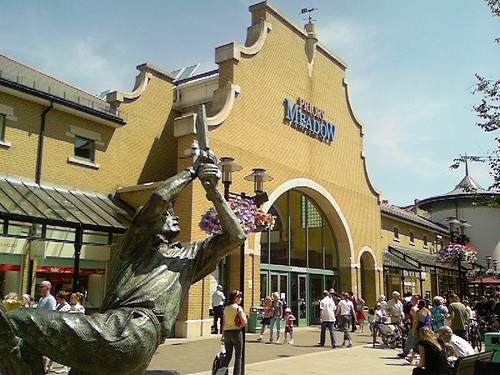
Next up we passed through another new development – a shopping centre. I suppose, as these go, with it built around a modern square that at least provides air and sunlight, this isn’t as bad as it might be. Appropriate really since as the statue attests, this was built on the old cricket ground. (Hardly the same level of activity among users, however.) And Benny pointed to the horrible proportions of the circular towers at each end – I suppose it is an attempt to refer to the Norman castle on the hill just above, but not a particularly successful one. And you have to wonder why new shops were needed, rather than redeveloping old buildings along the front.
read more »