Haltwhistle to Corbridge, 26 miles
First off this morning the wonderfully evocative name of Vindolanda. It was, until March 1973, just another fort – nicely enough preserved, and in a wonderful sheltered valley behind the wall – indeed behind the line of what is now known as Stanegate – the road that formed the lime (temporary border) before the wall was built. But it was then that the first of the writing tablets that have provided wonderful insight into wall life were found. (I’ve written before about the “birthday” invitation one that is usually on display in the British Museum.)
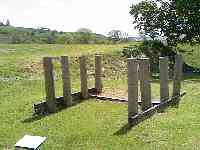 I won’t chart them in detail – this site does a wonderful job – except to note that they were found near these wooden markers for one of the gates of the early wooden fort (left) from which they date). But I will rave about many of the recently discovered objects on display in the museum. (No photos allowed unfortunately.)
The sodden, anaerobic conditions allow the most remarkable things to survive – not just leather (“more than 1,000 items of footwear”) and a horse’s ceremonial leather headdress (chamefron), but even more remarkable are wigs/hairpieces made from local “hair-moss”. They look to me more like furry hats, but they are anyway astonishingly well preserved.
In 2001 they also found a helmet-crest made out of the same material – the only one known. They may have been decoration, unit identification or rank identification. Centurions wore them transverse across the skull, ordinary soldiers’ ran up from the line of their nose down to the back of their necks.
A narrow and finely proportioned horse skull – which fitted the chamefron perfectly – suggests Arab blood had been introduced into the Roman stock here.
read more


 About