Category Archives: History

History

A day of history

“British Day” to commemorate the Magna Carta? Not surprising to find the Telegraph is the paper most prominently reporting a History Today finding that June 15 is the preferred date for a new national day. How prescient of the barons to pick mid-summer.

*****

More seriously, a letter has been uncovered that appears to prove that in 1950 the US approved the killing of Korean refugees from the North, for fear that they might be a vehicle for communist agents to enter the South.

The letter, dated the day of the army’s mass killing of South Korean refugees at No Gun Ri in 1950, is the strongest indication yet that such a policy existed for all US forces in Korea, and the first evidence that that policy was known to upper ranks of the US government.

“If refugees do appear from north of US lines they will receive warning shots, and if they then persist in advancing they will be shot,” wrote the ambassador, John J Muccio, in his message to the Assistant Secretary of State, Dean Rusk.

The letter reported on decisions made at a high-level meeting in South Korea on 25 July 1950, the night before the 7th US Cavalry Regiment shot the refugees at No Gun Ri.

Estimates vary on the number of dead at No Gun Ri. American soldiers’ estimates ranged from under 100 to “hundreds” dead; Korean survivors say about 400, mostly women and children, were killed at the village 100 miles (160km) south-east of Seoul, the South Korean capital. Hundreds more refugees were killed in later, similar episodes, survivors say.

The report provokes the question as to why it is that, among the broadly “democratic” nations, the US military’s seems to be the worst on human rights. (Of course it is still nothing like as bad as non-democratic state – no argument there.) Is it some problem with the US system that reduces civilian oversight and control, or is it something about lack of education and knowledge of the rest of the world that produces, as in this case, a panicky, hysterical, reaction to the challenge of “the Other”?

*****

In the “you couldn’t make it up” class, a perfectly cast “mild-mannered American accountant” is the first man outside Asia to trace his ancestry directly to Genghis Khan. In a neat piece of proof that race has absolutely no biological meaning at all (as opposed to cultural meaning, of which it has all too much), the accountant can trace his ancestry by documents to the Windermere area of northern Britain – so of course he’s “white”, in so far as that means anything at all…
*****

A Turkish museum director has been arrested after it was found that some of the “Lydian” artefacts on display in his museum were fakes. The report says they “belonged to Creosus” … hmmm. But still, you have to wonder how often this goes on. Suspect this can’t be the only case ever.
Early modern history Women's history

An astonishing receipt (recipe)

I’ve been reading With Faith and Physic: The Life of a Tudor Gentlewoman Lady Grace Mildmay 1552-1620. She was a highly religious woman, with plenty of things in her life – a thoroughly unpleasant husband, a father who left her almost penniless at the behest of her mother and sister – to encourage her to trust in God, for want of other alternatives.

But it seems the real passion of her life was medicine, and she must have spent a huge percentage of her meagre income on the medications to treat her neighbours and callers, and read everything she could get her hands on medical matters.

One of her favourite treatments was a balm that she made herself containing “24 types of roots, 68 kinds of herbs, 14 types of seeds, 12 sorts of flowers, 10 kinds of spices, 20 types of gum, 6 different purgatives, 5 different cordials”. That’s what you call a recipe.

I’ve pasted it below the fold – read it and think of the labour involved…
(I think the “standing in horse dung” was probably a method of heating – the temperature in a good-size compost heap, such as her household would surely have boasted, was probably pretty constant.)
read more »

Early modern history

Curiously pagan gentlemen

Erasmus in Moriae Encomium of 1509 mocked the English hunting tradition. This a translation by Sir Thomas Chaloner from 1549:

For as touchyng the death of a deare, or other wilde deast, ye know your selves, what ceremonies they use about the same. Every poore man maie cutte out an oxe, or a shepe, whereas suche venaison maie not be dismembered but of a gentilman; who beareheadded, and set on knees, with a knife prepared proprely to that use … also with certainte jestures, cuttes a sunder certaine partes of the wildbeast, in certaine order verie circumstantly. Which durying, the standers by, not speakyng a worde, behold it solemnly, as if it were some holy Misterie, havyng seen the like yet more than a hundred tymes before.

This strikes me as an oddly pagan ceremony; but would this be something that survived through the Middle Ages, in a continuous tradition back to Saxons, or even earlier, or something revived through exposure to classical texts?

(Quoted in Wilson, E. “The Testament of the Buck and the Sociology of the Text,” The Review of English Studies, New Series, Vol XLV, 1994, pp. 176) I’ve changed “u”s to “v”s and “i”s to “j”s for readability.

History

A new group blog

Because I don’t spend enough time at the computer already (right!), I’ve just joined a new group blog – Revise and Dissent, on the History News Network. Quite how it will work out I’m not quite sure yet (I don’t think anyone is), but I’ve used my first post to look at the way various aspects of agricultural history I’ve dealt with here this week have come together in my mind.

The honour of the first post there goes to Alun, whose own blog has long been on my blogroll. He asked an interesting question: From an archaeological perspective) is vandalism of ancient sites a bad thing?

History Women's history

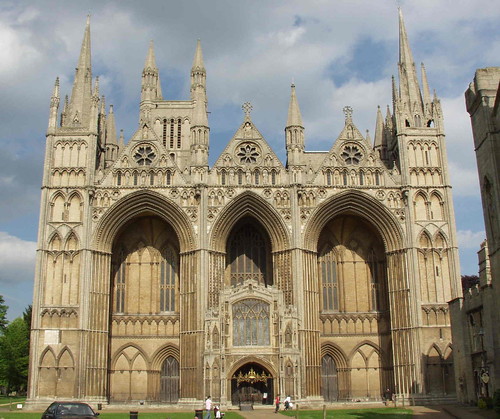
Peterborough Cathedral: Prominent women, tragic women

peterboroughcathedral
Off on Thursday to Peteborough, for reasons to be described elsewhere. But had enough time to check out the truly spectacular cathedral, the majority of which was built between 1118 and 1238, although there’s been a church here since 655AD.It had a rough first half-millennium – destroyed by the Danes in 870, burned down by accident in 1116 . Then it had a disasterous fire in 2001, which means the inside has a very “newly restored” feel.

But you can’t beat the view above, across the lovely grassed square at the front of the cathedral.Its second glory is the painted ceiling pictured below, dating back to about 1230. This must have been a truly important place then – perhaps a growing wool economy? – althought the important was helped by an enthusiastic abbott, Aelfsey (abbott from 1005-1055 – he must have started young).

A chronicler described him as “a laborious bee”, and gullible is another word that might have been applied. He collected “part of Aaron’s rod, piece of Our Lord’s swaddling cloth, a shoulder blade of one of the Holy Innocents [the babies killed by Herod] and a piece of bread from the feeding of the 5,000″. Although it was his successor who got “St Oswald’s arm“, which was to be the monastery’s most important relic until the Dissolution.

A really battered memorial, perhaps fairly really, of John Chambers, the last abbott, who became the first bishop of the diocese of Peterborough (so quite happy to change sides) marks that.

read more »

Early modern history Women's history

The last will and testament of Dame Helen Branch (1593)

It has taken me far too long, and I really can’t complain about the writing, but I have now finally completed the transcription of the will of my amazing dame, who died the year following the making of this will, at the age of 90.

I’ve put the full transcript below the fold, since in detail it isn’t exactly gripping reading. Any of my early modernist readers who feel like taking a shot at the italicised words (which I can’t identify fully) would be most welcome to do so; also I’d greatly welcome any general thoughts on the contents.

I think Dame Helen broadly fits into the “godly” mould – in fact an expert was telling me her second husband certainly did, but the will seems to me quite light on that sort of rhetoric. (Although of course that might in part be the influence of the scribe.)

Generally the form is pretty standard, but there are a couple of places where I think the words and character of Dame Branch come through – in the preamble when she humbly gives god thanks for being in “perfecte memory” (at the age of 89!) and in the careful listing of all of the jails and hospitals to which money was to go. Also perhaps the way it rambles a little – an old lady just thinking her thoughts out loud, rather than starting at the biggest bequest and working her way down the list.

Her executor is her brother’s son Robert Nicholson (which I already knew), although I didn’t know the brother Beniamyne (possibly Robert’s father – got to chase that) was still alive. He presumably must be also a pretty significant age – some good genes in there, although the fact that Robert got all the work suggests he’s fully “retired”. (All the father gets is a black gown, presumably to attend the funeral.)

One thing that strikes me about the will is how broad Dame Helen’s social circle still is, even at her great age. There are godchildren being left gold rings, lots of neighbours and widows (presumably friends) – although unfortunately many of them have common names, which is going to make them hard to track down.

Interesting too that she wants to be buried as near as possible to her first husband (Mynors), not her second – and that neither husband’s family has an obvious role in her life (although no way of knowing at the moment if there are female relatives from them along the line – at present I know nothing at the Wismans/Wisemans, or the Hide/Hydes or which side cosen Thomas Smyth comes from. Why did he have to have such a common name?!)

read more »