Category Archives: Politics

Blogging/IT Politics

Britblog Roundup No 282

Yes, it is the political conference season, but before I get into all of that, something different – an interview by Cath Redfern on The F Word with blogger/writer Zoe Margolis, on her new book about her experience of being a reluctant celebrity.

But back to those politics – for the Green Party conference I’ve only got to point to one post, Jim’s pretty well comprehensive blog roundup. Although he did write it before I’d had the chance to record our excellent fringe with a speaker from the English Collective of Prostitutes and a Manchester street worker, so I’m going to take the host’s privilege to point to that post now.

Ongoing now is of course what an independent observer would consider a fascinating if uncomfortable conference, that of the Lib Dems. Jonathan on Liberal England, sometime host of this roundup, is, I’m surprised to find, in New York, but he’s got some thoughts on Labour’s claim to be scooping up Lib Dem members. (And before conference blogging MP Lynne Featherstone followed through the unlamented end of ID cards.)

There’s a promise you might want to note about the universal postal service, on Caron’s Musings, and David blogging at Disgruntled Radical has thoughts on the emergency motion process, and a plea for the Trident motion.

More no doubt on next week’s roundup…

Looking back, Brian Barder has been reading the chapter on Kosovo in Tony Blair’s autobiography. He says “not to allow the perversely distorted and self-serving account offered by Mr Blair to become the accepted wisdom.” There are lessons for the future. And looking forward Jeff on Better Nation wonders what “Labour leader Ed Milliband” would mean for Scotland.

You might have also noted that a religious leader, and head of a minor little statelet, has been visiting Britain this week. Onionbagblog has an eyewitness account, with copious pics, of a little covered part of the visit. Stroppyblog has been “taking a pop at the Pope” (and those who can’t understand why he’s an issue). While Cruella is questioning the BBC’s news priorities.

Back to women’s issues, fairy godfather of the roundup, Tim Worstall, offers his views on maternity pay mandated by the European Union. Regular readers of this blog are likely to be well aware of my likely reaction – but that’s one of the pleasures of this roundup – everyone’s welcome (and if you want to nominate something you read this week the email address is britblog AT gmail DOT com.)

And All that Chas, who I suspect might have a good debate with Tim, has been watching The Wright Stuff (which I gather from Google is a TV show, although curiously the website doesn’t seem to say which channel) and getting (I’d judge rightly) very, very annoyed.

For more great blogging like that, Cath Elliott has compiled The Missing List, a great collection of feminist bloggers who somehow always seem to get left of lists of political blogs.

Away from the political world, Sharon on Early Modern Notes has been revelling in the pleasures of Twitter, not just for historians, and Earthwitch has been ruminating on the trouble with perfectionism.

And on the science side, John Hawks isn’t writing from the UK, but I’m going to use this post on the UK debate over cousin marriage as an excuse to point to his excellent blog, a must-read if you’re at all interested in human evolution, and lots of other genetics issues.

For an entirely defensible form of vigilantism, I rather think the Stroud “catch a plonker” campaign, as documented by Ruscombe Green, might catch on.

But we might worry about how the probation service might treat offenders, after reading the excellent newish On Probation blog, by a self-billed “ordinary probation officer”. Also from inside the justice system, The Magistrate explains George Michael’s sentence.

And finally on the lighter side, as the news bulletins say, Richard Osley has an account of north London’s most important sporting encounter last week, the Camden New Journal versus Camden Labour – Alastair Campbell looms large in more ways than one…

If that sounds too hard to stomach, you might enjoy a short visit to Jubilee Market Hall in Covent Garden with Ornamental Passions instead.

That’s all for this week – don’t forget those nominations (britblog AT gmail DOT com) for Matt Wardman next week.

Feminism

Can we remove the lingering legal stigma of sex work?

A further belated report from Green Party conference from the fringe on the need to decriminalise all aspects of sex work, which I organised. I was really pleased that in addition to a high numerical turnout, around 50 at the peak, it attracted a number of our elected reps from England and Scotland, and had a very high quality of questions and debate.

Since I was chairing, I didn’t have time to take many notes, but the one issue that I want to highlight was one on which it might be possible to take immediate, achievable action.

It arose from the testimony of “Jenny”, a streetworker from Manchester who is caring for her disabled daughter. She explained how because prostitution offences (prostitution itself is legal in the UK, but many of the essential actions around it are not) show up on the “enhanced” criminal checks, such as those conducted for people wanting to work with children and vulnerable adults, for their entire lives, not lapsing as other offences do.

Given that many of the people being convicted for these offences are women, a significant number would be likely, were the option available to them, to be seeking this career option.

And if this were to be changed, even for women and men who aren’t seeking such a job, it would, in Jenny’s own words “take the stigma away”.

This is something that I hope many people could agree would be a good idea, and which I hope to work on further.
read more »

Feminism Politics

One good side of cuts – they could lead to a fall in prisoner numbers

A belated collection of notes of the excellent Women in Prison panel on Friday night of Green Party conference.

The first speaker was the hugely impressive and powerful Juliet Lyon, director of the Prison Reform Trust.

She explained the rising numbers of women in prison from the fact that sentences have become longer, and more women are going in on remand even though they won’t subsequently be jailed. The rising sentences “seem to be particularly acute with women”.

“What is particularly frustrating everyone knows (it was New Labour policy) that the way solve women’s offending is through education, employment, safer housing, better housing. Yet having said that they cheerily went on and built more capacity for women to go into the prison.”

She identified a “handwringing element” to discussion of prison reform: “we don’t want to keep going over the problems – let’s move on to solutions.”

It doesn’t excuse fact they have hurt or harmed someone else, but helps to understand why they do offend – half of women prisoners have been victims of domestic violence, a third of sexual abuse. “I do feel that at the worst we are punishing women for the experience they are having for being victims.”

Then she came to one of the extremely painful facts of the evening – only 5% of 18,000 children whose mothers are jailed every year end up staying in their own homes.

But she did have a rare piece of good news – government cutbacks will almost certainly reduce the number of prisoners – because keeping people in prison is very expensive.

But the problem is, and this isn’t something you’d want to use to argue for prison, it is also the only place where for many women services they need are available. Women prisoners say: this is the first time I’ve had help with my drug problem, my mental health problems.
read more »

Books Feminism

A great women’s art

Article first published on Blogcritics

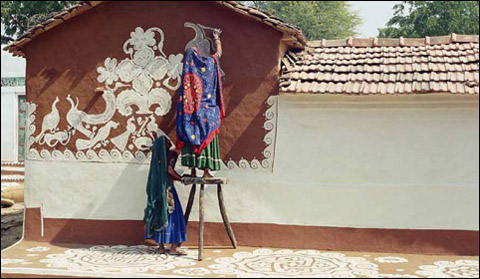
If you ask people to imagine “an artist”, what you’ll probably get is an image of a Renaissance man in a linen smock, or a slightly modernised equivalent. What you’re unlikely to get is an Indian peasant woman in traditional dress perched on a rough country ladder, painting the side of her house.

But browse through the pages of Nurturing Walls: Animal Art by Meena Women and the image in your head might well be changed.

Two short essays in the text explain and explore the women’s work, setting out how Mandana painting, as their work is term, is done by women from the Meena tribe in Rajasthan. It explains that the large tribe is concentrated as farmers in the Aravalli Hills, although they have a history as a warrior clan, which when overrun in the 11th century took to the hills as guerrillas, a role they maintained into the 20th century, leading to them being named by the British under the “Habitual Criminals Act” of 1930 as robbers and criminals whose movements needed to be curtailed.

Yet there’s nothing of this surely turbulent history in the images of this tradition, although perhaps a hint in the fact that it’s a temporary art, meant to be painted over again and again, as the chalk on mud fades. (Then again perhaps that’s simply a reflection of art has it has surely been through most of human history – a pleasurable creation to be immediately enjoyed, before we distorted it with the destructive effects of the market. And it gives a hint of how much of human artistic history we’ll never be able to recover through archaeology, except through the most unusual accidents of preservation.)

The style certainly broadly fits within that tradition somewhat patronisingly called “naive”, in that there’s no focus on realism, or the rules of perspective or many rules at all really (except one that’s probably largely practical – the great majority of the images are white chalk on brown walls).

And the skill of the artists, as you’d expect, varies – but the best of it here is truly stunning – captivating in its depiction of a playful love between animal mother and child, innervating in its lithe energy.
read more »

Books Feminism

Thoughts on Before I Go…Reflections on my life and times by Mary Stott

The London Library copy of Before I Go…Reflections on my life and times, by the late Guardian women’s editor Mary Stott, was last borrowed in 1998, and only a couple of times before that.

It’s a pity for her 1985 memoirs have much to offer the reader of today, and have many reminders that many of the issues with which we’re wrestling politically – from voting systems to maternity leave – have been the subject of furious debate for decades.

Born in 1917, she’s something of a bridge between the First Wave feminists and the Second Wave, which she viewed from a place of mature professional power and influence (one of the few women in that position at that time) with some understandable bemusement. By modern standards she’s unsound on the subject of “Ms”, she hated it, and rather unsound on homosexual rights, but given the world she grew up in, she’s humane, commonsensical and remarkably clear-sighted, while being self-effacing and alost frustratingly humble.

She’s much to say on feminism that still has powerful resonance today, for example:

“The spate of books on women’s subjects in the last few years has been extraordinary. Too many, in my view, have been inaccessible to me, who left my grammar school at 17, and to the girls who leave their comprehensives at 16 – not to mention many others in between. I think it is time to concentrate more attention on the writing, on the simple, comprehensible exposition of ideas rather than on the bibliography.”

She’s also interesting as a defector from Labour to be a founding member of the SDP in 1981, and a member of its executive in 1982, a self-identified political neophyte:

“…it takes a very strong and politically idealistic spirit to survive bickering over procedural hassles. Procedure has to be sorted out, but perhaps the political novices, ‘the nice people’, the ‘wets’ have a role in indicating, now and then, when we can summon courage to tackle the technicians, that ‘ends’ are really what matter and what keep enthusiasm alive, and, even, that means can corrupt ends. Sometimes I fear that the more ‘political’ one becomes, the more one is likely to lose sight of the goal that made one join a party in the first place.”

Today, as the conservative government talks much of Big Society, while also slashing funding for the institutions that might support it, she reports on the president of the National Council of Women, Helen Waldsax, asking “that the government should ‘acknowledge in some constructive form the public service given by so many voluntary organisations to this country’ and warned that unless this was done, many organisations would have to function at half strength, or even disappear, which would mean the loss of ‘the source of supply of many specialist skills’. She added, ‘a very important democratic principle is at stake here’. But there has been no sign that Prime Minister Thatcher, who so heartily approves, she says the voluntary principle, has taken any notice.”

But perhaps the most pervasive sense one gets from this book is the modestly and self-deprecation of a woman who was obviously powerful and exceptional. It’s a reminder of how women were taught to be – and must never allowed to be again.

Books Feminism

Nina Power’s One-Dimensional Woman

Article first published on Blogcritics.

Nina Power, if placed in a classification of feminists, would clearly fall within the socialist/Marxist camp, seeing the oppression of women arising chiefly from the economic base. But this is a sophisticated, nuanced form of this analysis, that is sensitive to the developments of the superstructure, as well as the base, of the past couple of decades.

Her One-Dimensional Woman is only about 50 actual pages of text, almost more pamphlet than book, but there’s a lot packed in, not all of it making an obviously coherent whole.

The title comes from Herbert Marcuse’s 1964 One-Dimensional Man, who is “fully immersed in the promissary world of liberal democracy and consumerism, and yet ‘the spontaneous reproduction of superimposed needs by the individual does not establish autonomy; it only testifies to the efficacy of the controls”. For women today, Power says, “what looks like emancipation is nothing but a tightening of the shackles”.

She begins with a brief exploration of the Sarah Palin phenomenon, which is something of an outlier, if a topical one. The conclusion: “She turns maternity into a war-weapon, inexperience into a populist virtue and feminism into something that even the Christian Right could approve of.” Power makes the point that if we allow the term “feminist” to be captured by such women, progressive women concerned about basic rights from access to abortion onwards will have to disown it – it is worth defending.

In a similar vein is the chapter on the attempt to justify the Iraq war, and particularly the Afghan war, by the claim that its purpose (so historically nonsensical) is to free the local women. The answer to this is easier, really, just listen to the local women, who are very clearly saying “get out”.

Then Power gets into the meat of her argument, that the workforce has indeed been feminised: “work is generally more precarious and communication-based, as women’s jobs tended to be in the past… Alternatively, we could turn this around and talk about the labourization of women – the way in which females are cast as worker first and only secondarily as mother or wife, or any other identity position not linked wiith economic productivity.”

Much of this has affected both sexes. So Power says: “The demand to be a ‘adaptable’ worker, to be constantly ‘networking’, ‘selling yourself,’ in effect, to become a kind of walking CV is felt keenly.” But for women this plays on older stereotypes to particularly focus on their looks, their clothes, their body, which bleeds into woman as consumer, and the claim that any consumer purchase – from lipstick to chocolate, is feminist indulgence, because you’re worth it.

On this, Power gets particularly strong: “Stripped of any internationalist and political quality, feminism becomes about as radical as a diamante phone cover.” (Here she’s being, I think on balance unfairly, strongly critical of Jessica Valenti.)

But perhaps the most original part of this text is the exploration of pornography, on which Power argues for historical perspectives. As she briefly alludes to, it is well worth remembering that pronographic images were used as a form of political communication during and around both the English Civil War and the French Revolution, but “the ahistoricism of the anti-pornography movement takes as its presupposition the idea that men will always nurture a violent desire towards women and that porn is merely a reflection of this”.

Power argues, however, that before WWII, porn lacked the mechanistic, highly specialised characteristics of today, in older forms, particularly French films, “sex isn’t just a succession of grim orgasms and the parading of physical prowess, but something closer to slapstick and vaudeville”. The performers, she says, genuinely appear to be having fun, and the “plot” not infrequently runs around men’s difficulty in “performing”. Very different she says, from sex that is clearly work in contemporary porn.

So there’s a lot here, but ultimately what it fails to do is really provide a road-map, a way forward. Power has entirely justifiable criticism of what is being presented to us today as “feminism”. But she doesn’t really tell us what her own looks like.