Category Archives: Politics

Environmental politics

Always read the small print

…or this might also be called another small example of globalisation idiocy.

I’ve got difficult, oily hair, and I’ve been looking for some time for an organic shampoo that can handle it. And I thought one day when dashing through Waitrose I’d found it – lovely lemon smell, really keeps hair clean for at least a day.

It was only when I was soaking in the bath, recovering from a tough cricket game, that I happened to read the really small print on the back, to discover that this plastic bottle has been imported from Canada – an utterly inordinate amount of “food miles”.

So it is back to the search for a British organic shampoo – really folks, it can’t be that hard!

(P.S. I’ve tried make-it-yourself with castille soap, lemon juice etc, but have not so far found that to be a success – anyone who’s got a good recipe, please let me know!)

Environmental politics

A small example of how our economy went terribly wrong

A small piece of conversational journalism from 1980 has left me with a jolt of recognition of just how far off the rails we gone in the past quarter-century or so.

Harry Whewell was musing then on the availability of wild bird seed. Why would you think about that, you might ask today? Isn’t it nice that people are trying to help the birds?

Well, yes, it is good people are thinking about the environment (if also seeking some entertainment for themselves by attracting the birds).

But what struck me about the article was how in 1980 this was an odd and new idea – or at least could still be presented as such.

Harry asks, very logically, why it was that people weren’t simply feeding the birds scraps from their own table, or else allowing plants in their garden to grow and seed? (Indeed he also notes that dogs and cats used to almost invariably be fed human scraps, rather than specialist food.)

He asks: “was there anybody who could not find crumbs in their cake tin, stale slices in their bread bin, and bits of bacon rind in the sink tidy, enough to keep half a dozen sparrows, two blackbirds, and a robin happy?”

He worries that the seed might be grown in Africa and being taken human supplies, or taken from wild places: “A charm of Cheshire goldfinches might find one autumn that its normal supplies of thistle seeds had totally disappeared, the plants having been stripped by foraging schoolboys and the seeds sold to pet shops in Manchester.”

And when you think about it, he’s absolutely right. (And to add in today’s concerns: all of that seed was shipped, using fossil fuel, to the mixing plant, packaged in plastic bags made from petroleum products, shipped likewise to a supermarket, and very likely carried home in a private car.)

Meanwhile, the same people who are carefully pouring this into the bird feeder, are most likely throwing large quantities of perfectly good food – certainly good for the birds — into the waste bin, from where it is carried in lorries to a landfill site, where it will eventually produce globally warming methane. And the supermarket that is selling it is carefully locking into its rubbish bins huge quantities of the same.

And they are very likely carefully mowing their lawn into a perfect sward, excluding with poison any “weed” (for which read seeding plant that the birds might like).

So many things that we do today, when you start to deconstruct them, are wrong from start to finish – even buying bird seed.

Books Politics

A migration, or a great journey…

They arrive, these refugees, asylum-seekers, “economic migrants”, in the developed world, from their home states that are dreadfully poor, war-wracked, or sometimes where they were born will no longer recognise them as their own. Sometimes we hear their stories, the Congolese in London, the Haitians in New York, but more often they are statistics, issues, problems.

Rarely do they get a chance to speak for themselves, to tell their stories. But that’s what Bibish has been lucky, and clever, persistent and brave enough, to do in The Dancer from Khiva.

And it’s a story from parts of the world we’re rarely exposed to, for she was born in a small village in Uzbekistan, a traditional Muslim area, where women were bound by strong traditional limits and restrictions. And she’s moved herself to a city just outside Moscow.

Her story’s a reminder that these migrants, these asylum-seekers, these supplicants, are in fact the brightest, the bravest, the best – the humans who will not settle for a small, constrained, sad life, who strike out, however unwisely and uncertainly, in search of something better.

Following the tales of Bibish’s life, as she breaks taboos by dancing and appearing on television, running off to study on her own, finding her own husband, completing her higher exams with a newborn baby and appendicitis, moving her reluctant husband and two sons to Russia, where she barely speaks the language and they face rampant, vicious discrimination – this is a trek of a life that bears comparison with the great explorers of history.

Yet all of that effort, that bravery, manages only to take Bibish and her husband to an uncertain life as market traders, with no security of housing or income, vulnerable to dangers ranging from theft to official persecution.

Bibish doesn’t come out as an altogether likable character; she’s doughty, tough and persistent, but prone to self-pity (understandable as it is) and still capable of remarkable naivety and with a strictly limited view of the world.

Yet this is a remarkable story, one that illuminates the uncertain place that so many people living in our cities now inhabit. Last year the landmark of more than half of the world’s population living in cities was passed, and Bibish’s story, while exceptional in being told, gives an insight into the tremendous difficulty of their experience.

(Yes, there were lots of other things I should have been doing this afternoon rather than reading this – blame Judd Books in Bloomsbury!)

Politics

Camden council calls for PCT to stop health centre tender

John Bryant, chair of the Camden Council health scrutiny committee, kept the best to last this evening, as after a long and sometimes heated debate about Camden NHS’s draft primary and urgent care strategy (formerly Camden PCT), he concluded that the committee would be recommending that all work on the tendering process for the proposed new GP-led health centre at Euston be postponed until after the public tendering process.

The long evening began with the PCT reps (I’m going to call them that for clarity) setting out at length the well-known facts about Camden’s healthcare problems, with huge disparities resulting in the 10 year gap in male life expectancies between the richest and poorest wards, the 20% of deaths due to smoking, and 29% of people being “hazardous drinkers”.

We also got at length the polyclinic network strategy, which aims to see GPs linked together, developing specialities and providing extra services, something broadly no one has problems with (although there are questions about the removal of district nurses into the larger structure).

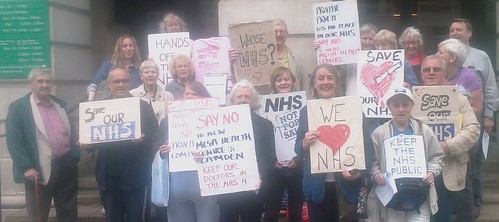
Then we got to the crux of the evening, the proposed GP-led health centre. Local campaigners – and the local community, as demonstrated by a huge public meeting this month, about which I had a letter in the CNJ this week – have expressed strong opposition to the plan, but tonight the PCT people, grudgingly, under questioning by councillors, admitted that they had already gone a long way to securing the building, and had begun the tendering process – all of this before commencing consultation, which is scheduled to start in July.

They say that they don’t have to consult on setting up the GP-led health centre, since that is mandated by the government, but only around the associated services. Whether indeed they are so directed to set up the centre was one of the evening’s key points of contention.

The Camden Local Medical Committee (an elected body representing all doctors working in general practice, with a statutory role), which expressed its clear opposition to the GP-led health centre, quoted a letter from then health minister Ben Bradshaw saying “these developments will only take place where it is ascertained after local consultation with the public and with GPs and other healthcare professionals that they will improve patient care for local communities”. This letter was also quoted by the Camden Keep Our NHS public delegation.

The PCT people in response quoted a letter from an NHS London bureaucrat; as one of the councillors said, you don’t have to be an expert on bureaucratic status to know that the minister trumps a bureaucrat.

They said they were now working fast because “London is behind the rest of the country in terms of timelines” (for setting up these GP-led centres). By the department of health targets they should already have delivered it, they said, but there had been confusion over the difference between polyclincs and GP-led health centres. (Although there still appears to be confusion: when a councillor asked about the way the new centre would be administered, who would be in charge of it, there was no answer.)

So what’s wrong with the GP-led health centre plan? This is how the Local Medical Committe puts it:
* We challenge the argument that this is a ‘must-do’ for the PCT
* We regret the lack of consultation with local GPs and patients
* We are concerned that resources will be diverted from other practices
* We do not accept this as the best way to address alleged ‘underdoctoring’ or health inequalities
* Patients of neighbouring GPs will not want their practices destablisied or forced to close down.
* Seeing unregistered patients will be costly, and will disrupt continuity of care and patient safety
* The procurement process is weighted against local practices and potentially lacks transparency. It ha also preceded local consultation
* We do not believe independent sector providers will improve health outcomes or patient satisfaction; nor will they increase access to GP care.

It wasn’t set out this evening, but the grapevine suggests that the PCT has on its initial shortlist four tenderers, of whom only one is a consortium of local GPs, with the rest being private providers, including American multinationals. It was explained that to bid for such a centre cost 50,000-60,000 pounds, with the big commercial operators expecting to get one in three or so of those bid for.

As well as the threat to GPs, this is one of the chief sources of opposition to the scheme, considerable complaints being expressed about the service being provided at the three local surgeries has handed over the American multinational United Health.

The delegation makes its point on the council steps:
nhsprotest2

You can find the agenda and the draft strategy here (and the NHS reports are in the appendix at the bottom).

Politics

Notes from the Compass Conference

I was speaking on Saturday at the Compass Conference, in a joint Fawcett Society/One World Action session on women and the recession, which was highly interesting, and which I’ll try to report separately, but this also gave me the chance to hear several other sessions.

There was an interesting mood at the conference, given Compass’s position — closely tied to the Left of the Labour party. Depression of course, about the state of the Labour party, but also a sense of new possibilities (with lots of talk of progressive coalitions), of new political space opening up.

The idea that clearly received the strongest support (that I heard anyway) was for a binding referendum on PR to be held simultaneously with the next election. There were many calls to campaign for that.

That new openness was shown by the invitation for Caroline Lucas to address the opening keynote session, aand an afternoon session also featuring her with Salma Yaqoob from Respect and Aadam Price from Plaid Cymru. Although there was little sign of openess from the Labour Party: Harriet Harman also addressed the opening session, but sat removed from the other speakers, and generally managed to convey that she didn’t want to be there.

Caroline Lucas suggested that Blair’s “experiment” with New Labour had been to attempt to bring readers of the Mirror into the same big tent as the Daily Mail. She suggested that what was needed instead was a campsite of smaller tents, within which events could be more honest and transparent.

Neal Lawson, chair of Compass, defending the invitation for Caroline, referred to the 10 proposed policies of the No Turning Back campaign. The Greens had supported nine of them, the Lib Dems six, and Labour none, he said.

He said that the rise of the BNP shouldn’t be attributed to the personality of the PM, but the rise of inequality.

We have reached the end of “steam-age politics” he said. People were fed up with waiting for leaders to do things for them, and were increasingly prepared to do thme themselves. “We are the people we have been waiting for.”

In the afternoon session, Salma noted that since 1997 not one single council house had been built in Birmingham, and it was now a Tory-led council that had taken a lead in recommencing building. “Most young people associate Labour with war, with deregulatign banking, with anti-migrant policies.” Among tthe three main parties, the neo-liberal approach had become so ubiquitous as to be invisible – it was the seen as the natural approach.

Adam Price said the progressive movement had to identify and support ideas as heretical and radical as free healthcare and council housing had been seen at the start of the 20th century. He proposed as the big idea the expansion of public services, to include free school meals, free personal care for the elderly, free uni-level education and free childcare.

And he said that inherited wealth was unacceptable. Rather than the “negligible” baby bond, there should be a social inheritance fund from which all could benefit.

He drew cheers when speaking about education changes in Wales that abandon formal learning until age seven. “We are finally turning out backs on the Prussian-based model of learning to prepare children for army and factory, and empowering children to believe that they are free, autonomous individuals.”

Caroline pointed out that when you counted the members of Amnesty, Greenpeace, the Terence Higgins Trust and many other progressive organisations, the movement had never been stronger. The problem was to engage these people in mainstream politics, when they were not inspired by Labour or the Lib Dems, and faced many barriers actively designed to keep them out: the voting system, the unelected House of Lords, and the fact that within the largest parties differences of views were ruthlessly suppressed.

Jon Cruddas said that the rise of the BNP couldn’t be attributed to PR: rather, first past the post had created the conditions in which the BNP can thrive, by leaving so many feeling excluded from the political process.

Responding to an enthusiast for independent candidates from the audience, Salma said the problem with British politics wasn’t too much ideology, but not enough of it. Caroline said politics should be about bringing people coming together, not becoming more atomised.
Politics

Why are people voting Green?

You might have noticed that I haven’t been here much; in large part that is because I’ve been out of the doorsteps and pavements of NW1 and WC1 in London, talking to voters and potential voters.

One of the stunning things about democracy is the wide range of views people bring to the political process, and the ways in which they make political decisions.

Here’s a small range (obviously I’m quoting from memory here; I wasn’t recording the conversations!):

Outside the farmers’ market in the Brunswick centre in Bloomsbury yesterday:

* “I saw Joanna Lumley’s backing the Green Party, so I’m now voting Green.”

* “I thought Caroline Lucas was excellent on Question Time; she was so poised. I’ve never thought about voting Green before, but I will now.

* “I’m going to vote Green or UKIP.” (This was a fascinating discussion: the young woman was hugely Eurosceptic and convinced each country should just be allowed to do what it wanted, even when I brought up Poland and coal-fired power stations; yet her views on every other subject we ranged over entirely matched the Green Party’s, and she was very keen to see women elected. But I still don’t know how she’ll vote.)

* “I used to be a member of the SWP (rueful shrug). I think you’re probably the best of the people likely to be elected.” (Man in his later 30s.)

On the doorstep in council housing in Somers Town, one of the most socially and economically deprived wards in London (and traditionally a Labour stronghold).

* “I’ve always voted Labour, but I’ve watched your election broadcasts and I agree with all of your policies, so I’m voting for you, and I’m happy to put up your election poster.” (A middle-aged man with a local accent: The poster was up by the time I walked back past it. This was the closest I’ve come across to the “perfect” model of how democracy is supposed to work.)

* “I haven’t seen anyone come around for many years. I’ll probably vote for you because you’ve done that.” (Older woman who has probably lived in the flat for many years.)

* “I vote for you because of your animal rights policy.” (Twenty-something woman.) I also had someone outside the Brunswick who probably wouldn’t vote for us solely on that basis – so you might call that one a draw.

There have been quite a few, but not perhaps so many as I expected, “I won’t vote for anyone; you’re all crooks”, but there’s perhaps a surprising interest in continuing that conversation among around 50% of people – and some are apparently won around by the conversation.

Others, however, are clearly not going to be swayed, including the woman who I heard clearly through an open window continuing an interrupted phone conversation after she’d almost, but not quite, slammed the door in my face. “It was a politician!” (said in tones of shocked horror). Well, that’s not quite the way I think of myself….but little point in arguing.

So, is this an electorate that is going to abstain in even huger numbers than usual, or is it going to march out to express its anger? I don’t know; there are a huge number of “undecideds” out there, and one of the things they haven’t decided is whether or not they are going to vote.