Miscellaneous

The literature of climate change? Where is it?

You might say it is too early, but Robert Macfarlane today asks in the Guardian – comparing it to the literature of nuclear holocaust – where is the literature of climate change?

And perhaps this is more than a question about creativity:

Bill McKibben, author of the premonitory classic The End of Nature (1989), has written of how individuals would not act against climate change – altering their habits of consumption, lobbying policy-makers – until they felt “fear in their guts”. Literature has a role to play in inducing this gut feeling, for one of its special abilities is that of allowing us to entertain hypothetical situations – alternative lives, or futures, or landscapes – as though they were real. It has a unique capacity to help us connect present action with future consequence.

I shall never forget reading Neville Shute’s On The Beach as a 12 or 13-year-old, illictly under the bedcovers by torchlight. When I finished, around 3am, Australian suburbia outside was dead quiet, and I was that I was the last person left alive in the world.

The same sort of scare about climate change, spread as widely as possible, could only be a good idea.

Miscellaneous

Persephone Books: The old and the new

My latest Persephone Quarterly tells me that this season’s books are about the very young and the very old. Doreen, published in 1946, is the tale of a nine-year-old Cockney girl sent away from the threat of bombing in 1939 to live with a middle-class family in the country.

The Persephone account says: As Jessica Mann [author of the preface] observes: ‘In 1946 few British people had yet heard of child psychology and specialists were only beginning to understand that bombs might have traumatised children less than the belief that their parents had deserted them.’ However, she concludes, ‘the separation of parent and child is a cruel fate but not as cruel as the risk of death.’

The psychologists might only have just thought of it, but the book makes it obvious the writers had.

The second book is There Were No Windows (1944), “based on the last months in the life of the writer Violet Hunt”. She’s suffering from a deterioration of memory that would probably today attract the label “Alzheimer’s”.

If you haven’t heard of the company, they “reprint forgotten classics by twentieth-century (mostly women) writers”. The books are paperbacks, but beautifully presented – ideal for presents. In fact I’ve give Miss Pettigrew Lives for a Day as a present several times due to multiple rave reviews – really must read it myself one of these days.

But really, if you’re stuck for a present idea, they’re ideal. And no, they’re not paying me!

Miscellaneous

Reports of Nushu’s demise were exaggerated

I first read about the unique script of Nushu, the only known one to be solely used to women, in the Sydney Morning Herald almost a quarter of a century ago. Then it was being “discovered”. Last year, it was being declared “dead”, when Yang Huangyi, its “last user” died at the age of 92.

Yet today’s Guardian reports that it is still going strong in its remote homeland in southwestern Hunan province.

The impetus is economic and the results anything but romantic. But the reinvention of the embroidered script as a tourist moneyspinner is reaping dividends and a new generation of girls is studying the language not for a means of intimate communication but because it offers a chance to earn more than their brothers and fathers.

It is thought that Nushu was invented by women so they could record their thoughts, and communicate with each other, without their words being intercepted by men. In the area there is a strong tradition of “sworn sisterhood”, and the script was one way women could maintain these relationships after marriage, when they could be torn from their home families and villages, to become virtual prisoners in the homes of their husband’s families.

There’s a whole website devoted to the script, the World of Nushu (it has some technical problems, but is worth sticking with) and you can see some examples of the script, in comparison with the Chinese, here. There’s also a short academic article and a Chinese account of an exhibition here here (although something seems to have been lost in translation, since it speaks of an exhibition, but doesn’t say where it was).

There also don’t yet seem to be any commercial sites selling items on the web – an opportunity for somebody!


Miscellaneous

History for nothing:clicks for free

(With apologies to Dire Straits.)

A great deal: the Oxford Dictionary of National Biography (that’s of the UK) is offering free access over the weekend. You do have to sign up, but it is a painless process.

I went looking for female “relatives” and found:

Etheldred Benett: (1775-1845) who “acted as a clearing-house for palaeontological and geological investigations throughout Wiltshire, though these were sometimes interupted by electioneering for her brother in the often sordid provincial politics before the Reform Act of 1832.”

Anna Maria Bennett, novelist: (d. 1808) Very much a self-made woman, from obscure origins, “she met Admiral Sir Thomas Pye while working in a chandler’s shop. She became his housekeeper and mistress in Tooting, Surrey, and had at least two children with him … Her daughter became the famous actress Harriet Pye Esten (1761?-1865).”

Louise Bennett,suffragist, trade unionist, and pacifist: ] (1870-1956): “It was the bitter labour conflicts in Dublin in 1913 that awakened Louie Bennett to full realization of the desperate situation of Irish women workers—‘the slaves of slaves’—who were very near starvation level. She founded the Irish Women’s Reform League and thereafter became the leading activist and organizer in the cause of economic justice and human dignity.”

Sarah Bennett, governess: (1797-1861) “The extent of her correspondence to former pupils, family, and missionaries (profits from the memoir were dedicated to the Church Missionary Society) gives an indication of the esteem in which she was held, especially as a role model for young ladies in similar straitened circumstances.”

Not such a bad lot.

Friday Femmes Fatales

Friday femmes fatales No 24

Where are all the female bloggers? Here, in my weekly “top ten” posts.

This week I’m a bit further on my way to the collection of 300.

First, I have to highlight Claire’s extremely promising new blog, We Are Still Here, which combines interests in feminism and history, so you can guess it is why the top of this list. Claire has been browsing the many little-known female writers on Project Gutenberg.

Staying on the artistic side, Gert, who promises she’s “woman-shaped”, on Mad Musings of Me, reviews a Donizetti concert performance. On Sudden Nothing, meanwhile, the Legendary Monkey wrestles with the difficult problem of writing about truth that is stranger than fiction. Then Deepa on Tea Shop on the Moon (what a lovely image) writes about Kamala Das, “one of the first women in India” to write about sex outside marriage, saying only now is she able to comprehend her courage, and her craft.

Moving on to “real life”, or something like that, Colette on Dancing on Colette’s Grave writes about the perils of internet dating. Bitter-Girl, who boasts she’s “now with extra cranky” is meanwhile detailing the perils of life in Cleveland and Lisset on Did I SHave My Legs for This? is lamenting the disconnections caused by the night shift. (Know the feeling – you might notice I often post at some pretty odd times.)

If that seems a bit depressing, then Laura Young on Musings of an Ant Watcher introduces Rasputina’s “wicked romp” “through territory one would never have dreamt possible for two cellists and a drummer” and Connie Phillips on Blogcritics is celebrating The Vanity Project, a musical celebration of “the LA dream”.

Finally, for those not yet convinced about Bill Gates and company, The Common Scold notes its non-existent diversity policy.

***
Last week’s edition is here.

***
Remember nominations are hugely welcome – I’ll probably get to you eventually anyway, but why not hurry along the process?

Miscellaneous

Two Englands: 1939, before and after

I noted yesterday how well HV Morton could write, on my reading of his I Saw Two Englands, which covers two trips across the country before and after the outbreak of war. Although much of it is more or less hack travel writing, this is also a fascinating portrait of a country on the cusp of war, and in the early “phoney war” period.

Two of the book’s images might sum it up:
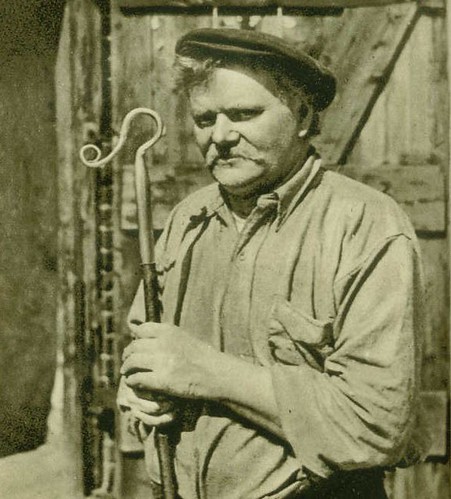
This is labelled “crookmaker of Pyecombe”. Morton laments that this is an England already almost gone – indeed you might call it a pre-WWI-style relic. “The head of the crook is of iron or steel, and nothing makes a better crook than an old gun barrel. The haft of the crook must be formed of unpeeled hazel for the shepherds will not have ash. They polish the hazel until it looks like mahogany.
As the purpose of a crook is to catch a sheep by the leg, and as the various breeds of sheep in England vary in size, there are many patterns. A Sussex crook would be of no use to a Kent shepherd, and a man herding Dorset Horns would require still a difference pattern. … Pyecombe crooks last more than a lifetime, but as there are fewer shepherds than ever on the Downs, there is not much genuine demand for them today. Instead the Mitchell brothers are generally busy making crooks for bishops and hikers.” (p. 111.-112)

Yet in between his accounts of architectural and cultural relics in the first section of the book, Morton is also seeing an England waiting for war. At Fotheringham, the site of the execution of Mary Queen of Scots, Morton finds a hand-written notice on the wall of the church about what is to be done after the proclamation of a state of war: “The Church bells will not be rung or chimed during the whole period of a state of War for any ordinary or special services … In the event of an enemy air raid threatening the village, the ALARM will be sounded by two, or more, of the church bells being rung continually for two, or more, minutes. When the alarm has sounded DON’T …. Be surprised at anything that may happen.” (p. 178)

At his hotel the next morning Morton meets an historian who says: “I gave up reading the papers last September and feel better for it in every way … there are not sufficient facts available these days on which anyone could base an opinion, therefore I feel I miss nothing.” (p. 179)

He also writes about class in a distinctly looking-down-the-nose way that must still have been acceptable in 1939, but that by the end of the war would, I suspect, have sounded a bit much. So in Fittleworth, Sussex, in the Swan, he has what he says is the only interesting conversation he has ever had with a bar maid. “The girl told me that she had been getting up at six o’clock for the past few mornings in order to photograph a family of foxes living on Fittleworth Common… no one, except perhaps Thomas Hardy, could have imagined a barmaid in the bracken, watching for little foxes.” (p. 113)
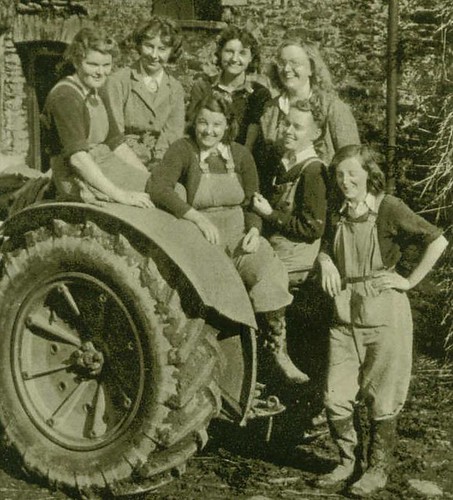
This of course is the post-outbreak photo, of members of the Women’s Land Army (“land girls”) being trained at an agricultural college. “As we were walking round, a shapeless female figure in voluminous garments passed across the weeping landscape … ‘She used to be a fashion artist,’ said the Principal. Another figure in corduroy breeches clumped past with a spade across her shoulder. ‘She was a typist,’ said the Principal. ‘No, I’m wrong, a ladies’ hairdresser.'” (p. 276) While he’s there a group of evacuated London schoolboys come past on a tour and express astonishment about where their food comes from.

The overall image is of a country is a state of slightly bemused dislocation, waiting for the bombs to fall, and in the meantime being disproportionately shocked by minor changes to their lives. “In the public-house between Frome and Bath … the tap room was full of the usual country characters, all talking about the War and listening to the B.B.C. news bulletin. Until the War the names of B.B.C. announcers had never been divulged, but as soon as War was declared, these gentlemen owned the best-known names in England. At first the phrase “and this is Frank Phillips reading it” was as startling and extraordinary as if The Times leaders had been signed.” (p. 214)

The postscript of the book has Morton as a member of the Home Guard (“Dad’s Army” – and this sounds like that) leading his platoon in a search for downed German airmen. “Harry and George clumb upon a mound of hay and prod about in it; and I am reminded of some story, read long ago, of Roundheads searching for Cavaliers…. Danger gas skipped us for a century or two; and now we are back in Danger, with a gun under the bed and an ear cocked for the sound of a signal” (p.285-7)

*****
One more interesting snippet as my postcript.

“The verb to canter is, of course, a contraction of a ‘Canterbury gallop’, which was the easy hand gallop into which the pilgrims urged their horses, possibly when they came to level stretches of the South Downs.” (p. 69)

(My edition is Metheun and Co London, 1942, I’d imagine the original, produced to the “Book Production War Economy Standard” – it is a hardback, but the paper’s very cheap-looking.)