Author Archives: Natalie Bennett

A wander around the wilds of Britain

I’ve been reading The Wild Places by Robert MacFarlane, and learning a lot.

Some words:

Holloway (from the Anglo-Saxon hola-wed, a sunken road. Always at least 300 years old, worn down by the traffic of centuries, some dating back to the early Iron Age. Many were drove roads – paths to market, some pilgrimage paths. Mostly found in the soft stone counties of southern England, the chalks of Kent, Wiltshire and East Anglia, the yellow sandstone of Dorset and Somerset, the greensand of Surrey and the malmstone of Hampshire and Sussex. Some 20 feet deep.

Turlough – a temporary lake that forms in limestone country after heavy rain, the water rising from beneath the rock. Also in limestone country flat pavements – e.g. on the Yorkshire moors, divided into clints, the glacially polished horizontals, and grykes, the fissures worn by water that divide the clints.

About animals…
Intelligent squirrels – “His phone line had gone crackly, then dead.. the engineers had found that squirrels had been nibbling the phone line. Apparently, Roger explained, this was becoming quite a common occurrence. Squirrels are highly intelligent, agile enough to tightrope-walk along telephone wires, and poor conductors of electricity. Somehow they have realised that by biting through to the bare wires and short-circuiting the 50 volts that run through them into their own bodies, they can heat themselves up. In this way, Roger said, each squirrel becomes a sort of low-voltage electric blanket – and will sit up on the wires with a stoned smile for hours.” Any telephone engineers out there that can confirm that?

About plants
“The devastation of the elm, when it came, seemed to some a prophecy fulfilled. For the elm had long been associated with death… It was ascribed maliciousness; if you loitered beneath it, branches would drop on you from the canopy. The tree’s habit of throwing out one strong side branch also made it a popular gallows tree. Elmwood was for a long time the staple wood of the coffin-maker.”
read more »
How does a hedgehog give birth?

Originally published on Blogcritics

How does a hedgehog give birth, given that the babies are born already with spines? The kind of question that mightn’t regularly pop into your head, but certain one that sticks there when you think about it.

The answer is that the babies are born swollen with fluid, so the prickles are beneath the surface of the skin. After birth, the fluid is absorbed and the prickles (which are evolutionarily speaking modified hair) emerge.

That’s one of the many fascinating facts that I learnt from A Prickly Affair: My Life with Hedgehogs by Hugh Warwick, a man who clearly doesn’t only live and breathe hedgehogs, but has certainly spent a lot of wet, cold English nights tracking them around the countryside.

I learnt that their ancestor is thought to have emerged in Asia during the Eocene, although there are ancestors dating back 70 million years, into the dinosaur age. In Britain we have Erinaceus europaeus, the western European hedgehog, although there’s species distributed throughout Eurasia, and down through North Africa.

They’re closely related to shrews and voles, being predominately insectivorous (Hugh watches one consume a large juice slug, having first wiped much of its slime off on a handy road surface – although it still chews a strong tasting leaf afterwards, presumably to cleanse its palate), unlike the American porcupine, which is a rodent. (And of course the Australian echidna, which is a marsupial.)

But this book is far from a collection of facts about hedgehogs. What it is mostly is a exploration of the author’s relationship with hedgehogs, and his meetings with some of the many people obsessed with them. (No wonder they’ve just been voted Britain’s national animal.)

We watch Hugh’s relationship with them and love of them develop as he takes on jobs tracking individuals around the countryside – primarily on projects to see how rescued ones fare when released back into the wild. Against all the rules, he develops, entirely understandably, a personal relationship with his subjects, giving them names and admiring their individual characters. (Although I suspect he’s wrong when he says voles and shrews aren’t similarly complex – look at them in the same detail I think you’d find the same complexity.)

read more »

Pterosaurs – forget practically everything you were ever told

tail

A shorter version was first published on Blogcritics

I last really looked at Pterosaurs some 30 years ago, when as a fossil-obsessed young teen, I haunted the paleontology section of the Australian Museum in Sydney. After reading Mark P. Witton’s new Pterosaurs: Natural History, Evolution, Anatomy I now know that practically everything the displays told me about pterosaurs, that they were incredibly light, fragile, clumsy creatures, walking on two legs, primitive in their evolutionary conception, were, while the “wisdom” of the time, entirely wrong.

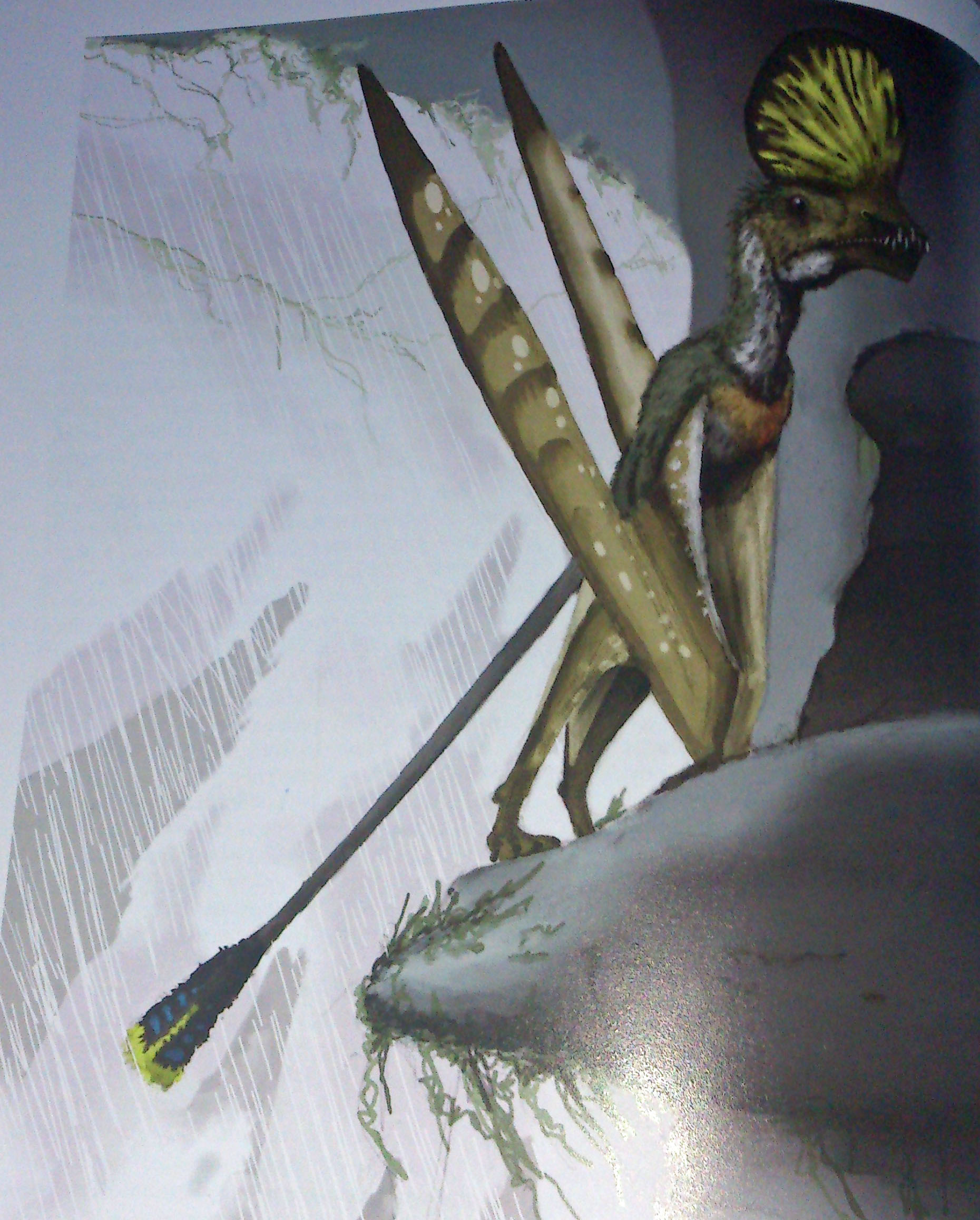
Pterosaurs is an unusual format – a coffee table-style book in its format, yet seriously academic, uncompromisingly serious in its content, except for an occasional whimsical light note, most commonly in the captions. To the right is, in Witton’s terms, is “one of the coolest-looking pterosaurs known”, Caviramus filisurensis. He also notes that “diddly-squat has been said in print about the biomechanics and functional biology of boreopterids“.

It’s unusual, but it works. I doubt too many non-academic readers will absorb every word about the anatomical morphology of ptesoaur types, or the long-running and often unresolved academic debates about the relative evolutionary relationships between different groups, but all the detail is there if you should want to dive in

giraffe

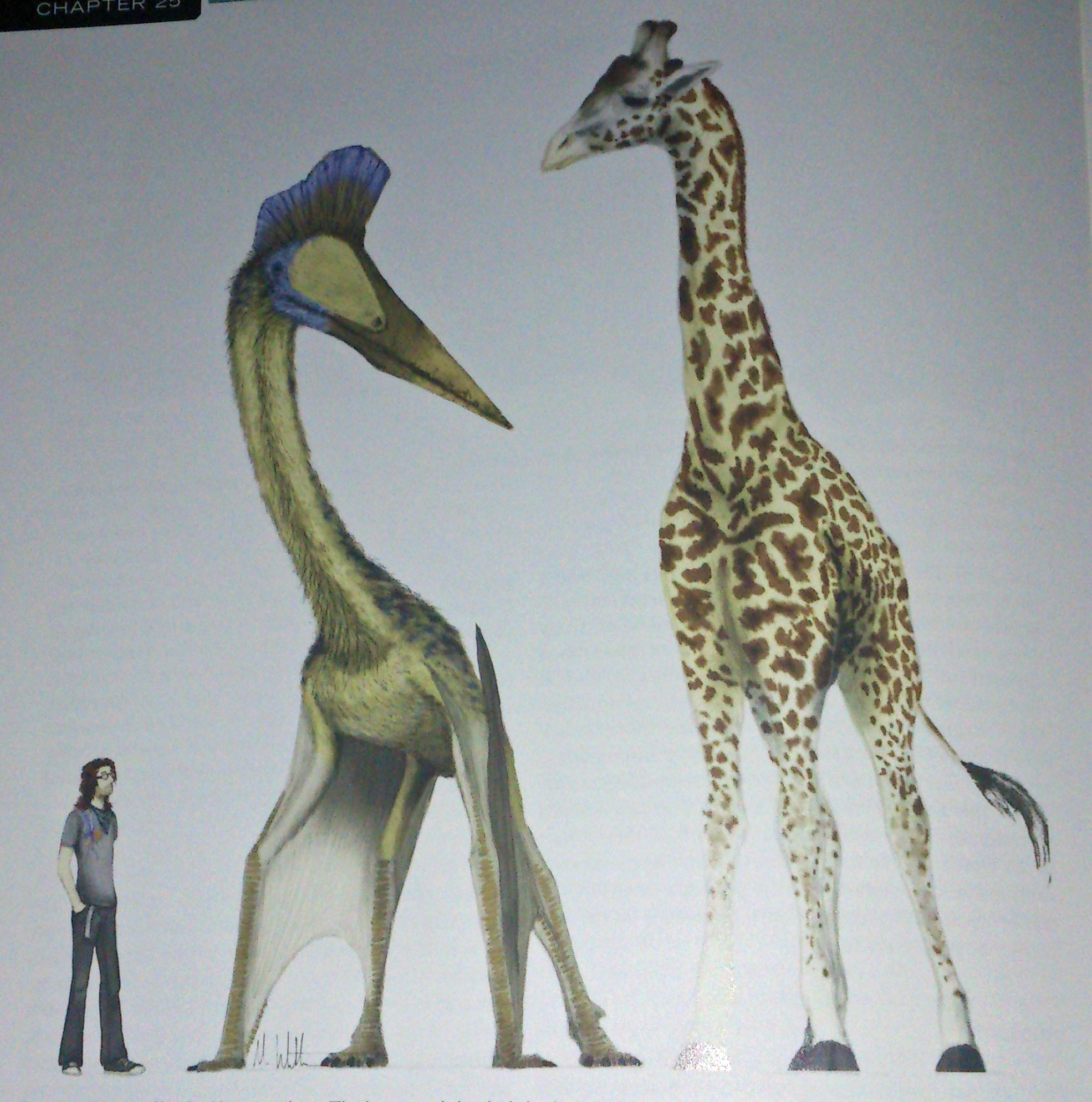
For those looking for the lighter version, there’s wonderful illustrations, also by Witton, of both reconstructions of pterosaurs in their environment, so far as we can know it, as well as a couple that help to put them in context, as with azhdarchid transposed with a human and a Masai giraffe right.

And the middle ground, in which I belong as a reader, to a whole exploration of the evolution, physique, physiology and ecology of this diverse, long-lived family that finally disappeared with the dinosaurs.

A lot of conventional wisdom is dispelled. Among the biggest surprises, that on the ground they were effective, often fast, movers, fully quadrupedal, that their bodies were primarily covered with a pelt of what are called pycnofibres, not scales or feathers, and that they aren’t dinosaurs, but belong to their own branch of the evolutionary tree, although whether that branches off before the Crurotarsi or after the Scleromochlus, or off earlier branches, is clearly a subject of much debate.

More, they were much heavier than had been predicted in studies of most of the last century, and not gliders or clumsy fliers, but every but as effective as the birds who eventually replaced in them in the skies. And they probably didn’t evolve from gliders, but from small, high energy little creatures (there’s a strong argument for the pterosaurs being warm-blooded – helping explain the pelt), running around trees or craggy cliffs.  Further, the headcrests that are a prominent feature of some species are not, at least generally, either aerodynamic features, or temperature regulators, but competitive mating features, generally only found on the males, which suggests, with other evidence, that many were lek breeders, with males competing for the control of harems of females.

So there goes pretty well everything you thought you knew about pterosaurs, if you picked the knowledge up a couple of decades ago. That’s not surprising, for Witton begins with short survey of pterosaurology, which records that, for reasons not really explicable, from the 1930s to the 1970s, studies virtually stopped, so that he world’s first popular pterosaur books, Dragons of the Air, published in 1901,  remained effectively the current state of knowledge.
read more »

Medieval dining – an unusual perspective on history

A shorter version was originally published on Blogcritics.

Food in Medieval England: Diet and Nutrition is a collection of academic monographs, arising from a diet research group that came to recognise that to maximise understanding of this fascinating topic, it is necessary to be truly cross-disciplinary, to draw on historical, archaeological and scientific expertise. Inevitably in any such collection, some articles are more accessible and interesting to the general reader such as myself than others, the overall picture is fascinating, and given there’s much lost ecological knowledge here, potential valuable. It fits rather neatly with another recent read of mine, also from the London Library, on medieval manure.

But above all there’s a detailed vision of medieval life, viewed from an unusual perspective. And that perspective, if we’re thinking of the diet most people for most of the time in question, is pottage – a thick soup based on grain but into which pretty well anything handy could be thrown, although as time goes on and wealth grows, bread becomes more important. In 1394, one Lincolnshire ploughman was given 15 loaves of bread a week, seven of them made from wheat (the most expensive kind – the poorest could be made from pea flour). Beer and ale consumption also rises over time, with the quality, so that 1365 the ordinances governing a chantry in Chesterfield were amended. so that “Where the ordinances say that the chaplain shall totally abstain from visiting taverns, this is to be understood as meaning that he shall not visit them habitually.” (p. 23)

There’s considerable insight into the medieval landscape through understanding of food and farming.

“Medieval cereals would have been much more genetically diverse, so that a single field -even of a single crop – would show (for example) variations in height, time of flowering, resistance to disease, and colour. Despite this internal diversity, there would still have been different races with characteristics in common that farmers would recognize; these are known today as landraces. Landraces offer a diversity of characterctics within a single crop, which reduces the risk of serious crop failure in unfavourable conditions. Under optimum conditions, this is generally at the expense of maximising yields; but for farmers in traditional agricultural societies, the trade-off is well worthwhile, as some harvest is considerably better than none. …fields can also be seen to have supported a considerable diversity of arable weeds… Some… may have been tolerated by farmers as a minor food source in their own right, especially for ‘green’. The various species of fat hen and goosefoot (Chenopodium spp) for example, have edible leaves, and recent experimental work suggests the collection or cultivation of fat hen in the late prehistoric period.” (p. 47)

Included here is much agricultural skills and knowledge we’ve lost, but might have to regain – even lost words, like ‘maslin’, a mix of rye and wheat, and spring-sown ‘dredge’, a mix of barley and oats. (p. 13) This could make a valuable read for those trying to restore sustainable agriculture to Britain.
read more »

Recent Reading: Women and The People: Authority, Authorship and the Radical Tradition in Nineteenth-Century England by Helen Rogers

You meet some fascinating women in the pages of Helen Roger’s Women and the People. The whole theoretical discussion left me a bit cold – not really my period or area, but I really enjoyed the characters,

There’s Miss Mary Anne Tocker, who in August 1818 successfully defended herself against a charge of libel brought by a lawyer who she had accused, writing under the name “An Enemy of Corruption”, of electoral malpractice in the West Briton and Cornwall Advertiser.(p12)

Then there’s Eliza Sharples – suspect I might not have liked her had I met her, but she in January 1832 arrived in London seeking, with remarkable sang froid, to be a “general” of the reform movement. In that year she became the “editress” of the Isis, the first radical journal run by a woman and a celebrated lecturer, and formed a “moral marriage” with Richard Carlisle, a leader of the campaign for a free press – quite a place for a 28-year-old daughter of a Wesleyan counterpane manufacturer from Bolton. (p48)

It isn’t a story that ends well – by 1849, a widow, she was appealing to a leading Chartist for help for her three children, saying that both she and the eldest, Hypatia, aged 13, “were employed in needlework, the girl earning only two shillings a week”. She wanted to pay for a few months apprenticeship to a milliner so Hypatia could get better paid work. The girl was “trading in the steps of womanhood to the same extent of helplessness in which we are all placed.” (p.161)

More cheerfully, we learn about the author of the posthumously published The Autobiography of Mary Smith: Schoolmistress and Nonconformist. Born into a rural family of small but insecure means, from an early age she managed the family grocery in Oxfordshire, but it was in part a move as a companion to the wife of a minister in Westmorland that enabled her to by step her meagre schooling and become a governess and schoolmistress – setting up the first school for girls in the area, although the villagers, who worked mostly in agriculture,could afford only scant fees.

What see wanted was to be a poet, but by age 40 she conceded that she did not have the means to pursue a literary career, and would have to “follow patiently the harder and narrower fortunes of meaner women”. But Shea also became highly active in politics – in temperance, suffrage and liberal causes, entrusted to be editor of the Liberal Club Circular in Carlisle before the first election I which many working men could vote. (p241-282)

Book Review: In Defence of Food by Michael Pollan

Michael Pollan’s In Defence of Food can really be read in two ways. First, you could read it as a diet book – a diet book to replace all other diet books, with a simple message, only eat food (I’ll get to his simple but effective definition of “food” later. Secondly, it can be read, equally powerfully, as in indictment of what he calls “nutritionism” – the professional and political approach to food that has misdirected our government policies over the past few decades.
On the later, he dates a major misdirection to 1977, when the US Senate Select Committee on Nutrition and Human Needs prepared a document “Dietary Goals for the United States”. It was based on the (we now understand mistaken) assumption that consumption of fat and dietary cholesterol was responsible for rising rates of heart disease. The committee recommended Americans consequently cut down red meat and dairy consumption.

In the way of lobbyist-driven American politics there was an immediate, enormous furore (Senator McGovern was to lose his seat at the next election as a result), and this was changed to “choose meats, poultry, and fish that will reduce saturated fat intake.” Politicians learnt a strong lesson: “Speak no more of food, only nutrients… in the revised guidelines, distinctions between entities as different as beef and chicken and fish have collapsed… Notice too how the new language exonerates the foods themselves. Now the culprit is an obscure, invisible, tasteless – and politically unconnected – substance that may or may not lurk in them called saturated fat.” (p. 14)