Category Archives: Miscellaneous

Miscellaneous

New Orleans: why?

Here’s the best analysis I’ve read of why the city was so physically vulnerable, and the reasons behind its current Mad Max state.

I’d like to think – and do think – that in a European city in the same circumstances people would be far more inclined to pull together and help each other; aside from anything else there’d be far fewer guns around to empower the ill-intentioned.

Miscellaneous

But where’s the loo?

It was in the Indian city of Varanasi that I first realised that provision of lavatory facilities is a feminist issue. Simply there are none, or at least weren’t when I was there eight or so years ago. For the men this wasn’t a problem; they just went anywhere. (One of the many things in Varanasi that contribute to it being a total hole of a place – if someone tells you to put it on their tour itinerary, ignore them.)

Women’s movements were effectively restricted to the range of their home, and the homes of any relatives or friends that might be along their intended route.

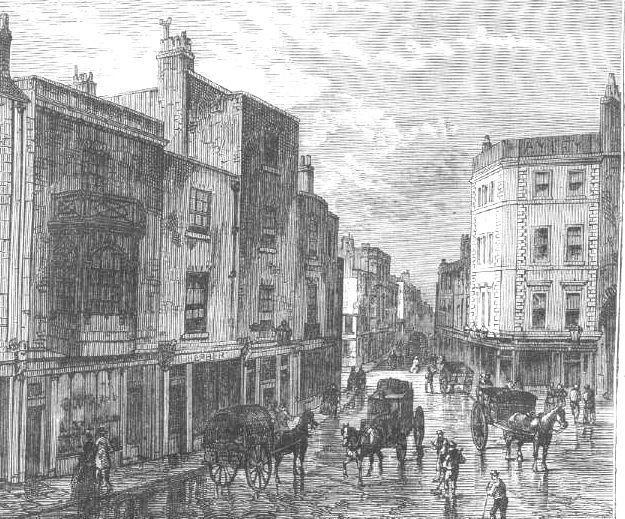
The above image is of London, Kensington High Street, about 1860. Then the same restrictions applied on Englishwomen.

“The middle-class diarist Ursula Bloom explained that when she was a girl ‘there were no public lavatories in England, and it was thought the height of indecency ever to desire anything of the sort.’ She went on to recall that ‘in London fashionable ladies went for a day’s shopping with no hope of any relief for those faithful tides of nature until they returned home again.’ …

Edith Hall, a working-class woman who was born in Middlesex in 1908, recalled that while walking with her mother along the Thames during the First World War, she asked, ‘There aren’t many lavatories for ladies, are there?’ Her mother matter-of-factly answered: ‘ Well, we are more lucky now … There didn’t seem to be any at all when we were young … Either ladies didn’t go out or ladies didn’t ‘go’.’ ” (Quoted in Shopping for Pleasure: Women in the Making of London’s West End, Erika Diane Rappaport, Princeton University Press, 2000, p. 82)

This also brings back memories of my agricultural science studies (my first degree – my only explanation is that I was only 17 when I chose it). We were the first year in which women were a majority, and the first-year excursion included virtually no facilities. Only wholesale revolts forced the bus to wait for the long queue using each farmer’s one and only loo. (And this was in northwest NSW, so no trees as an alternative option.)

*Image from Old and New London, By Edward Walford, Illustrated, Part 49, hard to date, but perhaps 1890s.)

Miscellaneous

Final fever update

Trying to sweat out a cold and fever with vigorous physical exercise is a really bad idea. I think my thigh muscles must have gone into meltdown, and they’re only very slowly recovering.

Dr Natalie says: Be sensible. Stay home in bed next time.

Dr Natalie asks herself: What would she do then?

And answers: Probably the same again.

Do as I say, not as I do.

Miscellaneous

Net nuggets No 19

* The Scandinavian states are often cited as paradises of gender relations. But it seems not all is right in the state of Sweden. A reminder, if one was needed, of the difficulties of changing deep-seated cultural patterns.

* The same might be said about this preview of a book about race in America which argues that the whites are the problem. Is it also true of Britain and Australia? I think you could make a reasonable case.

* Britain is sending homosexual men back to Iran, where they face persecution, maybe even execution. (Except in one case the victim committed suicide first.) Read this excellent post on Musings from Middle England and write to your MP; I have. (Found on Tim Worstall’s Britblog roundup.)

* But when it comes to pure barbarism, it is always hard to beat America. There’s an account on Women’s eNews of woman who had to go to court to enforce her right to an abortion, which of course she had to pay for, and made just in time. But what really struck me was the account further down the story of a woman who spent the last three weeks of her pregnancy chained to a hospital bed, having to call for assistance to have her chains moved when she even wanted to turn over. Now I’ve never been pregnant, and don’t expect to be, but when you see heavily pregnant women they usually look very uncomfortable and shift around regularly trying to find some relief. Just imagine!

Miscellaneous

Thai women and work

Finally, very belatedly, I’ve done a quick update on my website, which has been hopelessly neglected for almost a year in favour of the blog. I guess in my new freelance writing life I’m going to have to do a major revamp soon, but in the meantime I’ve just put up a series of articles on “Thai women and work”, written for the Kitakyushu Forum on Asian Women’s foreign correspondent programme for 1995-6, that I stumbled across during my recent move.

There’s Breaking through the barriers, a general overview, Sex work – A Labour issue? and Unemployment, A Looming Danger.

The statistics are not the latest now, but probably as up-to-date as many to be found on the web, and the articles might still be of use to somebody. (I do hate to labour over something that then just sits on a shelf.)

I know a lot more about HTML now than I did when I set up the website in 2001, although I’m still far from expert. I wrote these using a programme called Hotdog, which I got off the front of a computer magazine(!) I’m wondering if anyone can recommend any free or cheap programmes to use, as this now looks awfully clunky?

Miscellaneous

The man to ultimately blame for Wal-Mart

I’ve explored before the early modern practice of charivaris, or rough music, but was surprised to read of a late 19th-century example, and in London.

It was Guy Fawkes Day, 1876, and small retailers were protesting about the practices of William Whiteley, a former draper who was developing what would be London’s first department store. About noon …

A grotesque and noisy cortege entered the thoroughfare [Westbourne Grove]. At its head was a vehicle, in which a gigantic Guy was propped up … vested in the conventional frock coat of a draper… Conspicuous on the figure was a label with the words ‘Live and Let Live’ … In one hand of the figure a piece of beef bore the label “5 1/2 d” and in the other was a handkerchief, with the ticket “2 1/2 d. all-linen”. (Quoted in Shopping for Pleasure: Women in the Making of London’s West End, Erika Diane Rappaport, Princeton University Press, 2000, p. 16)

So this might be the man you could ultimately blame for Wal-Mart. “He became known as the “Universal Provider” – a merchant who claimed to sell anything to anybody. By combining dissimilar goods in one business and offering cut-price goods for cash only.” (p. 17) He was consequently, local shopkeepers complained, putting them out of business.

Thus the debate over Wal-Mart, Tesco and their ilk of our time has echoes in late Victorian London. And there are others.

In 1872 Whiteley had applied for a liquor licence for wine in his new refreshment room. But this could mean LADIES drinking spirits in PUBLIC! The otherwise general liberal editor of the local paper complained: “… sherry and silks, or port and piques, need not of necessity go together when ladies go ‘shopping’.” (p. 30)

Today the debate in England and Wales is over the extension of liquor licence hours, which is producing a similar moralistic backlash.

Some complained that the provision of abundant goods in opulent settings encouraged consumption. Even the provision of “rest rooms” encouraged “excessive shopping” that produced a “wild and reckless period …. things are done in a financial way that would make the angels weep … The afternoon’s excitement has … all the attractions of a delightful dream, with the slight dash of an orgy, leaving a lingering pleasure even over repentance”. (p. 38) Today’s debate is over-consumption of credit, and also, of course, plain over-consumption.

And finally, for those who complain about the pavement jaywalkers of Oxford Street, there’s the consolation to know that once “two young servants were fined for driving their perambulators abreast… The magistrate asked them: ‘How are the people to pass if you girls are gaping after soldiers and policemen?’ (p. 44)