Category Archives: Miscellaneous

Miscellaneous

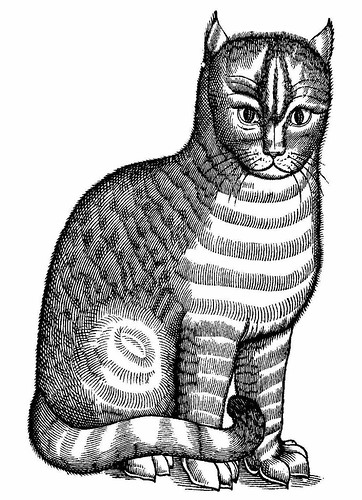
Friday’s cat is melancholy

.flickr-photo { border: solid 2px #000000; }.flickr-yourcomment { }.flickr-frame { text-align: left; padding: 3px; }.flickr-caption { font-size: 0.8em; margin-top: 0px; }


mcat, originally uploaded by natalieben.

… or at least so it seemed to Shakespeare.

I’ve just been reading a fascinating article built around Falstaff’s response to the prince’s suggestion that the jolly gent might become the official hangman in Henry IV, Part 1.

Falstaff’s response is “I am as melancholy as a gib cat or a lugg’d bear …”

It seems odd, since melancholy is one of the last emotions I would have thought we’d be inclined to lay on cats today – haughty, perhaps, playful for kittens, sleepy for some – but not expressions of sadness. (Even if gib seems to have meant gelded.)

But the article puts up a convincing case that what is “bodily or emotional figuration for us, preserved metaphors of somatic consciousness, was the literal stuff of psychological theory for early modern scriptors of the body”. (p. 116)

Everything was made up of the four elements of earth, water, fire and air, and their linked qualities of cold, wet, hot and dry. Cats were cold, for as Edward Topsell, in the Historie of Four-Footed Beasts, 1607, from which the above image comes, said: “Cats are of divers colours, but for the most part gryself, like to congealed yse, which commeth from the condition of her meate.” (“Yse” I assume means “ice”, although please correct me if I’m wrong.)

“A cat’s melancholy is a humour – hence a temperature, a temperament, a disposition and a liquid of specific consistency organizing its relations to the world.” (p. 119)

As so if you think of “icy” as “haughty”, perhaps our two points of view are not so far apart.

(The lugg’d bear, by the way, was being dragged out to be baited by dogs, which gave it plentiful cause for melancholy.)

From “Melancholy cats, lugged bears and early modern cosmology: reading Shakespeare’s psychological materialism across the species barrier,” Gail Kern Paster, from Reading the Early Modern Passions: Essays in the Cultural History of Emotion, Paster, Owe and Floyd-Wilson, Uni of Penn. Press, 2004.

Miscellaneous

Only in America

Only in (fill in the blank): this is a whole category of news story, the sort of item that usually ends at the bottom of a column of briefs. Witchdoctors make men’s genitals disappear, town believes world is flat, centipedes are worshipped here … They used to originate from Africa, or the further reaches of Asia.

But increasingly these seem to be coming out of America, that land of the unfree and deluded. Today’s examples:

1. I read on Slit that an 18-year-old has been charged with planning a terrorist act for writing a story about zombies taking over a high school. I doubt even the wilder reaches of al-Qaida have considered the use of zombies, although of course you can never be sure about the CIA …

2. I dread to imagine what a “Chuck-E Cheese” all-you-can-eat restaurant that seats 562 might be like, but you wouldn’t think eating there, even if you’ve lost the receipt, would lead to police officers using the human equivalent of a super-powered cattle prod on you in full view of your children. (Hat tip to Popping culture.)

3. And I was reading on And then I stepped in gum about her most commendable effort to teach her young charges that other countries existed, only to find that her co-leader was unaware that Canada was not a US state.

If that has left you with a mild case of depression, I offer the cheering, if slightly odd, news that you can brush up your classical Mongolian at a website based in Aberystwyth, Wales. That’s what you call “good globalisation”.

I thought learning to read Thai was hard, in part because vowels can be placed in all different positions around a consonant and also because words are not split up, but this looks a lot worse:

“All Mongolian words are based around single straight line which the Mongols call the spine (Mong. nighurun). All individual letters are then represented by flicks and dashes away from this central line.” (From Script Tutorial 1)

Miscellaneous

Carnivalesque No. 4

I’m not planning to go in the radical carnival direction suggested by The Rhine River, and turn history blogging inside out and upside down, but this Early Modern Carnival might be somewhat different in approach from its predecessors. I’m by training and profession a journalist, so narrative is my thing, although I also have a weakness for the grand theory ala Jared Diamond, and for the oddest of odd facts.

I’m also going to particularly prioritise posts by women bloggers and about women, because I’m a feminist, and I want to. (I made this decision after a Historical Association event at which the audience was about 50/50 male/female, but every person who addressed it — including questioners — was male.)

So to start, a joyfully brisk debunking of the “Shakespeare had syphilis” theory by Majikthise, and Pseudopodium’s exploration of the obstacles Fanny Burney encountered in trying to have her plays performed. This includes a link to the text of her first, The Witlings, prepared from the sole manuscript by the site author. (Browsing around the subject I found the play is to be produced this year.)

While I’m at the theatre, visit Idiocentrism for a biography of Lope de Vega, described without hyperbole as “one of the most prolific writers of all time”. With 1,800 plays to his name, I could almost break my journalist’s rule of always qualifying an absolute to say THE most prolific.

Scribbling Woman, meanwhile, finds two men with the attractive name of William Smellie contributing to the sum of human knowledge, and human existence, in the 18th century. A modern-day doctor is rather less confident, however, as he tries a home visit in 1740.

But you have to be envious, for Barista has found a man who knew everything, including how to interpret hieroglyphs in 1635. Well so he said ….

Charles II didn’t know where one of his favourite dogs was, however, as Prodigies and Wonders reports; it appears the monarch had a trusting faith in canine nature. The Duke of Bedford, however, had great faith in the efficacy of cats as pest controllers, as recorded by Cronaca, a blog that does an excellent job of aggregating history stories in the “old” media.

Carnival mistress extraordinaire Sharon has also been getting bestial, with a look at Cats, rabbits and monstrous births prompted by yours truly, who did a bit of Friday cat blogging not intended for feline fanciers.

This inspired “Ephelia” to recount the sad story of Mary Toft, while Siris took this explanation of monstrous births to a higher level, with a detailed exploration of the early modern view in Malebranche and Seventeenth-Century Views of Heredity.

If you’d prefer a machine, you might like to try one of the automata of the attractively named John Merlin, who might have inspired the young Charles Babbage, on robmacdougall.org.

Less attractive elements of human nature are discussed by Detrimental Postulation in a critique of a popular article finding in Shakespeare the origins of a definition of “whiteness”.

For those who’d like to apply early modern thought to modern conundrums, Ancarett’s Abode, meanwhile, is finding that all students are Little Whigs, while Zippy Zappy She Goes is finding some nasty parallels between the tactics of The Taming of the Shrew and the modern-day Promise Keepers.

But would John Locke have advocated toleration of Islam? Positive Liberty asks, for those who like a mix of current affairs and EM history.

The question “was John Calvin a geocentrist?” probably doesn’t keep you awake at nights. Prosthesis’s post is, however, an extensive and interesting exploration of the historiography of the claim, as well as Calvin’s actual view. Go on; a bit of early modern theology won’t hurt you …

And while I’m being philosophical, Houyhnhnm Land has put up a collection of resources on Lady Mary Shepherd’s Causal Theory, which aimed to establish “the relation of Cause and Effect, which can be securely used, as an efficient instrument in the advancement of science”.

But was the Old Regime of France similar to a Stalinist state? Positive Liberty explores that question via the law against artichoke litter on the Rue des Ecosses.

Leavening the mix, I’ve noticed history blogs are getting increasingly pictorial, and a fine example of this trend is Giornale Nuovo. One post explores the gorgeous pictorial alphabet of Giuseppe Maria Mitelli. If you want to set up your own database, Scribbling Woman can point you in the right direction, while The Social Affairs Unit will be pointing you in the direction of Buckingham Palace, with a glowing review of Dutch Paintings at the Royal Collection.

And if you want to find out where that “luminously mysterious Vermeer, three brilliant Rembrandts, a powerful Hals” et al came from, visit Rhine River’s exploration of the Netherlands’ miracle.

But there’s nothing like a good pun. Chapati Mystery reports on an excellent, although apocryphal, one from 1843, marking a British military victory in Sindh.

Now this may be cheating slightly, since it is actually an old post, but it is at the top of the blog, and I don’t think we’ve had anything from what’s now Slovenia before, so check out The Glory of Carniola.

Moving away from Europe, Regions of The Mind claims to have gone quiet while working on the book, yet still found time to report on the differing differing perspectives on war of the two sides in early colonial America (and lots of other interesting historical issues). God didn’t matter, however, to the Founding Fathers, or at least one treaty so suggests, Ralph E. Luker argued on Cliopatra.

And you think you know when America became independent? No loss for words will set you straight.

Also in America, Mode for Caleb is teaching about the forgotten black abolitionists, while Pratie Place reports how Jewish pirate saved Louisiana.

Heading further from London, Japanese sumo wrestlers were not always the established symbol of the nation that they are today, Far Outliers tells us, while as it gradually drifted away from anything like real combat, alternative forms of military training sprang up.

Frog in a Well, meanwhile, is pondering early modern numeracy, and the question of whether the samurai might have been less numerate than their “lower-class” compatriots.

Bringing the continents together, Chapati Mystery has been been making links across time and cultures, looking at inauguration/coronation ceremonies in Tudor England, for the Nigerian Umundri, medieval India, and of course the one we’ve just had in the US.

I was also looking at historical links in Three degrees of separation, which reports how I found the London district of “Alsatia”, which linked to Thomas Shadwell, who took me to the actress Anne Bracegirdle, at whom I’ve previously arrived from an entirely different direction.

Now who can link Japanese sumo wrestlers to the glories of Carniola in six degrees of separation or less? Answers in the comment field …

The next Carnivalesque, at the start of May, will be hosted by Nathanael at Rhine River, email rhineriverATearthlinkDOTnet . Nominate earlier; nominate often ….

If you’ve inexplicable missed the others, here’s No 1 and No 2. News on future carnivals can be found here.

(And if I’ve made any errors, or missed anything, please tell me. I’ll be happy to make any necessary corrections.)

A tag:

Miscellaneous

A delightful, and frightening, naivete

.flickr-photo { border: solid 2px #000000; }.flickr-yourcomment { }.flickr-frame { text-align: left; padding: 3px; }.flickr-caption { font-size: 0.8em; margin-top: 0px; }


china, originally uploaded by natalieben.

“What I longed for has arrived”, by Wu Zhefu, Li Mubai (1978), from an exhibition now in Leiden.

Communist realist art is often brutal and inhuman, but it can also display a touching faith in human nature and perfectability, as I think this poster indicates. It is a reminder that there was, at the start, an idealistic dream.

It also curiously brings back my memories of a noodle soup shop on the back streets of Xian (home of the terracotta warriors). I was welcomed there like an honoured guest, and carefully tended by the staff, while the customers went through my bag (with my permission, not that there would have been much point in refusing) to “read” all of my books, and my passport, and use them as the base for a conversation in sign language. There was the same eager hunger to learn that this poster depicts, but this time about capitalism!

Images of women are frequently less positive, however. Picturing Women “explores how women are figured, fashioned, turned into portraits, and told about in words and pictorial narrative”. The online version of a gallery show, it has some fearfully vicious images – check out particularly the caricatures. Some can be sent as e-postcards.
(Hat-tip to Scribbling Woman.)

Finally, some good advice from Mark Twain: “Write without pay until somebody offers pay. If nobody offers within three years the candidate may look upon his circumstances with the most implicit confidence as a sign that sawing wood is what he was intended for.”
(From the Freelance daily newsletter)

Miscellaneous

Final call, final call …

Only two days to go until the next Carnivalesque, and yes it will be here.

I’ve had some interesting submissions, but I couldn’t exactly say they’ve been flooding in, so please don’t be shy: nominate yourself for a little glory now – enhance your dignitas and auctoritas in the blogsphere. (Yes I have been in ancient Rome for a few days now.)

Submissions of blog posts on any early modern history subject under the sun should be sent to natalieben at journ.freeserve.co.uk as soon as possible. If you’re thinking “Carnivalesque?”, there’s an explanation of this gathering of early modernists here. (For these purposes “early modern” is defined as covering the period between c.1450-1850. Anything posted in the past two months – more or less – is most welcome.)

And to get in the mood, check out History Carnival No 3; no ancient Romans, but Rastafarian visitations to Ethiopia, women during the Meiji Restoration and lots of other fascinating stuff.

P.S. I note that while I’ve been away my auctoritas has so risen that on the TTLB Ecosystem I’ve been promoted from a “Flappy Bird” to an “Adorable Little Rodent” – not sure how that came about, but perhaps I should loll around reading for days on end and not posting more often.

Miscellaneous

Sickbed reading and historical consciousness

Apologies for being away longer than planned; it was a horrible cold, so I had five of those most frustrating days when you have endless hours to read but neither the concentration nor energy to read anything in the serious stacks. Instead, when I’m in this state I just want to read “escape” books – ones in which you disappear into another world for hours at a time, only emerging when the cough gets too pressing or the fever decides to have a spike.

So I dedicated myself to rereading Colleen McCullough’s six-volume ancient Rome series. (They’re about 800 pages each, so there’s plenty of escape.)

And although these are page-turners rather than “great literature”, and of course you know how it all comes out in the end (for those unfamiliar, they cover the fall of the Republic, from the rise of Marius to Octavius’s defeat of Mark Anthony), they are meticulously researched and well put together – no jarring anachronisms.

Reading the second-last, simply entitled Caesar, which starts with his Gallic Wars, I was reminded that I should have already known about the European headhunters on which I posted recently, since they feature quite prominently. I also learnt that they particularly terrified the Romans since a headless body would have no means of carrying a coin (which was put in the mouth) to pay for the ride across the River Styx into the underworld, so instead all that remained of the person would wander as a demented shade across the earth.

I read the series also musing about the possibility of a historical novelist actually getting inside the head of a character from another time, prompted in part by an interesting recent post on the problems of historical mysteries by The Little Professor and in part by my small role as a research subject on the handling of ancient objects that I do at the British Museum.

I sometimes there share my question – one without an answer, but I find it fascinating nonetheless: if you could jump in your time machine and go back to meet the person who made this hand-axe you are now holding 350,000 years ago, or even further back, to the person making this chopper 1.8 million years ago, would you be able to communicate with them?

Obviously you wouldn’t be able to talk to them, but would they understand the body language that communicates peaceful intentions, or a desire for food or water, or other things that I’ve found can be communicated very well without language in farflung parts of the world today?

I’ve never come across a discussion of this, but I wonder at what point a grimace – the drawing back of teeth to show threat or anger – became a smile? (Have to be careful with that in the time machine.)

So does McCullough manage it with a far easier subject, on a time from which considerable contemporary writings survive?

In some ways yes, and in the ways you might expect the sources to allow her. She’s excellent on dignitas and auctoritas, I think, and not bad on issues of patron-client relationships – overall on the whole way Roman politics worked, not just the theory of it.

How can I judge? Oddly, the place where I’ve seen something fairly close to what she describes is Thailand; its modern “democracy” bears remarkably resemblances to ancient Rome’s, including the centrality of patron-client relationships, the concept of “face” being all-important and broad scale bribery of voters.

It is on the domestic stuff, on really getting inside how people think, that she fails, or perhaps necessarily swerves into the modern. Her Romans are, I think, far too humane, too nice to their slaves, too kind to their relatives, in a society that regarded such behaviour as a weakness and a folly. (Except those characters who are out-and-out villains.)

Her Marius proscribes only when senile dementia has taken hold, her Sulla only for the necessity of state, and Caesar only while being sickened at the need to take action to prevent further bloodshed in the long term.

But then, if her main characters weren’t like this, would we not be repulsed by them, or at least insufficiently seduced (and her Caesar in particular is very seductive) to stick with them for 800 or more pages?

Probably not. She is caught like the historical mystery writer by the demands and conventions of her readers. It is perhaps we rather than she who can only go so far into the head of an ancient Roman.