Category Archives: Miscellaneous

Miscellaneous

Salute the queen

.flickr-photo { border: solid 2px #000000; }.flickr-yourcomment { }.flickr-frame { text-align: left; padding: 3px; }.flickr-caption { font-size: 0.8em; margin-top: 0px; }
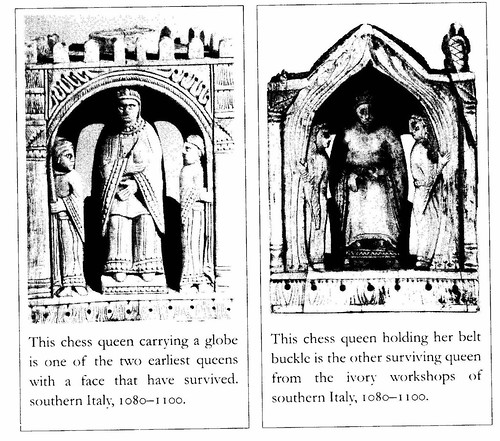

chessqueen, originally uploaded by natalieben.

Luckily, most of the sales of review copies of books held in newspaper offices (which raise money for charity) are held at lunchtime, when I’m not there, otherwise I’d have already had to move out of home to make space for the bookshelves.

But I was reminded of what I’m missing by a rare sale I managed to get to, where I bought (along with lots of other books), Birth of the Chess Queen: A History, by Marilyn Yalow, 2004, Pandora.

It explains that when chess was invented in India, then transplanted into the Muslim world (where non-figurative pieces were used because of Islamic iconoclasm), and finally arrived in Europe with the Moors, the piece that stood beside the King was the vizier.

The first chess queen recorded appears in a manuscript written in the late 990s in the Einsiedeln Monastery in Switzerland. The monk who wrote it was German-speaking, although of course he was working in Latin. He makes no particular remark about her presence, so the piece was obviously well established. (p. 17)

A pawn, as today, could become a queen by getting to the other end of the board, but only if the original queen had been taken.

“…an attempt to preserve the uniqueness of the king’s wife, his only permissible conjugal mate, according to Christian doctrine…. The idea of multiple queens on the chessboard proved so anxiety-making for Europeans that it remained a subject of contention for centuries to come”. (p. 18)

The author seeks to find a unique model for the chess queen, proposing either Adelaide of Germany, queen to Otto I, “a second Charlemagne”, or her daughter-in-law, Theosophano, the Byzantine princess, queen to Otto II and mother and regent to Otto III.

This I’d suggest is problematic – perhaps one sycophantic courtier might have had the idea of commissioning a set featuring a single powerful queen, but the idea would sure have not caught on broadly, with chess seen as a model for courtly life, unless queens in general were significant “players” in politics and war.

Yalow indeed makes this point, saying: “for a brief period in the 980s, the rule of queens regent was dominant in Western Europe. Not only were Adelaide and Theophano regents for Otto III, but Adelaide’s daughter Emma was regent for the French King Louis V, the duchess Beatrice of Lorraine ruled for her minor son, and the youthful Aethelred II in England was under his mother’s tutelage.” (p. 26.) It is surely no accident that about this time the chess piece appeared.

It’s “funny” how little focus gets put on such periods of history.

P.S. This is an interesting read, but irritating when the academic writer makes patronising attempts to cater to an “ordinary” audience. Reaching them surely does not require the profuse use of exclamation marks!
Miscellaneous

Raise your glasses please …

Virginia Woolf said: “All women together ought to let flowers fall upon the tomb of Aphra Behn, which is, most scandalously but rather appropriately, in Westminster Abbey, for it was she who earned them the right to speak their minds. It is she — shady and amorous as she was — who makes it not quite fantastic for me to say to you tonight: Earn five hundred a year by your wits.”

Not quite, I would argue in the light of today’s knowledge, historically accurate, but Behn deserves it anyway today, on the anniversary of her baptism. (Her birth date is not known).

Which I know from Today in Literature’s free newsletter. (This link will only work for a couple of days.)

I’ll be raising my glass this evening for this, and for my cricket club (belated) end of season dinner. It may be some time before I return.

Miscellaneous

‘Queen Elizabeth’s posset for winde’

Half an ounce each of ginger, cinnamon, galingale, aniseed, carraway seed, fennel seed and two drams each of mace and nutmegs, to be reduced to powder and taken before or after meat.

(Galingale seems to be galangal, as used in Asian cooking.)

There’s certainly plenty of testament to the early spice trade there – and I reckon it might have even worked. Certainly aniseed and cinnamon help to settle my stomach.

(The English Abigail, by Dorothy Margaret Stuart, London, Macmillan & Co, 1946, p. 22.)

Miscellaneous

More to celebrate …

… about the EU. It might even (partially) save the US from itself, by tightening standards for consumer goods in chemical content, recycling.

“Cameron points out that the United States and the European Union remain each other’s most significant trading partners in the world–our entanglements are deep and abiding. But as Europe becomes a more assertive political force, the question will become, as he puts it, “Why shouldn’t Americans enjoy the same standards as Europeans?”

Such a basic question used to run in the other direction, when the United States set the gold standard for the world’s environmental health. And the answer strikes at the core of the Bush Administration’s most savored narratives–that we, alone, are masters of our nation’s fate.”

From The Nation, via Arts and Letters Daily.

I’ve another celebration here.

Now I’m off to write my Christmas cards. My record is sending them on Boxing Day, but this year I’m aiming to actually get them to (most) people by Christmas Day.

Miscellaneous

Thank Cecilia

I learned yesterday that if you want to thank, or blame, anyone for the “1066 and all that”, perhaps it should be a nine-year-old girl called Cecilia.

She was the daughter of William the (to be) Conqueror and his queen Matilda, and she was given to a monastery in France before the invasion set out to help to ensure God’s blessing on the expedition. She became a great abbess at Caen. There’s a geneological summary here.

This was at a Historical Association talk at the Swedenborgh Society in Bloomsbury; a lovely hall very evocative of 19th-century “self-improvement”.

The Historical Association local branch programme can be found here.

Miscellaneous

This week’s acquisitions

.flickr-photo { border: solid 2px #000000; }.flickr-yourcomment { }.flickr-frame { text-align: left; padding: 3px; }.flickr-caption { font-size: 0.8em; margin-top: 0px; }


abigails, originally uploaded by natalieben.

Only two this week, possibly because the post is getting even slower than usual.

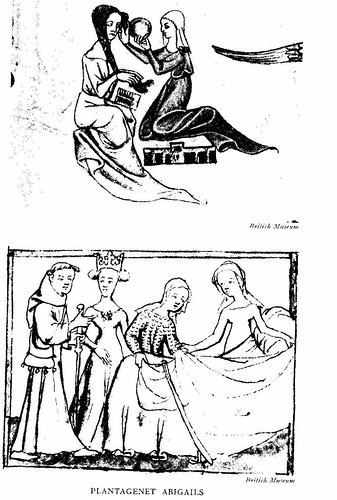
One is the curiously titled The English Abigail, by Dorothy Margaret Stuart, London, Macmillan & Co, 1946, from which the above illustration is taken. “Abigail” is apparently a term for servant, although I’ve never heard it before.

It traces from Norman times into Victorian, although its definition of “servant” is rather broad, seemingly from the lowest scullion to the Queen Elizabeth’s Chief Gentlewoman, Blanch(e) Parry.

The above illustrations are apparently from the Luttrell Psalter; “We see her kneeling beside a young lady and holding up a round hand-mirror so that the effect of the elaborate head-dress may be seen; we see her helping to make a bed, and stretching out streets which fall into symmetrical, angular convolutions…” (p. 4)

One theme that carries through the book is how the “great and good” are always complaining about the servahts climbing above their station, from the 14th-century poet John Gower to a correspondent to The Lady’s Monthly Museum or Polite Repository of 1823:
“I found nothing but young ladies, delicately arrayed in white, with their heads a la Brutus, who declared they were all anxious for places, and wished to go out to service.”

The second purchase was Letters from Dorothy Osborne to Sir William Temple (1652-54) edited by Edward Abbott Parry. It is available online, as I mentioned here, but for £1 on ebay how could I resist?