Category Archives: History

Lady of Quality

Making sense of the world in the 19th century

Miss Frances Williams Wynn is today hearing more stories of the exotic east from the mysterious Mr Davidson.

Davidson has a theory of his own on the subject of the Pyramids. He considers them as signs or monuments in commemoration of the Deluge, deriving the present name from Py (the) Aram (ancient).

The most startling fact which he told us was, that in Mexico and on the coast of Coromandel there exist to this day pyramids of still greater magnitude than the Egyptian, but not as high.”

I can identify the Wilkinson who entered into a debate with Davidson – his papers are in the Bodleian. He was a distinguished Egyptologist and he married a very interesting-sounding woman, Caroline Catherine Lucas (1822-81), described as an antiquarian, botanist and actress! I haven’t been able to find any independent info about her. Anyone know her?

(By the way: should you want to see all of the Williams Wynn posts together just click on “Lady of Quality” below.)

Early modern history

Should you have run out of Viagra…

Off to a medieval talk at the IHR tonight. It was supposed to be about biographies (which ties in with several things I’m working on at the moment), but that was cancelled so instead it was an entertaining account of an obscure German text of 1551, On the Healing of Magical Illnesses by Bartholomaeus Carrichter, a physician of no known education dismissed by the qualified men of Vienna as an “empiric”, although associated in the mind of many at the time with Paracelsus (and translated into three languages and being reprinted into the 18th century). The talk was by Catherine Rider of Christ’s College Cambridge.

She said that most of his 30 or so recipes didn’t have an identifiable written source, suggesting they might be fairly widely held popular remedies. What is curious about it is that before providing cures, Carrichter presents a detailed account of the witches’ methods – one interesting thought is that this is a covert witches’ manual.

There’s certainly some folk echoes in this one: “The witches prick a pretty apple with a needle, with which a dead person has been sewn into their shroud, and then straight away drip the juice of oxtongue plant into the holes they have made, and keep the apple with them until the holes have dried up by themselves, and they cannot be seen. Afterward they present the apple to a maiden or woman”. Sleeping Beauty anyone?

Lots of the cures are for impotence, and I have a feeling the Freudians might have something to say about them – the afflicted man should “pull a stick out of a hedge, sit down on the ground and lay his penis in the hole, where the stick has been pulled out, and urinate into it. Then he should stand up, put the stick that he has pulled back in the hole, and pray to God that he will be healed.”

History

The carnival moves on

The History Carnival No 31 is now up on Airminded. I was particularly taken by a novel, classy way to introduce the birth of a baby, an account of the evolution of a Wikipedia entry, and a novel use of Google Earth to map the lives of Henry VIII’s wives.
But do go and check out the whole thing.

Early modern history Women's history

Well-spoken children and Latin-speaking nurses

From Sir Thomas Elyot’s, The Book Named Governor, 1531:

“…it shall be expedient that a nobleman’s son, in his infancy, have with him continually only such as may accustom him by little and little to speak pure and elegant Latin. Semblably the nurses and other women about him, if it be possible, to do the same; or at the leastways, that they speak none English but that which is clean, polite, perfectly and articulately pronounced, omitting no letter or syllable, as foolish women often times do of a wantonness, whereby divers noblemen and gentleman’s children (as I do at this day know) have attained corrupt and foul pronunciation.”

Some things about the English class system don’t seem to change…

Interesting, though,  that he’s expecting, or at least setting out as an ideal, that the female attendants in the nursery who are – except perhaps in the case of royalty – unlikely to be of high status or class, are being expected to know Latin, and indeed presumably know it quite well.
(Quote page 18, Everyman 1962 edition)

Lady of Quality

Tales of the exotic east

My 19th-century “blogger” Miss Frances Williams Wynn is today hearing stories from an eastern traveller, most notably about Lady Hester Stanhope, although sadly mainly in the days of her decline.

I haven’t been able to identify the “Mr Davidson” from whom she is hearing the tale – anyone know who he is?

Cycling History

Through the fields of Cambridgeshire

Despite the failure of the BBC weather forecasters to deliver on their promise of a sunny afternoon, I’ve just returned from a pleasant cycle tour through the history of Cambridgeshire (with a dominant overlay of Big Agriculture).

I started out from St Neots, a rather bleak and industrial town (although it has the remains of some nice coaching inns in the city centre) and is named after a relative of Alfred the Great, of whom I confess I had not previously heard. (And unlike the usual case in Britain, it is pronounced as it is spelt…)

My route took me through Offord Cluny, so named because the parish was owned from the eleventh to the fourteenth century by the Cluny monastery in Burgundy. (One in the eye for the Europhobes.)

Next up was Buckden, a very wealthy-looking little place, with a few interesting historical features. I was taken by the slogan on the South’s Almshouse (1810) “Industry rewarded, age protected”, and by its architecture – I suspect lots of its features came from Buckden Tower next door, which was a grand bishop’s residence that sure its share of tragedy and drama.

This site (click on history) lists a good few of them, including its role as a jail for Catherine of Aragon as the divorce went through, and the place of death of Henry and Charles Brandon, son of Henry VIII’s favourite, the Duke of Suffolk. Their mother had them brough here from Cambridge to avoid the sweating plague, but it claimed their lives within 48 hours. (I think the general consensus is that we still don’t know what “sweating sickness” was.)
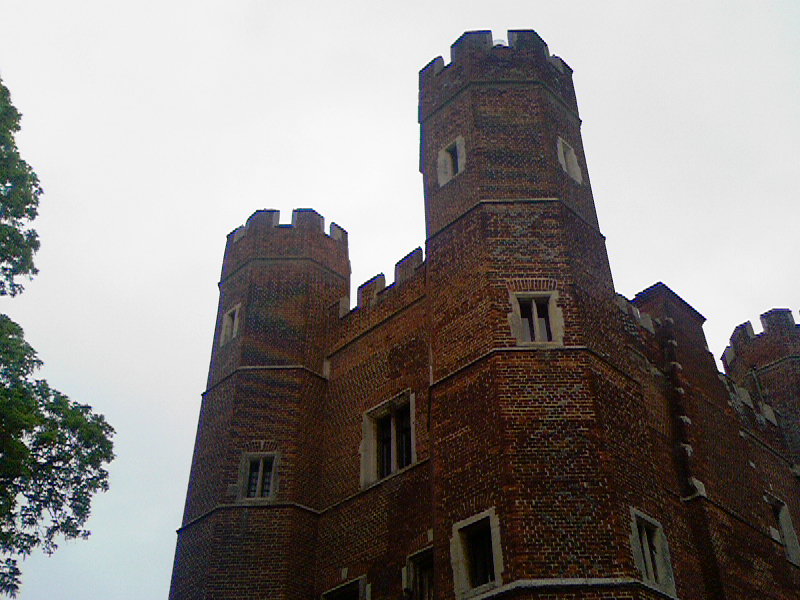
buckden tower

This is the Great Tower (restored in 1957) on the same site as the original in which the Queen stayed. “The foundations were laid about the year 1479 by Bishop Rotherham (1472-80), but this work ceased upon his death in 1480 and was not recommenced by his successor, Bishop Russell, until 1491. The lowest storey resting upon the vaulted arches of the great cellar, formed a large dining hall, the large apartment immediately above it being called the King’s Lodging.”

Then it was on to Bushmead priory, only to discover that it is only open for groups, so I missed out on the “”magnificent 13th-century timber roof of crown post construction with medieval wall paintings and stained glass”.

The Ordinance Survey map of the area is thick with notations in the Gothic script denoting historical buildings or remains: “moat”, “manorial earthworks”, “palace remains”, but the primary visual impression is of Big Agriculture. Huge fields of rape-seed in brilliant yellow flower were the most evident, but there were also a lot of summer cereals.

Total: about 33 miles (c. 55km). If I’m ever going to make the Dunwich Dynamo I’m going to have to do this and more at least once a week. I think most of my body can make it; not too sure about the knees, however.

The route came from: