Miscellaneous

Nadia Anjuman: a fitting memorial

My small posts here and on Blogcritics about the horrific killing of the Afghan poet Nadia Anjuman have drawn a strong reaction, particularly on Blogcritics, where two poets have left their personal feelings in verse.

Gary Lawless (I think this is him here) has emailed with a very constructive suggestion, that as a memorial to her, donations be made to the Revolutionary Association of the Women of Afghanistan (RAWA). One of its main programmes is providing basic education for women and girls Just $60 (now £35) a month will support a full-time teacher working in Afghanistan.

Miscellaneous

Forgotten Women: Sister Mabel of the Free Dispensary for Animals of the Poor

The Free Dispensary for Animals of the Poor was run, starting in the early 1920s, under a railway arch in Camberwell (south London) – four hours a week when the poor could bring their pets to be treated for free by a vet. It was started by a woman described only as “Sister Mabel”, who’d raised the money from “Lord Hertford”.

I’ve not been able to find any web references to it, but read about the dispensary in H.V. Morton’s The Spell of London, first printed in 1926. They are collected sketches from the Daily Express (a very different, far more humane paper than its modern sister) and do lay the pathos on with a trowel, but are gripping nonetheless.

I watched this for an hour: pups run over by motor-cars, dogs with mange and distemper, and always such love, such tender looks, such tail waggings from the dogs, until –
“Please, mother says will you have Arfur killed, ’cause the lady upstairs says she’ll turn us into the street if he don’t stop barkin’.”
Arthur, a nice little fox terrier, stood there with his head on one side, so pathetically unconscious of crime, so pleased with life, and – so near death.
“You can’t kill him?” I said.
“We do our best not to,” said Mr Murt [the vet]. “We have a register of those willing to take dogs. We keep these poor little chaps and try to find them homes, but if we can’t … it’s better than having them kicked about in the streets starving.”

Has anyone else come across Sister Mabel?

Miscellaneous

Hold the front page: school behaviour is getting better

Regular readers will know that I come down strongly against “the world’s all going to hell” school of thought. One of the favourite complaits is how “manners”, “behaviour”, “respect” are all going south at a rate of knots.

Today’s Prospect has an antidote to that claim, a piece, based on detailed observation, that concludes that the situation is actually improving in British schools, in large part due to better management.

“The [British crime] survey’s most recent findings suggest, perhaps surprisingly, that the rate of violence against teachers has dropped by more than 40 per cent in the past eight years. Drawing on its results, home office researchers found that in 2002 and 2003 1 per cent of teachers were physically attacked at work. Between 1994 and 1998 the level of assaults on teachers was almost twice as high, running at 1.8 per cent.
Verbal threats against teachers have also decreased, the survey found. Two per cent of teachers reported the problem each year between 1994 and 1998, but by 2002-03 that figure had dropped to 1.2 per cent.

And it makes the seemingly oft-forgotten point that these are children; if the school has got out of control it is not their fault, but that of the management.

I was reminded of the one and only real fight I’ve ever had – arranged in the classic school manner – “meet you in the playground after class” form. And that then was accepted – the teachers must have known about it, but then it was just “kids being kids”. *

A lot of the “bullying”, “violence” and “aggression” we now worry about in schools (and elsewehere) were once regarded as normal behaviour. The fact that it no longer is can only be a good thing, but it does produce an awful lot of unwarranted anxiety about “declining standards”.

*In case you were wondering, I lost. Not surprising since I didn’t have the faintest clue how to throw a punch (something all girls should be taught at a young age), and she was the school “tough”.

Miscellaneous

Carnival of Feminists No 3 – don’t miss it!

The third Carnival of Feminists is up now on Sour Duck and it is a cracker!

For those of you who were around in the Seventies (and remember – as they say) there’s a number of explorations about the then and the now – how far have we come?

If that’s a bit early for you, or if you’d rather just forget the whole decade, there are broader examinations of the feminist world – Feminism 101, and a lovely little tirade against marriage – who wants to live in an institution?

Then moving around the world, there’s several takes on President Ellen Johnson-Sirleaf of Liberia, on US abortion politics, and much, much more.

Don’t miss it, and please spread the word!

And don’t forget you can always keep up with the latest on the Carnival of Feminists on the home page.

And if you missed them, the other editions: No 1 and No 2.

***
While I’m on the subject of carnivals, also don’t miss History Carnival No XX, up on Tigerlily Lounge – also a brilliant collection.

And the Carnival of Feminists is my fourth of the week. You’ll also find me on the Carnival of Capitalists (don’t worry, it is my book review of the anti-Wal-Mart business model), and the Carnival of the Green, which you might think a bit more expected.

Hic, hic … think I might have eaten a little too much fairy floss. (Which I think in America you’d call cotton candy.)

LATE UPDATE 17/11: You’ll also find me on the Carnival of Vanities thanks to one of the first bloggers on my blogroll, Dr Charles. Thanks!

Miscellaneous

Economists to listen to

Most writers on economics are about as reliable as an old woman wrapped in a silly scarf peering over a spatter of tea-leaves. They just wrap their prognostications is in an impenetrable layer of jargon to disguise their ignorance of the state of the world.

There are, in my opinion, two exceptions to this dismal rule: Anatole Kaletsky, writing in The Times in London, and Ross Gittins, in the Sydney Morning Herald.

Amidst Australia’s latest terror panic – so surprising it coincides with John Howard’s efforts to get through another piece of repressive legislation, Gittins today looks at the actual risk of terrorism.

“There are plenty of things that offer a greater threat to our wellbeing than local terrorism, and they aren’t getting nearly as much attention or money lavished on them. Getting overexcited about terrorism, in other words, has its opportunity cost.
… It’s well known to psychologists that humans have a tendency to overestimate small risks while underestimating big risks.”

Gittins points out that an estimated 1,200 American drivers died in crashes caused by a switch from air travel after 9/11. (Despite, I’d add, the fact that the tactics used that day are obviously unrepeatable – since no plane-load of passengers would then sit by and let men armed with Stanley knives take over their aircraft.)

“The US Centres for Disease Control and Prevention says the odds of an American dying in a terrorist attack are about one in 88,000. The odds of dying by falling off a ladder are one in 10,000. And, says an article in Foreign Policy magazine, even in 2001, car crashes killed 15 times more Americans than terrorism did.”

He points out that incumbent politicians, police and other officials, and the media, all have an interested in playing up the dangers of terrorism out of all proportion.

Gittins conclude:

“Leaving aside the people whose civil liberties are trampled, these mutually enjoyable terror games would be harmless if time and money grew on trees. Since they don’t, we’d probably save more lives by putting the same effort into fixing black spots on the Pacific Highway.
Or think on this: buried by last week’s avalanche about terrorism was the news that suicide is the leading cause of death among 10- to 14-year-olds in Queensland. Presuming that problem isn’t unique to Queensland, might it not deserve a bit more of our attention?”

Ban all ladders! I say. That’s about as sensible as current government policies, in Australia, and Britain.

Miscellaneous

Learning to love Mao

When you visit China you’re quickly aware of rather tacky plastic Mao badges on sale – in addition to all of the Mao lighters, cigarettes, watches and just about any other tacky consumer item you can imagine. What I didn’t realise at the time was this is only the modern tip of an historic iceberg.

At a conference for British Museum volunteers yesterday I learnt, from Helen Wang from the Department of Coins and Medals, that these badges, then just bearing the communist star, began to appear in the Forties, when they were primarily given to people attending party conferences.

It was at the start of the Cultural Revolution that the concept – now usually bearing the image of Mao, or his words, really took off – at the same time as the Red Guards were being given Mao’s Little Red Book.
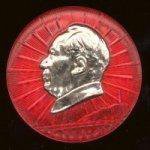
Many show rays of the sun emanating from the Chairman (as left), others feature the phrase (usually in Chinese but sometimes in English) “Serve the People”, the title of an essay Mao had written. This was usually reproduced in Mao’s own hand – he was very proud of his calligraphy.

So, you might think, a minor element of the Cultural Revolution. Not so, either then or now. These were made in enormous quantities and an enormous range of styles. To be considered a serious collector in China now (and there are many at or aspiring to that status), you need a minimum of 40,000!

In 1969 Mao ordered that their production end. “Give me back my aeroplanes,” Mao is said to have said. (It was estimated the metal used in them would have produced 40,000 aircraft.)

It is an interesting example of the way in which something dictated from the centre can spiral out of control. You can just imagine thousands of provincial officials straining every sinew to produce more badges than their rivals, until the state ended up with badge mountains. We were told of one southern province where this was the case. But disposing of this mountain was a serious problem. This had to be done “respectfully”, lest the destruction be seen as a political act.

There’s an extensive introduction on the badges here.