Miscellaneous

How far have we come?

In 1973 the then Labour Prime Minister of Australia, Gough Whitlam (who looks like an unbelievable radical from the perspective of today), told the Young Women’s Christian Association in Queensland that the Australian Government could not achieve immediately the revolution required for Australian women to develop fully as individuals … “the first and fundamental step towards freedom is awareness by women themselves of their real inequality, the extent of social, political, economic and cultural discrimination”. (The Age, August 25, 1973)

He was speaking as the women’s movement was only just arriving on our intellectually (and then physically) isolated shores. I was a child of seven. I’d never heard of Germaine Greer, and I doubt my Mum could have told you more than a sentence about her. Two years later two of the foundation texts of Australian feminism would be published. I reckon it was about this time that I can recall my father making jokes about burning bras.

This is the world charted in one of the most evocative books on my bookshelf, Media She, by Patricia Edgar and Hilary McPhee (1974), envisaged as a source book, a conscious-raiser for this new-born movement. The introduction says:

“For some readers this book may be the first time they have considered the stereotyping of sex roles and the effects this has had on their own lives.” That would have been true of me, and pretty well all of my contemporaries for the next decade. Personally, I was angry and rebellious about what being female meant, but I had no framework in which to put those feelings.

I went to a would-be-posh fee-paying school, which was utterly unable to decide if it was educating us to be solicitors’ wives, or solicitors. And perhaps that was not entirely the institution’s fault. As the Media She editors wrote:

“Marriage is regarded as the higest point in a girl’s life and women are defined in terms of the institution of marriage: mum, the wife, the spinster who ‘missed out’. Very few Australian girls leave home before they marry so the Australian woman spends all her life in the bosom of her family.”

All of that has, I’d say, at least for the middle class, changed. So what else has, or hasn’t?

Well some of the editorial and advertising looks purely prehistoric now.

There’s the reader’s story “on how to SURVIVE when the LITTLE WOMAN is away in hospital. ‘Guile will win you lots of dinner invitations if you happen to be batching,’ says Sydneysider Ian Mallard. ‘The secret is in the subtle approach.’

Then the furniture advert, the text beside a snap of the “happy couple”:

“Colin and Pru Tatham, both 20, think marriage is a great scene. The Tathams consider themselves liberated, not least when it comes to furniture. They chose Stag Rondo for the bedroom because it is bold and modern, and full of character. Colin might never admit this, but he checked quite carefully on Stag craftsmanship before settling for Pru’s choice of Rondo. Costing about £145, he decided he liked its value for money. Pru just likes Rondo for its looks … “

And jokes you’d be unlikely to see in a mainstream publication today:

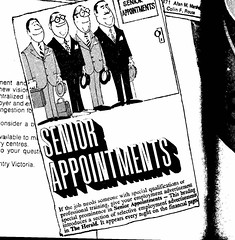
Then there are job advertisement here that, I hope, we’ll never see the like of again.

“Come and work with us now! All over Australia young people are joining the National Bank. .. Chances are they’re guys and gals a lot like you … self-reliant, independent. Today’s generation. That’s the type we’re looking for: to train in any one of a dozen careers; to accept promotion on ability, not seniority; to enjoy beneits like superannuation, medical benefits and education assistance.
And girls, there are lots of interesting positions for you too. And marriage grants.”
And the response to female political candidates:

“Backbench beauty? Parramatta by-election candidate Mrs Marian Pye would be the most attractive MP in Federal Parliament if she is elected on September 22. But good looks are not her only attribute.”

So yes, we have come a long way.

But then, I start looking at the things that haven’t changed. An advert for a new newspaper says: “We didn’t design The National Times for women. Maybe that’s why so many of them read it. … There’s a lot more to being a woman than just keeping up with new recipes, crash diets and what the Royal Family is doing.” Wish they’d tell today’s newspaper editors – who think stories about hairdos, lipstick and sex are all women want to read.

Then there are the “page three girls” (near-naked models “gracing” the pages of newspapers). Well they’re still in place, although when I look at these models I can’t help thinking how small, and natural, their breasts are, compared to their modern sisters’. (Although surgical breast enhancement did exist. “Don’t consider it until you’re at least 20,” says an agony aunt. Advice well out of date now, at least for would-be “glamour models”.)
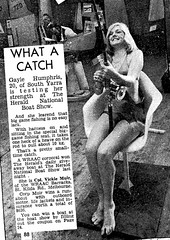
And the weight-loss advert would pretty well work without change today, although the model is probably a bit on the “fat” side …

And you might not see quite such an overtly sexist advert today:

.. well except in the wilder reaches of men’s magazines, but there’s another one, of a scantily clad woman draped across a tyre, that I saw a dead-ringer for on a billboard a couple of days ago.

So, where has this impressionistic survey left me? In employment we’ve coming an astonishingly long way in 30 years – in the expectation that women will have “careers”, in the jobs they do, in their access to at least the middle and upper-middle levels of management and the professions. The cynic in me thinks, however, that Western economies needed these women’s contribution, and no longer has the clerk-typist jobs that they used to occupy.

Then on the level of rhetoric, many things that could be said with impunity in 1974, in slandering half of the human race, are not – at least publicly – sayable today. As the “advertising guru” Neil French found, apparently to his surprise.

What struck me, however, is that what has really not changed is in the nature and use of the visual images of women. Near-naked women, women who’ve “lost weight”, attractive women in vaguely suggestive poses, blonde women smiling nicely – those are the pictures of women we see on the pages of mainstream newspapers and magazines, as we did in the Seventies.

If women want to be visible – and media visibility that is far more valued today than it was back then – they have before them a million lessons in how to achieve it – lessons that say you must be pretty, petite, fair-skinned, preferably blonde, and definitely young.


If you want to find out if you are a Seventies “good wife” I also posted a quiz from Media She.

And if you fancy a bit of earlier Australian history, I recommended a text here.

Miscellaneous

More problems with words

Since I really must do something about my desk ergonomics, was looking up “footrests” on eBay. I wasn’t expecting to get mostly motorcycle parts …

That was after waking up this morning to a “Boycottt-ball” (from the former England opener Geoffrey.: “Trescothick has made an excellent 193 … ”

As opposed to a mediocre one.

To North American readers I’m talking about cricket, which is … oh, never mind.

Miscellaneous

Women Latin Poets – a revolutionary book

“Ground-breaking”, “revolutionary” and “astonshingly erudite” are the sorts of labels all too often used in book reviews – and even more often in press releases – which leaves me without adequate words to describe Jane Stevenson’s Women Latin Poets: Language, Gender, and Authority from Antiquity to the Eighteenth Century. Only a decade ago, so distinguished a feminist historian as Gerda Lerner was saying there were no more than 300 learned women up until 1700 in the entire Christian era, suggesting an almost total exclusion from the central language of scholarship through that great arc of history. Stevenson, however, multiplies that figure by at least a factor of ten, and suggests many avenues of research by which it might be further increased.

But this is more than a charting of new, fascinating women from history, as important as that is. By finding these women, bringing them together and exploring their lives, Stevenson is forcing a rethink about the basic position of women over 1,880 years – in the societies of ancient Rome, in the medieval and later nunnery, and of the social role of the city’s “showpiece educated woman” across a wide swathe of early modern Europe. Every scholar interested in women in any of these periods should, I’d suggest, read this book shed new lights, from different angles, on their period.

But, I can hear potential readers say Latin poetry, particularly neo-Latin poetry, is deadly dull stuff. Do I have to?

Well while it is true that some of the verses are paens to dull princes, dutiful religious professions or formulaic odes to nature, there’s plenty of genuinely good poetry here. (Sensibly always provided in translation as well as the original.)

Just listen to the astonishing Martha Marchina, the daughter of a Neapolitan soap-boiler living in Rome, whose precocious talent was recognised when her brothers, left under her care after their mother died, made astonishing progress in school. But one of the boys – none of whom wrote verses themselves – was mocking the quality of her verse. She responded:

You appear to be a straitlaced fellow, and too severe,
My brother, since none of my verses ever please you.
This one is silly, you say, this is harsh, the other is wordy,
This is flat, these are tumid, this one has a hole in it, those others collapse —
You criticize innumerable faults in my verses –
And yet it is I who compose the no-good poems, you compose none. (p. 310-11


(She remained single, living at home with her father, acquiring a cardinal as a patron, and published a collection of letters and verse that was dedicated to Christina, ex-queen of Sweden.)

Or if you prefer your poetry heartfelt, what about the work of the Frenchwoman Camille de Morel, who mourns her sister:

Lucrece, why did you leave the earth alone,
To ascend into heaven, why did the fates give this to you without me?
You who were once the sweet solace of my sad mind,
My darling, and half of my soul …
Above all, dead sister, it is my grief to remember
You used to cultivate the sacred gifts of the divine Muses,
It is my grief to remember, since I lack you, my dear,
And what you are in your excellence, so swiftly snatched.
But it helps to remember, since a person who lived without sin
Lived long, and does not know how to die.”
(p. 193)

Starting in republican Rome, Stevenson makes a case for groups of women poets in the Ancient city as more established, and establishment, figures than they are commonly portrayed. (I’ve already posted on the aristocrat Sulpicia and her relationship with her lectrix. Male scholars have been inclined to assume that the women poets of whom we know, such as this Sulpicia (there were other later ones), were no more than educated courtesans (directed, surely, by the predjudices of their own times).

Instead Stevenson presents an image of a rich, aristocratic, respectable young woman from an educated family – her father having a literary reputation for translating Greek verse. So, Stevenson says: “Sulpicia insists on her control over the relationship [in a love poem], where her male counterparts insist on their lack it it … she makes no claim to be either sexually libertarian or even socially independent .. she never implies that she has had lovers in the past, threatens to take another lover, or suggests that she might be unfaithful.” (p. 41.)

Then, through the Christian period, Stevenson, through her writers from within and without convents across the continent, provides a sensible, nuanced discussion of the way in which the walls that surrounded nuns were sometimes a prison, sometimes a welcome protection. But whichever was the case at a particular time and place, Stevenson shows the nuns doing their best to improve their condition. Hildegard of Bingen, one of her best-known characters, who’d begun to see visions at the age of three and went on to produce “a prodigious oeuvre in cosmology, ethics, medicine and mystical poetry”. Hers was also a political mind, moving her nunnery to a more independent position, away from the close supervision of male clerics by asserting she had been forbidden by God “to utter or write anything more in that place”. Pressure from her extensive international following did the rest.

Outside the convent, as the early modern era progresses, Stevenson puts together a fascinating account of the way cities and even countries came to regard the possession of an extensively educated woman scholar as a mark of pride, and someone to be paraded before important visitors, at which point they usually delivered a formal oration or similar. (So much for the theory that women were always supposed to remain silent.)

This was one factor that led parents – usually fathers – to decide that educating a daughter in Latin – and other Greek, Hebrew and even more esoteric languages – might be good not just for her but as a way of advancing the whole family. Often, but not always, such fathers were professional educators themselves. I’m very interested in the most prominent English example of this – Bathsua Makin, but was fascinated to find it a phenomena spread virtually the length and breadth of Europe.

So Juliana/Julienne Morell (1593-1853) was writing letters to her Catallan father in Latin at age seven in Barcelona. He committed murder and they were forced to flee to Lyon, where she defended a Latin philosophical thesis in a public audience before Margaret of Austria at the age of about 14. Her father then removed her to Avignon, where he wanted her to study to become a doctor of law. However, she was determined to become a nun, and attracted the support of local nobles with another Latin public defence, and so was able to enter the convent of her choice. Her father refused to pay her dowry; the Pope eventually did so. But even there she didn’t escape, or chose to escape, speaking her various languages (which also included Greek and Hebrew) for distinguished visitors.

But since writing in Latin was so often regarded as a male preserve, were these women merely aping men’s work? Stevenson says not. She finds many cases in which the women Latinists wrote narratives in distinctly female ways.

To give just one example, she looks closely at a poem written by a German nun, Willetrudis, possibly in the early 1100s. It is the story of Susanna and the Elders who try to blackmail her into sleeping with them when they sneak into the garden where she is bathing. She instead cries out, and they claim they saw her with a lover. She is about to be judged when young Daniel steps forward, questions the men’s story, and reveals its falsity.

Stevenson compares the nun’s work with a roughly contemporary work by Petrus de Riga. She finds that the male writer in his choice of words subtly blames Susanna: “Her beauty captivates the old men; her desirability draws them.” (original itals) Even when she tests the water before bathing – surely an innocent enough act – he draws attention to her nuda and she is a temptare, a temptress. The poet then lingers on her beauty, her milky neck in what, in medieval terms, says Stevenson, is “mildly pornographic” and says she went to the garden all alone – seemingly in itself a suspicious act.

The nun, however, has Susanna go to a pool in her husband’s orchard, to cool herself on a hot day, using a verb that suggests not full disrobing, but possibly no more than splashing herself with water. Her chastity and goodness is held up as a model, possibly to other nuns, and when she is attacked “there is a torrent of metaphors: she is like a dove, or perhaps a swan, or a tender lamb in the mouth of a wolf”. And even before Daniel’s intervention, she is surrounded by a group of supporters inclined to trust her. She is then compared to a virgin martyr when she is taken before her judges, including her would-be assailants. The nun wrote:

“They have ordered the clothes stripped from her soft body,
And they violate with their gaze the secret parts of Susanna,
So that thereby a depraved mentality may be satiated by the sight:
Oh how wickedly perverse men become worse after the worst!”


Then, while Petrus de Riga has Susanna stumbling and falling silent before her accusers, Willetrudis makes a long and moving speech declaring her faith and trust in God. She then goes unflinchingly towards a martyrs death. And when Daniel intervenes, he is acting not for himself but as an agent of God – almost of her own prayer.

I think Stevenson is right; this is a woman telling a woman’s story.

These are voices that must become better known, incorporated into the much better explored arena of women’s writing in their vernacular languages. I’ve sought wherever possible in this review to provide links to internet resources about the writers mentioned; their scarcity tells its own story. This is a book whose important should be proclaimed from the rooftops – or at least should find a prominent place in the sources of any scholar of European women’s history.


Stevenson wrote about her book in The Guardian. She’s also been on Woman’s Hour.

Tags: , , , .

Miscellaneous

The Dictionary problem online

I can still remember when as a child of about seven I got my first dictionary. I was almost beside myself with excitement. (Yes I was an odd child.) While I’d been proudly able to spell “elephant” before I went to school, there were so many traps in the English language. Now all my problems would be solved.

Then, when I got the dictionary, I realised you had to pretty well know how to spell the word before you could look it up. It was a crushing disappointment.

Now I’m in the middle of taking my computer “language” to a whole new level. Yep, the MySQL database seems to be working nicely thank you – not that I’m quite sure what it is. And I’ve even managed to wrongly install some WordPress themes, uninstall them and reinstall themn correctly.

But the dictionary problem is striking again. There are things I want to do – and there are no doubt directions on the web as to how to do them, even some pitched at my level – but I don’t know how to look them up.

You might call all that a complicated introduction to a question (since I know some very tech-savvy people read this blog). What I want to do is to be able to put the first couple of pars of a post up on one blog, then with a “more” bottom send people to another blog to read the rest, BUT, so that they enter the post at the right place i.e. where they stopped reading in the first blog.

Can anyone either tell me what this is called, or tell me how to do it?

All help gratefully received!

Miscellaneous

At the National Gallery: Reunions – Bringing Early Italian Paintings Back Together

Amidst a cornucopia of great art, how do you choose what to look at, what to focus on? You often see visitors to the National Gallery wandering along in a daze, so overwhelmed they’re obviously not really taking anything in. What you need is some guideposts, some suggestions to point you in a direction for this visit.

One way the gallery does this is with the small, regularly changing exhibitions in Room 1. Just up is a little gem: Reunions, Bringing Early Italian Paintings Back Together.”

What the three works in the exhibition have in common – in addition to their time and place of origin – is that they are consist of parts only recently reunited.

The intimate little 13th-century diptych is perhaps the most amazing – now so obviously complete when it has been, perhaps for centuries, split asunder. The left-side Mother and Child was only found in 1999, when it was rejoined with its Man of Sorrows (the dead Christ on the cross). As the mini-catalogue says: “the Virgin’s direct gaze and melancholy expression betray her knowledge of her son’s future sacrifice”. Now we can gaze on it today as did its commissioner, perhaps a wandering Franciscan friar.

Half of the second work – in chronological terms – is also an astonishingly recent discovery, a Virgin and the Child with Two Angels, found at a country house in Suffolk in 2000. It is the second (known) part of a Cimabue. The other part here is The Flagellation of Christ. The bodies and setting are stylised, almost sketched, but unlike the first work here (with its distinctly Byzantine, otherworldly character), these are real, individual, human faces.

The third work is definitely the most artistically gripping. Bernardo Daddi’s The Coronation of the Virgin, here reunited with the panel that would have sat beneath it when it was painted about 1340. It starts to look like the “Renaissance” art we know and love. There’s an ornate gold background, but both main figures are real people. The Virgin’s face is particularly stunning. She’s a beautiful matron, with maturity and pride, bearing the look of a mother who’s seen her son achieve beyond her wildest dreams.

Here are just three paintings, paintings that you’d probably pass by in the flood of images in one of the main galleries. Yet here, in an open space of their own, there is so much to get from them: the question about “what is still out there, unfound?”; the musing on how while we think of this as a time of “Dark Age” stagnation the nature and understanding of art was changing remarkably fast; and, that you’d really love to have the time to spend so much time on more and more of the gallery’s collection in this way.

The exhibition continues until January 29. Other paintings from the same era can be found in Gallery 52.

Miscellaneous

An alternative to Google News

I’ve found Topix.net because visitors have been finding my site through it. And it looks rather good – lots of varied news sources. And while I’m far from anti-Google, since any form of commercial monopoly is a bad thing, it is good to promote its competitors.