Miscellaneous

The new Guardian: what do you think?

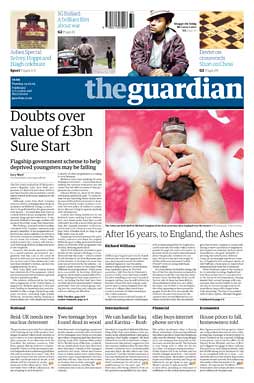
The new “Berliner” (mid-sized) Guardian has drawn much scorn from my workmates (but then I do work for the opposition). Although it is only early days, I’m, however, quite excited by it. As Stephen Glover wrote in The Independent, the question is “whether this is the same old Guardian repackaged in a new form, or whether it has become a different sort of newspaper, possibly more upmarket or even more Establishment in its feel”.

And I think the answer to that is that it seems to be going upmarket, or at least holding its ground, which in a newspaper market fast streaming towards the populist can only be a good thing.

There can be lots of technical objections to the design – it is certainly over-busy at present, and I do think the interaction of the heads with sub-heads wiith bylines is going to have to be worked on, but the overall message is that this is a serious, even heavy, paper. I’d like to think that can work!

They are, however, I’d suggest, going to have a big problem in newsagents with it falling apart – and bagging is a very expensive option.

Yet this all might in the end up being academic. What really matters for the Guardian is that it is the only paper that really gets the web, as evidenced by its remarkably open blog about the development and implementation of the new design.

It has made itself an international brand through its huge and fast-acting web presence – I often notice how often purely American sources cite it – and through that in 10 years it might be the last “newspaper” left, when all of the dead-tree versions have long gone.

Miscellaneous

Review: War Reporting for Cowards

First, I should make a declaration of interest. I was working for The Times during the period covered by the bulk of War Reporting for Cowards, and I know all of the people in the London office about whom Chris Ayres writes, although I never met him. And I think he gets their characters and mannerisms well; at least as well as you could reasonably expect anyone still working for them to do.

As the title suggests, there are echoes in this book of a long British tradition of comedy drawn from men behaving ineptly, JK Jerome’s Three Men In A Boat, perhaps the originator of the genre, the comedy of course coming from the fact that men are not expected to be incompetent in dealing with physical challenges. (We’ll really have got somewhere when a female correspondent can write a similar book, without provoking a “do women belong in war zones?” debate, and facing unemployment. That, I fear, is still some decades off.)

Yet Ayres gets a long way beyond the limitations of the genre of comedy, and indeed the common line of “war reporting”, into his real feelings of terror and pain during the nine days he spent “embedded” with the US marines during the invasion of Iraq. This is a real book from an observer at the very heart of the war; he’s not a subtle or outright cheerleader for the “sport”, as are so many who write on the subject.

Ayres was indeed as unlikely a war correspondent as could be imagined. His account begins with him as a student in the City University post-graduate journalism course, which, as he reports, gets a remarkable percentage of its graduates into the national media. But he chose the unfashionable business stream, and thence with unpaid work experience on the Times business desk. (Yes this is how many people get into journalism, and goes a long way towards explaining the narrow social pool from which British national journalists tend to be drawn.)

His account of this time does fall rather into the Boat trap; had he been as inept as he suggests, he would never have got a job – and he must surely have learnt what a “nib” was at journalism school. (Connections, unless they are very strong, will still only get you so far.)

Gradually, Ayres reports, however, he became a veteran of the business lunch, and through following e-business through the dot-com boom, an office star. It seems part of the persona that he claims this was an accident, but then it was an accident that he was in New York, on the very doorstep of 9/11, and shortly after at the middle of the anthrax attacks.

He then saw an opening when the current editor of The Times, Robert Thomson, took over, and bid for, and won, the job of Los Angeles correspondent, because, Ayres says, “He apparently had wanted someone on the West Coast who could write about the economics of celebrity fluff, as well as the celebrity fluff itself.”

The reality, I’d suggest, was a bit more complex. The fact is that “serious” national newspapers are increasingly being pushed – some would say by social trends, some would say by newspaper fashion, some would say by desperation for readers – to include more and more of what their traditional staff dismissively call “fluff”. And most staff have to be bludgeoned into writing this material; anyone who volunteers and shows the real desire that Ayers apparently has to cover it is likely to find it a great way to get ahead. This is particularly the case at The Times, where its history as “The Thunderer” is at war with its market position at the bottom of the old “broadsheet” chain, just above the traditionally tabloid Daily Mail. (This was the great unmentionable fact when I was working there.)

So how did he end up in Iraq as a war correspondent? From what I knew (which was not a lot) from the London end, Ayres’ account is accurate. The idea of “embedding” journalists with the troops was a new one, and newsrooms were, justifiably, highly suspicious of how effective it was likely to be. So experienced correspondents – the ones expected to provide the bulk of the coverage – were placed strategically around Iraq – in the Kurdish areas in the north, in Iran, in Baghdad itself. Putting reporters with the troops was seen as a high-risk option, likely to produce little more than military PR, so inexperienced, seemingly ill-equipped, reporters like Ayres were given that role.

As it turned out of course, the northern front never rolled, thanks to the Turks, and it quickly became clear that it was horribly dangerous – and several journalists paid with their lives – to attempt to report on your own. So it was left to the “embeds” to report the progress of the war – in the case of Ayres, as he presents himself, a hypochondriac, physically inept, overweight man, with no military knowledge or background whatsoever.

Yet as I remember at the time, and is clear from the book, he made a great war correspondent. He described what he saw, what he felt, what he heard, from the perspective of a naive, unknowing viewer – exactly the same as the position of the reader on the 7.50 from Saffron Walden. So War Reporting begins:

The day, like most of my days in Iraq, had got off to a bad start. I awoke that morning, as usual, shivering violently and aching from another night in the Humvee… The first thing you notice is the contortion necessary to sleep inside the vehicle: the head dangles inches from the bare metal floor; the right leg is somewhere behind the left ear. The spine feels as though it has been splintered like a cocktail stick …
Then comes the mental replay footage from the night before – the hollers of ‘Lightning! Lightning!’; the absurd 3am fumble for the gas mask, welly boots and rubber gloves; the casualty reports over the radio …

And even Ayres, perhaps the least likely marine in history, gets caught up with the feelings of the men with whom he is enduring all of these deprivations, and on whose protection his life depends. His account is their account too. When Ayres resists being taught how to fire an M-16, he tells what happens next:

Murphy … looked me in the eye and drawled, ‘So if there’s a shitstorm, and you can shoot an Iraqi and save my life, or NOT shoot an Iraqi and let me die, what you gonna do?” It was more of an instruction than a question. And I had to spend the rest of the war sharing a Humvee with Murphy … I wanted Buck and his men to beat the Iraqis as much as they did. After all, my own life was at stake. “I’d shoot the bastard,” I said quickly. Then I took the weapon from his hands.”

Here is a reporter who can write, can tell a story, can make you laugh and make you cry. (And speaking as a sub-editor, I can say that is far from a common case.) Reading War Reporting for Cowards will give you lots of laughs, and many squirms of uncomfortable self-recognition at your own condition as a 21st-century human being. You’ll also finish up knowing a lot about war, and newspapers, and how they fit together.

***
What the New York junior cousin thought of it is here.

;

Miscellaneous

Australia: once a free country

Hacking through my 1,600 emails from a week away – yes I do belong to too many email lists – I came across a couple of pieces about Australia that can only be cause for further depression about its prospects.

The unlovely Halliburton is apparently taking over most of South Australia, and getting army contracts without tendering. Well of course John Howard wants to keep George Bush sweet, even though I doubt the President could find Australia on a map.

But American activists are another question. Not content with locking up children of asylum-seekers, the government is now calling activists of the Greenpeace ilk “security threats”. Norties McCarthyism anyone?

I saw, or rather heard, an astonishing number of Australians in Biarritz last week – well it is a surf town – but they say one million Australians (one in 20 or so) live abroard, and I can’t but feel this is only going to increase.

Miscellaneous

London, you’ve got to love it

Arrived at Stansted at 10.50pm last night: huge queue for passport control, long wait for bags – well this is the budget airport, so you can’t really complain.

Outside is a fair attempt at a setting for a Sherlock Holmes movie – a thick yellow fog that quickly forms a greasy film over your face.

Just caught the 11.59 Stansted “Express”, which should have just connected me to the Victoria line before it does its usually half-after-midnight shutdown (when IS Ken Livingstone going to do something about this?), had it not sat for 15 minutes or so in the middle of nowhere. (No idea why – the driver did make an announcement, but it was unintelligible).

So, to the joys of the N73 night bus, to be caught from the middle of a dodgy industrial estate at Tottenham Hale. But yes, it was a joy.

First, there was the Korean Elvis impersonator, with, if not in a biblical sense – although not for want of his trying – the American “from LA”, dressed as Dorothy from the Wizard of Oz. (Not a look I’d recommend, overall if you’re over 40 and have a really bad blonde dye job.)

Then, there was the sailor from Plymouth who sat beside me and tried to chat, but whose muscle control was so far gone that at each stop he slowly slid from view along the mixture of chewing gum and general grime on the seat, ending up crouched on his haunches, swaying gently, but politely trying very hard not to brush against me.

Then there was the sober soldier-boy (had to be with that haircut), grimly hanging on to his temper after copping an elbow to the head from a drunk who really didn’t look like he should be able to stand, and the bloke who’d fancied his chances for the evening, until his “date” had caught a nightbus 40 minutes in the wrong direction, so now they were heading, he hoped, on the route to her bedroom. Whether she intended the mistake I don’t know – a 50/50. But certainly his ardour was cooling by the minute.

The woman behind me who’d said in an ominous tone “I feel sick” didn’t throw up, so it was a successful return to the old home town. And I was reminded why I love living here – all of life is at your side, if not in your lap.

Friday Femmes Fatales

Friday femmes fatales No 22

Where are all the female bloggers? Here, in my weekly “top ten” posts.

Since I’m on holiday in France, I should be looking for French female bloggers, but to be frank the internet cafe is neither comfortable enough – it is supposed to be non fumeur but I keep getting great gusts of cigarette smoke from the air-conditioning – nor is the beach far enough away – to justify it. So if you know any, please tell me about them (whether they write in French or English).

So again this week I’m revisiting some old favourites …

Now I haven’t been following the Katrina debate in the blogosphere this week – after some spirited engagements on Blogcritics last week – but reading it in the French papers instead. (And yes they are slightly gloating, but then after a couple of years of being called cheese-easting surrender monkeys I can excuse that.)

But Bitch PhD has a nice roundup of blogs on the subject, and some thoughts of her own. Sharon on Early Modern Notes, meanwhile, is finding parallels in the Great Fire of London, “a vulnerable city, warnings ignored….” There’s also a nice collection of links about the “Great Plague”, in cqse you were wondering about what might be next.

Frogs and Ravens has a solution, impeachment. Much as I agree with her sentiments, I just can’t face it – imagine going through the whole Clinton saga all over again! Kameron on Brutal Women, meanwhile, reports that an entire city in Oregon disappeared under similar circumstances. (The question I haven’t seen asked, but keep wondering about, is whether it makes any sense to rebuild New Orleans, when an equally bad or even worse hurricane could just as easily come along next year, or next decade?)

After all of that it must be time for a laugh: Pandagon suggests some strategies for the “wingnuts” to combat feminism. Remember, coupon-cutting is a Marxist activity. America This Is Serious, meanwhile, finds that a Seventies book of lesbian ethics still has worthwhile messages for everyone.

Jessica on Feministing, in the meantime, has found a must-read “part memoir, part cultural commentary”, Tiny Ladies in Shiny Pants.

Staying literary, The Little Professor is sceptical about a claim for a newly discovered source for Oliver Twist. Shouldn’t someone have noticed at the time, she asks?

Then for a serious lump of real life, visit Real E Fun. She’s a non-religious funeral celebrant, but don’t let that put you off. The author of Personal Political, meanwhile, is encountering a new dilemma in an encounter with religion as a lesbian mother.

***

Last week’s edition is here.

***

Next week I’ll probably start collecting my next hundred female bloggers, to eventually take my total to 300, so if you’ve any nominations – including of your own blog – please leave in the comments.

Miscellaneous

The Basque country

I’ve been talking for the past few days about being in France, but of course from another perspective I’m in the “Basque country”. This is not, in general, very evident, except for the traditional Basque houses, most of which I suspect are not very old, the Basque language on the official signage, and the odd restaurant and linen shop.

One night I asked for the wine of the region and got Irouleguy. I wrote it down phonetically as “ir-ree-le-goo” – I don’t think there’s much point in trying to pronounce Basque words any other way.

I found this interesting piece on the Basque tradition in America and a simple online dictionary.