Sit back, relax, read, enjoy
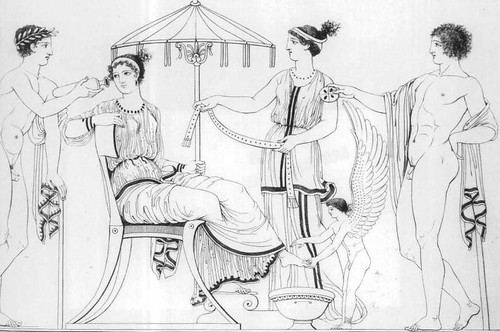
Like an ancient Greek host who got to choose in what proportions to mix the wine and water, and so whether to host a decorous debate or a riotous rampage, as carnival organiser I get to decide who gets invited and what sort of tunes they can play. I’ve restricted the number of links to 40, so the party doesn’t drag on too long, and tried for a mix of tones. You’ll find some serious research here, and some original sources, but also posts that tell a good yarn: a love of narrative is a weakness of mine. So let the symposium begin …
Being the middle of August, when many academics have more surf on their minds than web surfing, there’s no great historiographic debates in this carnival, unless you count a question of literary history: Do the Hobbits come from Kentucky? In this post The Elfin Ethicist conducts some empirical research, building on posts by other bloggers.
Perhaps this carnival could start a blogosphere meme instead? I’m taken by the idea of a manuscript wishlist, found on Sauvage Noble: five texts (or set of texts) that you wish had survived but apparently haven’t.

The canapes: modern tastes
Something about the weather seems to mean many are finding in history lessons relevant to today. A Canadian Lefty in Occupied Land reviews a book about his homeland’s own “McCarthy era” (and draws parallels with the new witchhunts being begun today). Clews: The Historical True Crime Blog, meanwhile, has recovered a horrifying story (perhaps not for those who are already having a depressing day) about a “family annihilator” called George Hassell, who in 1920s America murdered two sets of his “nearest and dearest”: a total of two women and 11 children. It’s a lesson for those who like to blame aspects of contemporary culture – like those pesky feminists – for similar crimes today.
Fragblog has found some papers showing how cavalier the [British] Foreign Office was about arms sales in the Seventies. On the lighter side, with the treason law also in the news in Britain, The Sharpener reports that “thanks to an Act from the reign of George I, if your faithful mutt shags one of the Queen’s corgis, technically you are committing treason”.
Got Medieval, meanwhile, finds that the American Right has developed a rosy-eyed view of the Middle Ages. In related news, over on the History News Network’s Liberty & Power Blog, Sudha Shenoy muses on the origin of the word jingoism in 19th-century Britain and the lessons for America today.
Ancient Times
Is that a little modern for you? Well, off to Achaemenid Persia, where Alun is examining the theory that Zoroaster’s Kaba is an astronomical instrument. Alun’s conclusion – “I haven’t the faintest idea” – is refreshingly honest (oddly enough you never get people quoted in newspapers saying that), but Alun does set out some of the questions that should be asked.
The ancients too had their almost unimaginable sorrows. Snail’s Tales has rediscovered, with the help of George Bean, Niobe, who lost her 14 children to the wrath of the goddess Leto.
Towards an Archaeology of Iconoclasm is meanwhile shedding some light on the place of pagans in the Corinth of his period, while Hypotyposeis is on the trail of the first patron saint of Venice
The Velveteen Rabbi has been holding a comparative reading of the Koran and the Torah, finding some subtle differences and surprising similarities at “the intersections of our family history”. There seems to have been a lot of fascinating posts relating to Jewish history recently: The Rhine River considers the 19th and 20th-century history of the Jewish body, and the difficulties some have had in accepting studies on the topic. Then, can a carnival point to another carnival? I can’t see why not, so check out the Temple Mount blogburst on Kesher Talk.
Revolutions
Do you fancy a revolution? Well I’ve got a selection to choose from. Mohraz reports on the Babylonian revolution (aided by Cyrus the Great) that produced “the first declaration of human rights”. Supermaxwell, meanwhile, is listening in to the French Assembly on the 4th of August 216 years ago, which heard how: “Men are everywhere eager to throw it off a yoke that has for so many ages pressed upon them so heavily …” (Women too, I’d guess.)
Chapati Mystery has an account of the Trial of Mangal Pandey, the sepoy who might be labelled the originator of what the British call the Indian Mutiny. Then, while you couldn’t call him a revolutionary exactly, Dom Mintoff was Malta’s first post-independence Prime Minister and, Wired Temples reports, a complex and interesting character, and a survivor.
And while the Space Revolution has yet to properly take off, the latest flight suggests it is still (just) moving. Ideas in Progress looks back to the decision in the 1980s not to provide a space shuttle repair kit, and asks what has changed today.
The entertainment
After those meaty main courses, it must be time for some entertainment: no dancing girls or boys, sorry, but a musical revolution, courtesy of Regions of the Mind, who finds that Trinidadian carnaval musical was shaped by British colonial prohibitions. And it might be a good time to inspect the crockery: perhaps some Japanese Satsuma Ware for the cultural mix, courtesy of Purple Tigress on Blogcritics*.
Then a commentary on comedy from an old-time “blogger”, Isaac D’Israeli (1766-1848). Mr H., who personally blogs at the delightful, highly illustrated Gionale Nuovo, is posting his Curiosities of Literature as a blog. The entry to which I’m pointing has D’Israeli sounding curiously modern in criticising “humour, arising from a personal defect, [which] is but a miserable substitute for that of a more genuine kind”.
For another old-time “blogger” check out the post on Public Brewery about Mark Twain. WordHoard has also been considering a list of potential bloggers of history, noting the similarity of the practice to the tradition of the miscellany. I was pleased to see she’s also a fan of Sei Shonagon – if you haven’t read her, do!
Now I used to work with an editor who didn’t think a newspaper was complete without a recipe of some kind. (Fish conservation stories were always accompanied by one, which did seem a little odd.) I haven’t exactly found a recipe to go with the wine for this carnival, but then if the offering consists of roast sheep’s eyes, eaten from the sockets with a spoon, and bull’s testicles, grilled and peeled, you might not want one. That’s the non-recommendation of the neo-Darwinian biologist George Gaylord Simpson in 1934, recorded on Copernicus Sashimi.
But you don’t want to go hungry either. Eastman’s Online Geneology Newsletter has found that behind a phrase that has survived at least five generations in the United States – “1800 and froze to death” – there is a well-documented story of hunger and migration. The year in fact was 1816; I was surprised to see just how good the weather records are for the period.
And I haven’t got a ghost tale to finish off the variety show, but perhaps a nice spooky Eighties spy story, ala Len Deighton, would do the trick: Dirk used to listen into top-secret shortwave
messages to spies in Europe, and he explains the whys and wherefores. Or perhaps you’d prefer a modern novelist’s research into ancient Roman poisons? Do taste these berries …
The beggars at the door
If you particularly like history from the point of view of the underdog, in London the whole area of Southwark has to get a mention. The author of The Aimless Ramblings of Zefrog – transplanted from ParisXXX(whoops, correction, from Dijon) – is exploring the history (and geography) of his adopted home. On Sleepwalker’s Glory, meanwhile, there’s a discussion of the politically fraught history of naming, still a big issue in parts of the world today.
War Historian, meanwhile, has collected documents about the difficulties of black soldiers in the American Civil War, and Greenespace has been revisiting the site of the Carrollton massacre.
Disability Studies has found examples of 19th-century teachers with disabilities. Is there yet a specialist field of “disability history”? If not, it seems to me there should be.
And if you are a bored 20th-century housewife who just can’t be bothered to get up in the morning to cook your man a three-course breakfast with all of the trimmings, check out Barista’s post on old pharmaceutical adverts: you’ll find a pill that will make you a Stepford Wife in no time at all.
Hiroshima
The chief historical anniversary in the past fortnight, which unsurprisingly generated a flood of blog posts, was that of the Hiroshima bombing. I’ve given it a special section, and restricted the number of posts linked, because otherwise it would have overwhelmed the carnival.
Through the cellardoor of existence collects two contemporary responses – one official, one a record of an eyewitness, while Paul on Soapgun tackles the big question – why was the bomb really used? He concludes: “In the end, those two cities were not victims of American/Soviet realpolitik, but of their own ultra-nationalist, unrelenting, fascist leadership.”
Siris, meanwhile, reports on how early this debate started, with a post on Elizabeth Anscombe’s 1956 protest against the proposal that Harry Truman be given an honorary Oxford degree, while Respectful Insolence notes that early opponents to the decision to bomb tended to be conservatives, an indication of how far political axes have moved.
Last drinks
Now that marks the end of the party proper, but for those of you still hanging around for those curious green liqueuers drunk only at this stage of the evening, check out Six Apart’s pictorial account of what would have happened If Bloggers Had been Around Throughout History.
And if you need a book to cover hung-over eyes on the beach tomorrow, you might want to read The Little Professor’s take on The Historian before deciding it’s the one. Instead, you might like to decide, having analysed the bodice-ripping genre, as has Creating Textiles, to write one of your own.
Then, for the real long-stayers, I’ll use the host’s right to the final word to point you to a little puzzle that I’ve been exploring: what is the oldest surviving handwriting by a woman?

The next Carnival will be hosted by Jeremy Boggs at Clioweb on 1 September, email jboggs AT gmu DOT edu.
If you’ve inexplicable missed the others, you can find a list of them here. No 13 is here and you can find other carnivals here.
Thanks to all who sent me links. Any errors are of course mine – please tell me. I’ll be happy to make any necessary corrections.)
* Declaration of interest: I’m an (unpaid) editor and contributor on Blogcritics.
The main image is a scene from a “south-Italian (probably Apulian) figured vase, as drawn in W. Tischbein, Collection of Engravings from Ancient Vases“, 1793-1803, taken from The Englightenment: Discovering the World in the Eighteenth Century, K. Sloan (ed), The British Museum Press, 2003.
The dividers come from Claudius.
History, a Technorati tag

 About