Miscellaneous

The oldest writing in a woman’s hand

I dragged myself out of bed early enough yesterday to finally make another British Museum gallery talk, this on “multicultural Roman Britain”, which debunked more than a few historical myths and was absolutely fascinating. More on the broader themes later today if I get time.

But I wanted to devote a post of its own to a wonderful piece that gets no special attention in the gallery but which does, I’d suggest, deserve it.

It is one of the Vindolanda tablets, the hoard of letters found in the fort of that name on Hadrian’s Wall that preserves the details of the everyday life of the garrison and their wives.

(Do check out the above link by the way – it is a model of archeaology on the web.)

One is a letter from Claudia Severa, wife of Aelius Brochus, the Vindolanda fort commander, to Sulpicia Lepidina, wife of the commander of a neighbouring fort. Most of the invitation to the birthday party is written by the garrison scribe, no doubt to Claudia’s dictation – his hand can be identified from other examples – but there’s a three-line personal note on the end in which Claudia adds a personal touch:

I shall expect you, sister. Farewell, sister, my dearest soul, as I hope to prosper, and hail.

(Sister seems to have been a term of endearment, rather than an expression of a family relationship.)

The gallery talk speaker, Sam Moorhead, suggested that this is the oldest surviving writing known to be in a woman’s hand — it is dated to between AD97 and 103 — which sounds about right to me. Can anyone think of an earlier example?

Miscellaneous

Human rights for sex workers

I posted a link a couple of days ago to the campaign for Justice for Linda campaign, and I’ve done my bit in sending the email to Venezuelan justice officials.

But the case has continued to haunt me – not just because of the horrific ordeal that she endured – four months of captivity and torture; I’m afraid I’ve been a journalist too long, and have read too much of the details of trials that never make it in to print for reasons of “taste”, to let such details affect me.

What really struck me was the legal situation:

“In an attempt to exploit an outrageous piece of the Venezuelan Penal Code which calls for a reduced sentence for crimes against sex workers, Carrera Almoina’s defense claimed that Loaiza was part of a prostitution ring. If sentenced to jail time, Carrera Almoina would have only have had to serve a fifth of the normal sentence. No evidence was presented in support of these claims, and Loaiza has consistently denied them.”

I was in a debate on the subject of religion over on Blogcritics about the damage done by religion, and here’s a classic example of the hideously damaging social effects of religious morality.

What this law is in effect declaring is that sex workers are sub-human – one-fifth of a human to be precise.

I’ve had more encounters with this issue in Asia, and have written on women’s humans rights there, but it seems this is a worldwide issue.

And it’s an issue for ALL women, as Linda’s case indicates. For this is really just an extension of the argument all too familiar to campaigners for women’s rights for protection from assault in Western states: “she asked for it by being drunk/wearing the wrong clothes/being in the wrong place”.

It occurs to me that only when the letter and the process of the law protects sex workers as it protects anyone else, is any woman fully protected. (Indeed, any person, since I suspect male rape is the great un-reported crime, and there are certainly plenty of male sex workers.)

, a Technorati tag

Miscellaneous

Quick query

Has anyone used a “pen scanner” for note-taking. Did it work? (It seems almost too good to be true.) Is there any particular brand or style you’d recommend?

Part of my current ongoing life revamp consists of reconsidering my data collection methods. It seems time to get out of paper.

If we’re not quite to Vannevar Bush’s perfect desktop, it seems as though we’re getting close.

Miscellaneous

Which emperor?

I’ve been a bit serious lately, and I’ve had a depressing evening, so a bit of frivolity, courtesy of Ahistoricality.

Emperor Augustus
You’re Augustus

Which Roman Emperor Are You?
brought to you by Quizilla

(It is a bit obvious – if you want to be Nero it is not hard to work out which answers to select.)

This left me posing the question, has anyone one done: Which great courtesan of history are you? That should be a good one. (Alternatively, can anyone recommend a site (not requiring to much inclination to the techie) to set up quizzes on? I might just do it myself.)

, a Technorati tag

Miscellaneous

Frida Kahlo: one of the greats

My mindframe as I walked into the Frida Kahlo exhibition was sceptical interest. I’d read reviews by blokes that were
negative and reviews by blokes that were positive. And I was well aware of Kahlo’s status as a feminist icon, who had a fascinating, traumatic life. But ultimately, you can only judge an artist by their art.

And it was Kahlo’s art that caused me to leave the exhibition shaken, almost overwhelmed, and convinced that she deserves to be up there as one of the greats. One day an exhibition will establish this beyond doubt; this is not, however, that exhibition – it merely points towards that possibility.

The Tate show focuses too much on her early art, and her political art, which is, it must be admitted, rather thin, and sometimes undergraduate. The mocking of America in My Dress Hangs There (1933), which features a golf trophy and a toilet on matching monumental columns is mildly amusing, but it isn’t great art. Her political paintings, while adding to the understanding of her life – her involvement with the nationalist Mexicanidad movement and marriage to a leading member of that movement – do little to advertise her art.

The first painting in this exhibition that stopped me was, however, very early in her career. A Few Small Pricks (1935)is based on a newspaper account of a brutal murder, in which a man who’d stabbed his lover with a knife many times said: “I gave her only a few little pricks.” Enclosed in a simple wooden frame covered too with the “blood” of the scene, Kahlo presents its simply, realistically. There is absolutely no dignity, no glamour in this death: an early sign of an absolutely uncompromising artistic vision.

Even earlier, another central aspect of her art – its personal nature – is evident in My Birth, painted after Kahlo had suffered a traumatic miscarriage and her mother had died. She emerges in gynaecological detail, but her mother’s face is shrouded like that of a corpse in a sheet, and the body/mother lies in a bleak, empty room, albeit it on perfectly made bed. This, with its Marian icon above the bed, must have been truly shocking in the Mexico of 1932.

But in this show you are then sent through several rather thin rooms of political art, drawings and still lifes (for which what I’d suggest over-grand claims are made – although the dreadfully kitsch circular flower painting, made for an American actress with whom her husband is thought to have been having an affair, is an enjoyable joke).

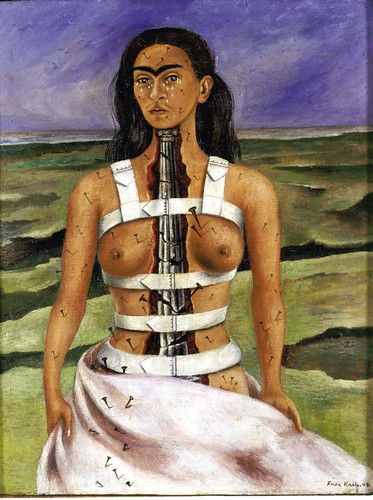
It is in the next two rooms that Kahlo’s greatness emerges. It is no accident that nearly all of the paintings are self-portraits in one form or another: it is when Kahlo is in her body, or out of her body looking in, that she’s at her most powerful. She makes the personal into art long before feminists came to call it political.

My single favourite, if I had to pick one, is Self-portait with Monkeys (1943). Kahlo, with a typically studiously neutral expression, wearing a simply white shift, stands amidst but apart from luxuriant tropical foliage, accompanied by these four primates. Two, diffidently and uncertainly, look as though they are trying to comfort her; the other two are curious onlookers. As a restrained portrait of sad, but proud, solitude and alienation it is breathtaking.

Yet Kahlo is not always so restrained. Self-Portrait with Loose Hair (1947) is more obviously, emotionally, bleak, as is The Mask (1945), in which Kahlo conceals her face behind a papier-mache image of La Malinche, the Indian mistress of the conquistador Cortes.

But it is when Kahlo maintains her distance that she is at her most powerful. That’s again the stance in The Little Hart (1946)in which Khalo is a stag in a forest pierced with a flurry of arrows, yet her face looks out at us serene, groomed, detached.

That neutral expression becomes strained, however, in The Broken Column (above). Painted in 1944, it reflects the continuing deterioration of her already shattered body. It is a depiction of shattering, chronic, inescapable pain and suffering that refuses to slide into self-pity.

Kahlo is, perhaps inescapably in view of the framework of her life, chiefly a painter of the miserable side of the human condition. But she rises above that, to show that even in misery there can be dignity and nobility. And she shows that from the perspective of the human body – the female body. Can you really claim – as some continue to do – that this in any way invalidates her greatness, rather than amplifies it?

The exhibition is at the Tate Modern until October 9.

This is a good collection of resources about Kahlo.

, a Technorati tag

Miscellaneous

Act! Act Now

I’m not a great one for e-mail campaigns and joining in protests, probably mostly because I’m just not a “joining” sort of person, but I found that this horrific story just demands action.

It is of a woman falsely imprisoned and raped for four months in Venezuala, by a politically well-connected man. He got off – although that verdict is being appealed – and she faces an investigation for prostitution.

Warning: there are disturbing pictures on this story, but read it anyway, and take the action it suggests.
(Via Bitch PhD.