Author Archives: Natalie Bennett

A good news morning

Having it all, i.e. a job, family and generally mixed life, is actually good for women’s health. Not a surprise really, for despite our society’s general paranoia about “stress”, I think we all know that, reasonably well managed, being busy, rushing around, and having things to do, is much better than underemployment and a routine life.

While homemakers are hailed by Middle England traditionalists as the proper example of sensible motherhood, research suggests that staying at home and giving up work leads to poorer long-term health. The risk of becoming obese was found to be almost double for a stay-at-home mother.

Then the music industry has traditionally been seen as a male preserve (and professional performance is still overwhelmingly so), but it seems the media has it entirely wrong, and the “MP3 revolution” is being at least equally driven by women as men.

The belief that growth in the market was coming from older male fans sparked a rash of magazines aimed at that niche. But research by the media group Emap shows that the huge popularity of MP3 players such as Apple’s iPod has now fuelled an increase in sales to women.The study also shows that the traditional image of the music press as a male preserve has been shattered. More women than men read the rock magazine Kerrang!, for example, and nearly half of those under 30 who buy the the music monthly Q are female. More women now spend more time listening to music than their male counterparts, with record labels speculating that the rise in digital downloads means they now find it quicker and easier to explore new artists.
Women in danger

Two truly depressing articles:

In Ethopia, girls face being kidnapped and forced into marriage with much older, and very likely HIV-positive, men.

In February, her parents received a letter from another suitor asking to marry Mulu but she refused so the 39-year-old man turned up at the house and kidnapped her with her parents’ consent. “I managed to get my parents to agree for us to be tested for HIV because I had heard about it at school and on the radio. I was negative but my abductor was positive.” Mulu’s parents agreed that she did not have to marry the man.

The one bit of hope in that is the obvious positive effect of education in giving girls and women – at least the really tough, smart ones – tools to protect themselves. (And when you read the story Mulu has to be very tough indeed.)

In Turkey, girls are meanwhile being effectively emotionally blackmailed into committing suicide (and no doubt sometimes straight-out murdered with suicide as a cover for the killers):

Turkey’s southeastern Anatolia … has become notorious in recent years for the high number of suicides, particularly of girls and young women whose despair is said to stem from their severely restricted lives. But women’s groups and human-rights workers believe a more sinister explanation lies behind many of the deaths. They’re convinced a growing number of girls and women are being locked in rooms by their families, with a gun, poison or a noose, and left there until they kill themselves.

A small historic moment

When William Rees-Mogg, the utterly traditionalist former Times editor, not only has a (newspaper) blog, but reports that a (real) blog, ConservativeHome, has revealed significant information about the internal workings of the Conservative Party, you can just feel the foundations of the traditional media shifting…

Through the fields of Cambridgeshire

Despite the failure of the BBC weather forecasters to deliver on their promise of a sunny afternoon, I’ve just returned from a pleasant cycle tour through the history of Cambridgeshire (with a dominant overlay of Big Agriculture).

I started out from St Neots, a rather bleak and industrial town (although it has the remains of some nice coaching inns in the city centre) and is named after a relative of Alfred the Great, of whom I confess I had not previously heard. (And unlike the usual case in Britain, it is pronounced as it is spelt…)

My route took me through Offord Cluny, so named because the parish was owned from the eleventh to the fourteenth century by the Cluny monastery in Burgundy. (One in the eye for the Europhobes.)

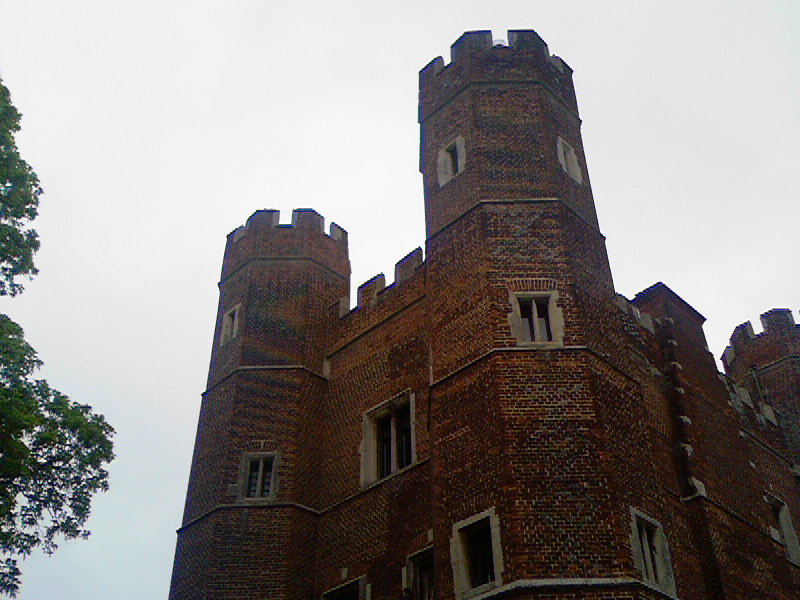
Next up was Buckden, a very wealthy-looking little place, with a few interesting historical features. I was taken by the slogan on the South’s Almshouse (1810) “Industry rewarded, age protected”, and by its architecture – I suspect lots of its features came from Buckden Tower next door, which was a grand bishop’s residence that sure its share of tragedy and drama.

This site (click on history) lists a good few of them, including its role as a jail for Catherine of Aragon as the divorce went through, and the place of death of Henry and Charles Brandon, son of Henry VIII’s favourite, the Duke of Suffolk. Their mother had them brough here from Cambridge to avoid the sweating plague, but it claimed their lives within 48 hours. (I think the general consensus is that we still don’t know what “sweating sickness” was.)

buckden tower

This is the Great Tower (restored in 1957) on the same site as the original in which the Queen stayed. “The foundations were laid about the year 1479 by Bishop Rotherham (1472-80), but this work ceased upon his death in 1480 and was not recommenced by his successor, Bishop Russell, until 1491. The lowest storey resting upon the vaulted arches of the great cellar, formed a large dining hall, the large apartment immediately above it being called the King’s Lodging.”

Then it was on to Bushmead priory, only to discover that it is only open for groups, so I missed out on the “”magnificent 13th-century timber roof of crown post construction with medieval wall paintings and stained glass”.

The Ordinance Survey map of the area is thick with notations in the Gothic script denoting historical buildings or remains: “moat”, “manorial earthworks”, “palace remains”, but the primary visual impression is of Big Agriculture. Huge fields of rape-seed in brilliant yellow flower were the most evident, but there were also a lot of summer cereals.

Total: about 33 miles (c. 55km). If I’m ever going to make the Dunwich Dynamo I’m going to have to do this and more at least once a week. I think most of my body can make it; not too sure about the knees, however.

The route came from:

The pathology of shopping

Cycling down Oxford Street yesterday lunchtime I was depressed, as I always am, by the swarms of people collecting stuff – bags and bags of stuff, that in many cases they can’t possibly need or really want. A beautiful, sunny Saturday and this was the best thing they could think to do with it.

Well not everybody, of course; I’d earlier had a lovely, madly busy session doing handling in the Enlightenment Gallery of the British Museum – barely stopped talking for 2.5 hours.

I particularly enjoy the “gifted kids” – an immediately identifiably category. They are usually with clearly working class parents with limited education, and the parents look with fond bemusement (and a touch of embarrassment) at the child they have produced – one who is interested in ancient Egypt and Mesopotamia, who talks extremely fluently for their age (usually around 10 or so) on such things.

It is partly because it brings back memories. Mum and I probably looked a bit like that when I dragged her around the Chinese exhibition in Sydney at age 11 or so.

As for the shoppers, well it seems there is nothing new about that. A Liverpool gallery has just opened an exhibition about an early 20th-century shopaholic, an intelligent woman given no professional or even social outlet:

The puzzle about the clothes is that not only were many of them unworn, but they were clothes she had little or no occasion to wear. As the wife of a local GP, she had few opportunities to dress up. The Tinnes do not seem to have had a particularly active social life; her husband held surgeries every evening, and they seldom went to parties.

Perhaps, like many middle-class families before the war, the couple dressed for dinner, but their daughter has no recollection of this. ‘I remember my mother in rather uninteresting black things,’ she says. ‘She wasn’t very stylish, and I just can’t imagine her wearing some of those dresses. Her family would have been shocked.’

This is understandable enough in its time and place; but why is it so many are still behaving in similar ways?

The cash cost/eco-benefit equation

I was only staring at my Ecover shower gel this morning, wondering if the enviro-benefits really justified the fact it is three times as expensive as some own-brand smellier solution. Then I read about its factory and ethos, and decided that it was.

The building that houses the UK’s favourite green cleaning company is made from several tonnes of sustainable wood and recycled bricks. Its crowning glory is a 5,600 square metre green roof; a living, breathing meadow of vegetation.

Where most of us have bricks and mortar, here there are cacti and flowering plants, including a 30cm layer of soil acting as insulation. Once combined with south-facing positioning and a ceiling studded with skylights, it allows the building to run without central heating or air-conditioning, and with little artificial light.

Hey, anyone else making stuff – if you’ve got a factory and ethos like this, I’ll buy your stuff too…