Category Archives: Miscellaneous

Miscellaneous

Australian humour

There are not many things about Australia that I miss, but I do sometimes hanker for the local irreverent, dry humour. So I enjoyed reading The Australian newspaper this morning with a piece on the British royal wedding. It had small pictures of Charles with Diana, then with Camilla, with captions that read “first wife”, “next wife” … implying there might be more.

In the “best” bookshop in Castle Hill, Dymocks, which isn’t saying a lot (one length of serious non-fiction, one of ‘literary fiction’, loosely defined), I was somewhat surprised to find six hard-back copies of Cherie Booth’s book, The Goldfish Bowl: Married to the Prime Minister 1955-1997, only $59.95 for the signed copy. (The only option on offer.)

Now I’m not a member of the Be Nasty to Cherie Blair Club: I think that like so many women in prominent positions she’ll cop heaps of criticism no matter what she does, but these kinds of stunts – if they are here they must be everywhere – don’t do anything for her image.

Miscellaneous

So…. The Da Vinci Code

Well I’ve read The Da Vinci Code and it seems like a bog-standard airport novel thriller with the addition of a couple of days of library research and occasional reference to a Lonely Planet Europe guide or similar. Presumably it got a fair bit of promotion when it came out, but why it has developed into a phenomenon is utterly beyond me.

Posting may be non-existent for the next few days since Castle Towers shopping centre, in the far north-western suburbs of Sydney, despite having more opportunities for consumer frenzy than you would think possible, has only one public internet machine. I guess you are supposed to buy a computer instead.

Miscellaneous

Greetings from Singapore

Posting from the free internet at Singapore airport. Why can’t Heathrow or Charles de Gaulle be like this? Everything is clean, easy-to-find, and it all just works! Checking in with BA at Heathrow was its normal bedlam – haven’t they noticed there are never enough staff?

Anyway, please excuse any infelicities in this post – after a 12-hour stopover in the airport hotel I’m not in too bad a condition for the onward leg to Australia in general, except my stomach thinks it is dinner time, even though the sun is just rising over the airport (not that you can see it through the mist) and my head isn’t sure what time it is. Blogger’s slow, so does that mean it is US peak time? (Not sure any more!)

Plane reading was Neal Stephenson’s Quicksilver – 900 pages of well-reviewed historical novel seemed about right for 12 hours. It wasn’t quite, however, since it is a bit too slow and discursive for that job, although a fine novel in many respects. I’ll be reading the next two volumes, but at a more leisurely pace.

There are lots of wonderful details. A couple I wrote down:
* Bewilderment, in its ancient and literal sense of being cast away in a trackless wild … (p. 47)

* The origins of the cravat were apparently “Louis XIV’s Croatian mercenaries had made a practice of tying their giant, flapping lace collars down so that gusts of wind would not blow them up over their faces in the middle of a battle or duel” (p. 179

* But on p. 649 there are dacoits in India, isn’t this a bit early for the world have made it to Europe?

The main female character Eliza, later “Countess de la Zeur”, is an absolute delight – she spends her youth in an eastern harim, and has the wits and knowledge to prove it, plus a healthy dollop of physical courage. Her sometime companion, a self-declared Vagabond, is also lovely – seemingly heavily based on the picaresque novels of the time.

The tying-togther male, if not central character, is Daniel Waterhouse. I don’t know if he’s historical, I guess so? He’s left at the end having the operation for “the stone” that Pepys had, and we know he survives. But he does seem a bit flat: maybe in the next volume?

For those unaware of the novel is the 1660s to 1680s (although it also ventures into the early 18th century, starting with a Boston (US) witchburning, the significance of which has yet to be established. This book also leaves one of the main characters on a boat pursued by a determined pirate – I don’t mind multi-volume works, but I do think each should stand on its own.

This is a minor quibble, however. I do feel that Quicksilver took me out of 747 cattleclass into another world. It is great on descriptions of cities, and vignete character sketchs. I enjoyed the time with Liebnitz (presented as a rather decent character), Isaac Newton (rather less so) and Robert Hooke (unusually sympathetically treated, although perhaps not if you are a dog-lover).

I wasn’t really in the mood to get heavily into the intellectual history, but there’s plenty there to ponder, and a prodigious amount of research. Tougher editing might have benefitted this book – there is perhaps a 600-pager in it struggling to get out – but it is well worth sticking with the slow patches.

Next, The Da Vinci Code. Everyone I respect has slated it, but for the second-half of a 24-hour journey the intellectual level seems about right, and I do have an alternative if it drives me mad.
Miscellaneous

Net nuggets No 5

.flickr-photo { border: solid 2px #000000; }.flickr-yourcomment { }.flickr-frame { text-align: left; padding: 3px; }.flickr-caption { font-size: 0.8em; margin-top: 0px; }


vesuvius, originally uploaded by natalieben.

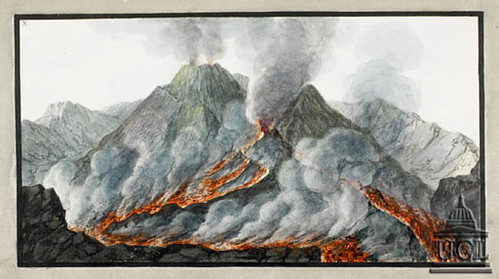
* Above is Sir William Hamilton’s drawing of an eruption of Vesuvius in the 1760s or 1770s – something to think about next time you are visiting Pompei. It is from a lovely little online exhibition from the University College London special collection. There’s also images from original texts by Copernicus, Gallileo and John Wilkins’ (then anonymous) 1638 conclusion that there was life on other planets.

* Just when you think America is going back to the 19th century, you come across an article like this, about “big business” providing transgender employees with medical expenses and unisex bathrooms.

* Every woman (and man) in journalism should read this piece. And television is just as bad.

* Humans are programmed to co-operate. There’s now evidence to take on the Right’s Hobbesian views. (Via Arts and Letters Daily.

* An argument for racial, but not racist genetics. And some fascinating information about the “Sonic hedgehog” mutation. (Via ditto)

* Islamic women (at least in the West) are making a move to lead prayers, seemingly an extremely radical step. Which reminds me of the brave woman in Bahrain on whom I posted in November. I haven’t been able to find out what happened to her. Anyone know?

*If you fancy dining with a knight and his lady in a medieval castle, the recipes are here, together with a great deal of other fascinating material on medieval life. (Hat-tip to Bibe’s box.)

Miscellaneous

I’ll be the Viking

I’m frantically busy, so what am I doing, taking internet quizzes. (Only while eating breakfast, honest!)

So thanks to Scribbling Woman, I’ve found out via this quiz that my ideal historical job would be to be a Viking warrior. The other suggested alternatives included an “arming squire with its potential to become a knight”, “topman” (sic), “powder monkey”, “Riding officer”, “Petardier’s assistant” or “Guillemot-egg collector”. But Viking sounded best.

Miscellaneous

The immigrant experience

I’ve been reading Margaret Atwood’s The Journals of Susanna Moodie, a collection of poems inspired by the writer on whom I posted yesterday. I was particularly taken by the piece called “The Immigrants”.

… “I see them coming
up from the hold smelling of vomit,
infested, emaciated, their skins grey
with travel; as they step on shore

the old countries recede, become
perfect, thumbnail castles preserved
like gallstones in a glass bottle, the
towns dwindle upon the hillsides
in a light paperweight-clear.

They carry their carpetbags and trunks
with clothes, dishes, the family pictures;
they think they will make an order
like the old one, sow miniature orchards,
carve children and flocks out of wood

but always they are too poor, the sky
is flat, the green fruit shrivels
in the prairie sun, wood is for burning;
and if they go back, the towns

in time have crumbled, their tongues
stumble among awkward teeth …”

(pp. 32-33)

It struck me that what is different about the immigrant experience in the late 20th and early 21st century, compared to the 19th, is that no one now is heading for the countryside. You get enormous migration within countries from rural to urban areas (but almost never the reverse, except for comfortably-off people “downsizing”, which is not the same thing at all), and when people cross borders they are almost always heading for the capital city of their destination state.

What does this mean? I suspect it makes the whole experience less innocent, more frightening and daunting, for there are all of the social obstacles, as well as the practical ones.

But although today it would be different, I couldn’t help imagine being in those “infested” holds, or trying to smuggle myself into the back of a lorry. It would do us all well to remember that, however unlikely it might seem, one day it could be us.